First Seen
2023-08-11T22:47:59+00:00
simple-description (qwen3.5_2b-q8_0)
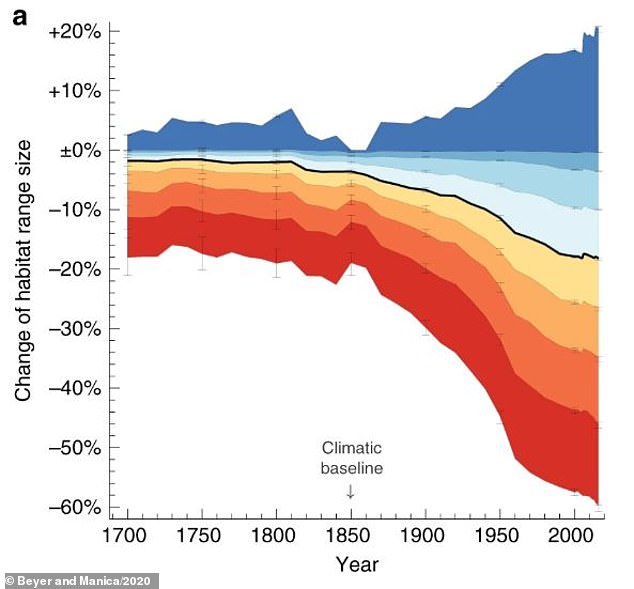
This chart is a graphic explanation of why animals are dying due to global warming. It shows that before 1850, there was a baseline amount of habitat available, but starting around the mid-19th century (indicated by the arrow labeled "Climatic baseline"), animals suddenly lost 50% to 60% of that space. The red bands at the bottom of the graph illustrate the massive and accelerating loss of territory caused by rising temperatures.
simple-description (llama3.2-vision_11b)
The meme is a graph showing the projected temperature increase from 1850 to 2100, with the actual temperature increase from 1850 to 2020. The graph is divided into five categories: very low confidence, low confidence, medium confidence, high confidence, and very high confidence. The graph shows that the projected temperature increase is expected to be higher than the actual temperature increase, indicating that the projections are more accurate than the actual data.
detailed-analysis (gemma3-27b-vision)
Okay, here’s an analysis of the image, broken down into sections as you requested, addressing only those theoretical lenses that are demonstrably applicable. Given the nature of the chart (ecological data over time), some of the more abstract or socially-focused lenses won’t have much to contribute.
1. Visual Description
The image is a line graph depicting the “Change of habitat range size” over time, from approximately 1700 to 2020. The y-axis displays percentage change (from -60% to +20%) and the x-axis represents years. The graph is constructed using shaded bands of color, each representing a range of change.
- Color Progression: The colors shift from blue (positive change) through teal and green to yellow, orange, and finally red (negative change). The widening of the red area over time is visually prominent.
- Initial Stability (1700-1800): The graph starts with relatively small fluctuations around 0% change, displaying some initial positive growth around 1720.
- Declining Trend (1800-2020): From about 1800 onwards, the graph demonstrates a clear downward trend, with the habitat range shrinking progressively. The rate of decline accelerates significantly after 1950.
- Climatic Baseline: An arrow indicates a point around 1850 labeled as the "climatic baseline," suggesting this point is a reference for understanding change.
- Data Fluctuation: There is a “fuzzy” or shaded look to the chart, likely indicating a range of possible values or confidence intervals for the data.
2. Critical Theory
The graph lends itself directly to a Critical Theory analysis. Critical Theory, particularly in the Frankfurt School tradition, seeks to understand how power structures and systems of domination shape our understanding of the world and maintain themselves.
- Domination of Nature: The declining habitat range represents a form of domination of nature by human activity. The graph visually embodies the increasingly severe impact of civilization on the environment.
- Instrumental Reason: The relentless downward trend can be interpreted as a result of “instrumental reason” – a focus on efficiency, control, and technological advancement without consideration for ecological consequences. The chart is a visual representation of the logic of extraction and commodification of nature.
- Systemic Problem: The gradual but accelerating decline suggests this isn't just a series of isolated events. It's a systemic problem embedded within the structures of industrial capitalism and the growth imperative. The graph points toward the failure of prevailing societal paradigms to account for ecological limits.
- Revealing Underlying Forces: The graph reveals (though doesn't explicitly state) that the forces driving these changes are rarely acknowledged within mainstream narratives. It acts as a critique of the "progress" narrative that often ignores environmental costs.
3. Marxist Conflict Theory
A Marxist perspective highlights conflict and class relations as central to understanding societal change. In this context, the graph can be analyzed as follows:
- Capital Accumulation & Environmental Degradation: The declining habitat range can be understood as a consequence of the inherent drive for capital accumulation within capitalism. Expansion requires exploiting natural resources, often at the expense of ecosystems.
- Unequal Distribution of Environmental Costs: The environmental degradation shown in the graph doesn’t affect all classes equally. Marginalized communities and the Global South often bear the brunt of ecological destruction, while the benefits of exploitation are concentrated in the hands of a few.
- Commodification of Nature: From a Marxist perspective, nature is increasingly viewed as a commodity—a source of raw materials and profit—rather than a system with intrinsic value. This commodification drives unsustainable practices.
- Contradiction of Capitalism: The chart illustrates a fundamental contradiction within capitalism: the system’s reliance on natural resources ultimately undermines the very basis of its own sustainability.
4. Foucauldian Genealogical Discourse Analysis
A Foucauldian approach focuses on how knowledge is constructed through discourse and power relations.
- Shifting Discourses on Nature: The graph can be viewed as a material effect of historical shifts in how we talk about and understand nature. For example, pre-industrial societies may have had more sustainable, localized relationships with the environment. The Industrial Revolution and the rise of scientific positivism fundamentally changed our perception of nature as something to be controlled and exploited.
- Biopower & Environmental Control: Foucault's concept of biopower (power over life) is relevant here. The graph demonstrates a growing capacity to manipulate and control the environment, but also the unintended consequences of that control. The decline in habitat is a result of attempts to organize and manage the natural world according to specific, often anthropocentric, goals.
- Production of "Environmental Problems": The very category of "environmental problem" is a product of discourse. The graph visually represents something that has come to be defined as a problem through scientific inquiry, public awareness campaigns, and policy debates.
- Genealogy of Ecological Knowledge: A genealogical analysis would trace the historical development of our understanding of ecosystems, the rise of conservation movements, and the emergence of ecological science as a distinct field.
Note: Postmodernism and Queer Feminist Intersectional Analysis don’t have a strong, direct relevance to the image. While one could apply these lenses, it would require significant stretching and abstraction, and wouldn’t yield particularly insightful analysis. The image is fundamentally about quantifiable ecological change, which is better addressed through the lenses described above.
Let me know if you'd like me to elaborate on any of these points or analyze the image further!
tesseract-ocr
a +20% +10% & 20%; = = - x ae = 3 2 S -10% = g 5S -20% oO = % -30% Da 2 o 5 40% 50% Climatic baseline + 60% a ee: tat 1700 1750 1800 1850 1900 1950 2000 Year
simple-description (llama3.2-vision)
This meme is a humorous graph that illustrates the relationship between climate change and the size of polar bears. The graph shows a steep decline in polar bear size over the past few centuries, with a sharp drop-off in recent years. The text "I'm not saying polar bears are getting smaller, but..." is often used to introduce a joke or sarcastic comment.