First Seen
2024-06-24T19:46:48.076228+00:00
simple-description (qwen3.5_2b-q8_0)
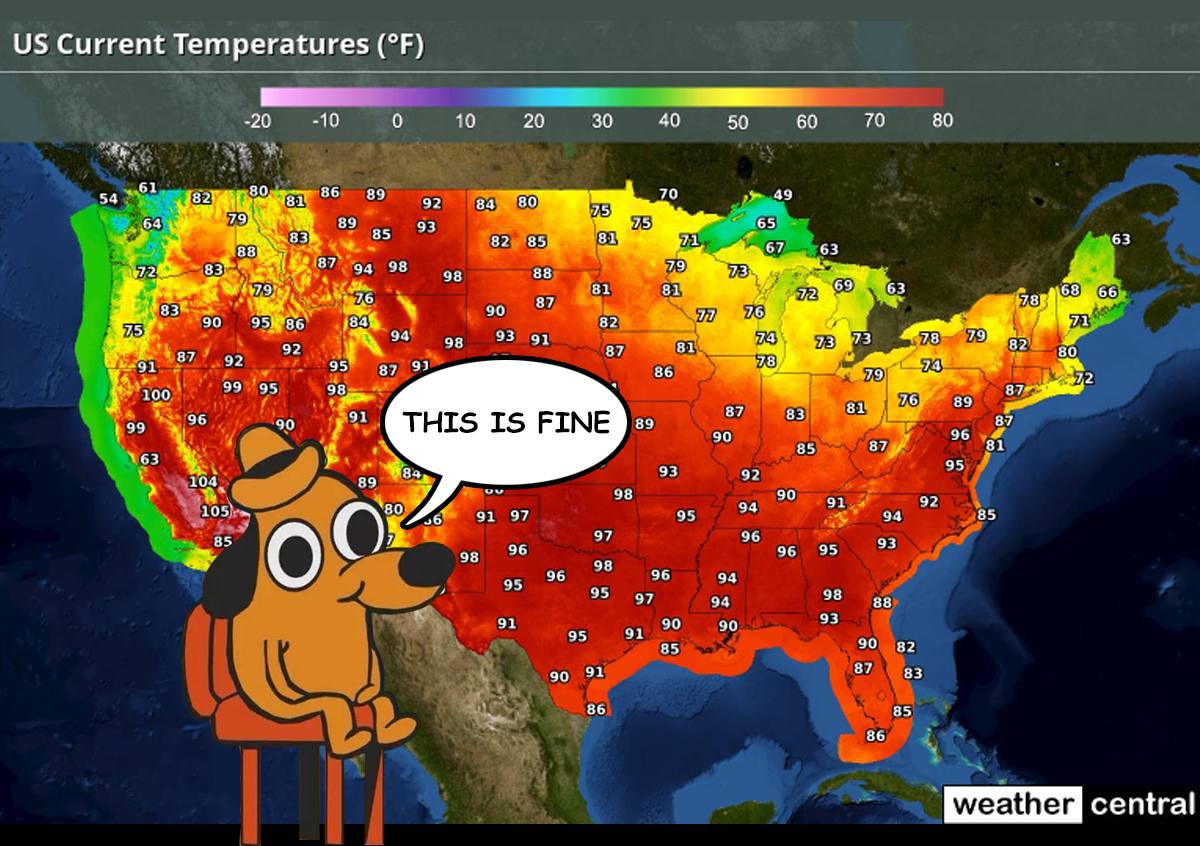
In a world struggling with rising temperatures, a cartoon dog is shown in front of a weather map that indicates the United States is in a state of extreme heat. The map is predominantly colored in red and orange, signifying current temperatures that are dangerously high, while parts of the west show cooler green patches. The dog speaks with a speech bubble saying "THIS IS FINE," a humorous commentary suggesting that he is unbothered by the severe climate crisis he is observing.
simple-description (llama3.2-vision_11b)
This meme is a humorous take on the extreme heat in the United States, with the image of a cartoon dog sitting in a chair, sweating, and saying "It's not me, it's you!" However, the text "It's not me, it's you!" is replaced with "It's not me, it's you... it's 100 degrees outside!"
detailed-analysis (gemma3-27b-vision)
Okay, let's break down this image – the "This is Fine" dog in a burning house superimposed on a map of the United States showing high temperatures – through several theoretical lenses.
Visual Description
The image is a digitally altered depiction of a map of the contiguous United States. A color gradient represents temperatures across the country, ranging from blues (coldest) to reds (hottest). The colors indicate extremely high temperatures across much of the country, particularly in the South and Southwest, with pockets of extreme heat reaching over 100 degrees Fahrenheit.
Superimposed on this map is the famous internet meme of a cartoon dog sitting calmly at a table in a room engulfed in flames. The dog is saying "This is fine." The "Weather Central" logo is in the bottom right corner. The entire image is a stark visual juxtaposition of objective meteorological data and subjective internet culture, conveying a clear message about denial in the face of an obvious crisis.
Foucauldian Genealogical Discourse Analysis
This image can be powerfully understood through a Foucauldian lens. Michel Foucault was interested in how power operates through discourse – the systems of knowledge and language that shape our understanding of the world.
- Discourses of Climate Change: We see a clash between the discourse of scientific objectivity (represented by the temperature map) and the discourse of denial (represented by the dog’s nonchalance). The map is a 'truth claim' built on data, while the dog embodies a willful rejection of that truth.
- Power/Knowledge: Foucault argued that power and knowledge are inextricably linked. The map claims authority through its apparent objectivity. However, the dog suggests that this authority is being undermined by a counter-discourse of normalization and complacency. The image subtly challenges the notion that simply presenting data will automatically lead to action.
- Genealogy of Complacency: A genealogical analysis might examine the historical development of this complacency – how various cultural and political forces have conspired to downplay or dismiss the severity of climate change, creating a context where "This is fine" is a readily understandable response.
Critical Theory
This image lends itself well to the Frankfurt School’s Critical Theory, which aims to critique and change society as a whole.
- Instrumental Reason: The temperature map, while seemingly objective, can be seen as an example of "instrumental reason" – a focus on quantifiable data without considering broader ethical or social implications. Critical theorists would argue that this detached approach contributes to the problem by reducing complex issues to mere numbers.
- Culture Industry: The use of a popular internet meme (the dog) positions the image within the “culture industry” (Adorno and Horkheimer). The meme's widespread circulation and pre-existing meaning allows for a quick and readily understood critique of the situation.
- Reification: The map, in a way, reifies climate change, reducing it to a set of data points. The dog’s response highlights the disconnect between the data and the human consequences.
- Domination: The image implies a systemic pattern of domination – the domination of short-term economic interests over long-term ecological well-being. "This is fine" is the attitude that allows this domination to continue.
Marxist Conflict Theory
From a Marxist perspective, the image reveals the inherent conflicts within a capitalist system.
- Class Conflict: The extreme temperatures disproportionately affect vulnerable populations – the poor, the elderly, those without access to air conditioning. The dog’s apathy can be read as the indifference of those in positions of power towards the suffering of the working class.
- Capital Accumulation: The prioritization of profit over ecological sustainability is central to Marxist thought. The image suggests that even in the face of existential threat, the system will continue to prioritize capital accumulation ("business as usual") while ignoring the consequences.
- False Consciousness: The dog embodies a “false consciousness” – a state of being unaware of the true nature of one’s social and economic position. The dog is comfortable in the burning house because it’s been conditioned to accept a reality that is ultimately destructive.
- Alienation: The image suggests a broader alienation – a disconnect between people and the natural world, and between people and their own capacity to address the crisis.
Postmodernism
A postmodern reading of the image focuses on its self-referentiality and the blurring of boundaries between reality and representation.
- Simulacra and Simulation (Baudrillard): The image is not a direct representation of climate change; it's a simulation of a response to climate change. The dog, as a meme, is a signifier that has become detached from any concrete reality. It's a "hyperreality" – a simulation that has become more real than the real.
- Deconstruction: The image deconstructs the traditional narrative of environmental activism, which often relies on appeals to reason and scientific evidence. It suggests that these appeals are no longer sufficient to motivate action.
- Irony and Parody: The image is deeply ironic and parodic. It mocks the complacency and denial that characterize contemporary responses to climate change.
- Fragmentation and Loss of Grand Narratives (Lyotard): The image rejects any grand narrative of progress or environmental salvation. It suggests that we are living in a fragmented and chaotic world where meaning is constantly deferred.
Queer Feminist Intersectional Analysis
While perhaps less immediately obvious, this image can be viewed through an intersectional lens that combines queer and feminist theories.
- Disproportionate Impacts: Climate change disproportionately affects marginalized groups – particularly women, people of color, LGBTQ+ individuals, and those with disabilities. The dog's apathy represents a system that ignores the suffering of these communities.
- Care Work & Emotional Labor: The constant need to advocate for climate action and cope with the emotional toll of the crisis falls disproportionately on marginalized groups, specifically women and queer folks. The dog’s inaction signifies the lack of support and care for those doing this emotional labor.
- Challenging "Normalcy": Queer theory often challenges dominant norms and expectations. The image subverts the "normal" response to a crisis (alarm, action) by presenting a state of passive acceptance.
- Interdependence & Mutual Aid: In the face of systemic failure, marginalized communities often rely on mutual aid networks for survival. The dog's isolation and lack of concern contrast sharply with the ethos of collective care.
- Rejection of Binary Thinking: The image rejects the binary of "problem" vs. "solution." It suggests that the problem is not simply a technical one, but a systemic one rooted in power imbalances and social injustice.
I hope this analysis provides a comprehensive understanding of the image through these various theoretical lenses. Let me know if you would like me to elaborate on any of these points.
simple-description (llama3.2-vision)
This meme features a map of the United States with temperatures in various states, but the map is not actually showing the current weather. The text "THIS IS FINE" is written in a speech bubble above the map, implying that the temperatures are normal and not actually causing any issues. The meme is likely poking fun at the idea that a map of temperatures is somehow a normal and acceptable thing.