First Seen
2025-03-06T22:08:06.773902+00:00
simple-description (qwen3.5_2b-q8_0)
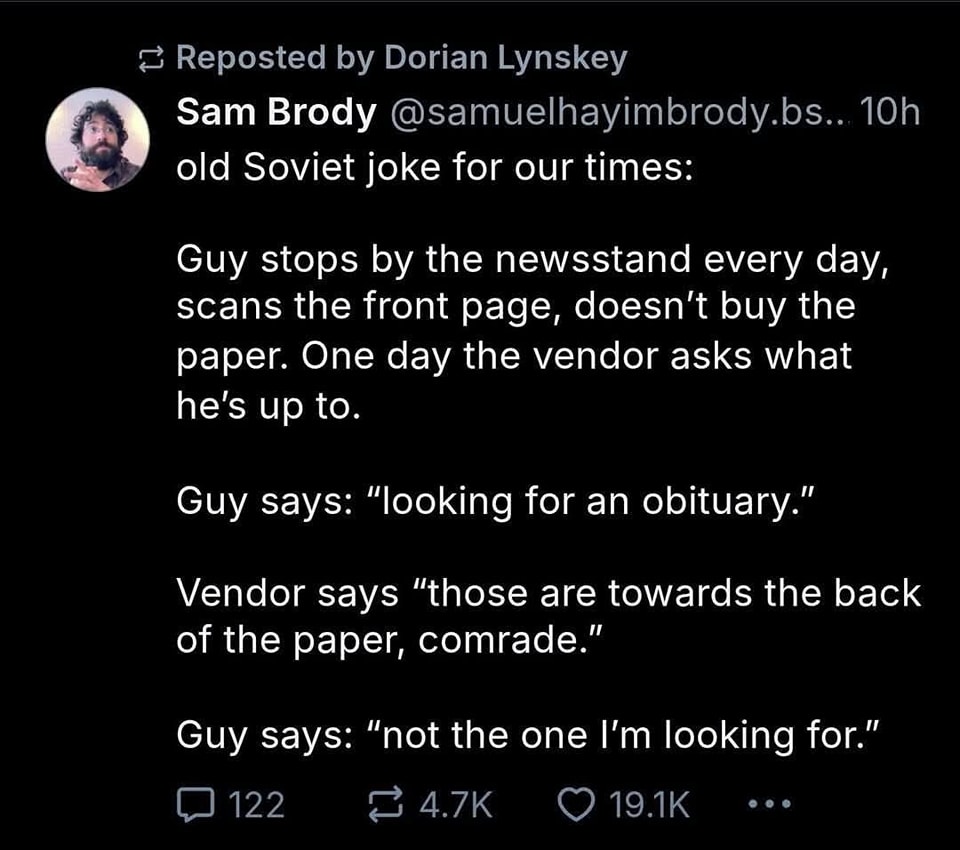
This viral post, often categorized as a "meme collapse," uses the text below it to tell a funny story about a frustrating routine. The text describes a man who stops buying the paper daily just to look for an "obituary," which is ironic because that section is usually towards the back. The final part explains that he isn't looking for that specific item, creating a humorous misunderstanding where he cannot see it but tries to find it.
detailed-analysis (gemma3_27b-it-q8_0)
Okay, let's break down this meme – a supposedly "old Soviet joke" – through the lens of "Collapse" as its category context. Collapse, in this context, refers to the potential (or perceived) breakdown of societal structures, systems, and values. This isn’t just environmental collapse, but also social, political, economic, and moral decay. Here's an analysis using the frameworks you requested, where applicable:
Visual Description
The image is a screenshot of a post from Twitter/X by Sam Brody. It's text-based, consisting of a short joke. There’s a profile picture accompanying the text, but it's secondary to the content of the joke itself. The meme’s design is minimalistic, relying entirely on the punchline's power for impact. The visual aesthetic signals a share rather than creation, and a slightly academic or intellectual tone due to the framing ("old Soviet joke…").
Foucauldian Genealogical Discourse Analysis
This joke is deeply rooted in a discourse of power, surveillance, and societal control—themes central to Foucault's work.
- Power/Knowledge: The news vendor isn't merely selling newspapers; they're part of the apparatus of information control. They implicitly represent the state or a controlling authority. The act of looking for an obituary is a subtle form of resistance – a measuring of who has fallen, a calculation of one’s own position.
- Genealogy: The “Soviet” origin is crucial. Soviet life was heavily monitored. A seemingly innocuous act like reading obituaries could be seen as a political statement. It could be a check on enemies, a morbid assessment of the ruling class, or a gauge of how long one has left. The joke’s power lies in referencing this history of constant scrutiny.
- Discipline and Punish: The vendor's response – "those are towards the back of the paper, comrade" – is a seemingly helpful, bureaucratic statement. However, it’s a chilling assertion of power. It's a reminder that everything is accounted for, categorized, and controlled. The word "comrade" is loaded, reminding the man of his place within the system.
Within a "Collapse" framework, this analysis highlights how seemingly benign institutions (news vendors, state media) are integral to maintaining control and how individuals might engage in subtle forms of resistance or desperation under oppressive regimes.
Marxist Conflict Theory
This joke brilliantly encapsulates key Marxist concepts.
- Class Struggle: The “guy” represents a member of the oppressed or disenfranchised, perhaps someone waiting for a significant figure in the power structure to die. It speaks to a resentment of the elite and a longing for change.
- Ideology & False Consciousness: The news vendor embodies the apparatus that maintains the dominant ideology. Their bureaucratic response deflects the underlying political implication of the question. They offer a surface-level answer to avoid acknowledging the deeper discontent.
- Alienation: The joke hints at a profound sense of alienation. The man isn't interested in the general news but in the deaths of specific people, suggesting a disconnect from everyday life and a preoccupation with power dynamics.
- Collapse as Inevitable: The joke’s dark humor implies a hope, or at least anticipation, of the system’s downfall. The desire for a specific obituary suggests a belief that the current order should end, and the man is waiting for a key figure to fall.
In the context of "Collapse", this suggests that the existing power structures are fundamentally unsustainable and that discontent is simmering beneath the surface, waiting for a catalyst.
Postmodernism
The joke’s effect relies heavily on a destabilization of meaning.
- Rejection of Grand Narratives: The "Soviet" context initially implies a grand, ideological narrative (Communism). However, the joke undermines this narrative by focusing on the individual’s cynical pursuit of death announcements. It’s a localized, individual response to a system that purported to offer universal meaning.
- Irony & Parody: The joke is ironic. The seemingly harmless act of reading obituaries is revealed to have a dark, politically charged undercurrent. It parodies the bureaucratic responses of authoritarian regimes.
- Fragmentation of Meaning: The punchline—"not the one I’m looking for"—introduces ambiguity. The audience is left to wonder who the man is waiting for. This fragmentation of meaning is a hallmark of postmodern thought.
Within "Collapse", this suggests that the grand narratives that once held society together (e.g., progress, democracy, capitalism) are losing their credibility, leaving individuals adrift in a sea of fragmented meanings.
Critical Theory
This joke resonates with the core tenets of Critical Theory:
- Critique of Power Structures: The joke is an inherent critique of power and control. The vendor is representative of those in power, while the man is a member of the public who is trying to find information about the elite.
- Unmasking Ideology: The joke "unmasks" the way in which ideologies can be used to control and manipulate populations. The vendor's response is a simple, yet effective, way of asserting their authority.
- Emancipation: The joke implies a desire for emancipation from oppressive power structures. The man is looking for an obituary of someone in power, suggesting that he wants to see the old order overthrown.
Within the framework of collapse, the joke suggests that current power structures are unsustainable and will eventually lead to societal breakdown.
In conclusion: This "old Soviet joke" is remarkably potent because it taps into anxieties about power, control, and the fragility of social order. In the context of "Collapse," it's not just a humorous anecdote; it's a bleakly prescient reflection of a world on the brink, where trust has eroded, and individuals are grappling with the potential for systemic failure. The dark humor derives from the acknowledgement that many people are already mentally preparing for the fall of those in power, even if they can't openly express it.
simple-description (llama3.2-vision_11b)
The meme is a play on the idea of a Soviet joke, which typically involves a clever and humorous twist on a mundane situation. The text reads: "A man walks into a library and asks the librarian, 'Is there a book on the Soviet Union?' 'There is a book on the Soviet Union,' replies the librarian. 'It's the one on the top shelf. But you have to read it. You have to read it. You have to read it.'" The joke is a clever play on the idea of a book on the Soviet Union, and the librarian's response is a clever and humorous twist on the idea of a book on the Soviet Union.
detailed-analysis (gemma3-27b-vision)
Okay, here's an analysis of the image/text (the "joke" posted by Sam Brody) broken down into the requested theoretical sections, only including those where the text meaningfully lends itself to that lens.
Visual Description
The image is a screenshot of a social media post (likely X/Twitter). It shows a profile picture (a man with a beard) belonging to "Sam Brody" with his username @samuelhaymbrody. Below the user info is the text of a joke. At the bottom are icons indicating engagement: 122 comments, 4.7K reposts, and 19.1K likes. The overall aesthetic is minimalistic; the focus is entirely on the textual content and its engagement metrics.
Foucauldian Genealogical Discourse Analysis
This joke, presented as a relic of Soviet times, immediately evokes questions of discourse and power/knowledge. Foucault argued that knowledge isn't neutral; it’s always produced within a specific historical context, serving particular power structures.
- Discourse of Control: In a Soviet context, the "news" (and specifically the obituaries) was tightly controlled by the state. The joke subtly reveals this control. The man isn't looking for any obituary; he’s looking for a specific one. This implies a desire to see evidence of the removal of someone in power, or someone he dislikes, and confirms their mortality. The vendor's response (“those are towards the back…”) highlights the bureaucratic sorting of death itself, turning it into a matter of position within the state-controlled narrative.
- Genealogy of Control: The humor rests on the understanding of how knowledge produced the reality of Soviet control. The man’s obsessive monitoring of obituaries is a symptom of that system, a perverse form of "reading" the shifting power dynamics based on who is allowed to be publicly acknowledged as dead. It’s not just about death itself but the representation of death and how it signals shifts in authority.
Critical Theory
The joke can be interpreted through the lens of Critical Theory as a commentary on the relationship between the individual and the totalitarian state.
- Instrumental Reason: The man’s repeated scanning of the obituaries demonstrates a reduction of human life to a purely instrumental purpose: confirmation of the state's power transitions. Life is no longer viewed for its intrinsic value but as a marker within a power structure. He isn’t mourning; he’s calculating.
- Alienation: The man's behavior also demonstrates alienation. He is separated from genuine emotional response or connection; his focus is entirely on the abstract monitoring of power dynamics. His interest in obituaries is not grief or empathy, but a distorted, abstract engagement with the human condition.
- Culture Industry: The joke itself, presented as a "Soviet joke," can be seen as a form of cultural production that critiques the system from within. It offers a moment of subversive humor that exposes the absurdity and paranoia of life under totalitarian rule.
Marxist Conflict Theory
While not overtly about economic class struggle, the joke implies a conflict based on power.
- Power Dynamics: The man's preoccupation with the obituaries reveals a constant, underlying tension and struggle for power. The death of an individual in a position of authority represents a shift in the balance of forces.
- The State as Instrument of Oppression: The joke reveals the state not as a neutral arbiter, but as an active participant in a constant struggle to maintain control. The control over information (including obituaries) is a crucial tool in this struggle.
- Hidden Power Struggles: The man isn't concerned with who died, but who is removed from power. This highlights the underlying conflict for influence and the importance of monitoring those in positions of authority.
Postmodernism
The joke subtly subverts traditional notions of meaning and narrative.
- Deconstruction of Authority: The man's obsessive monitoring of obituaries exposes the arbitrariness of power and the fragility of authority. The joke suggests that even those in positions of power are ultimately subject to mortality.
- Intertextuality: The framing of the joke as a “Soviet joke” evokes a specific historical and cultural context. This intertextuality adds layers of meaning and invites the audience to consider the joke within a broader narrative of oppression and resistance.
- The Loss of Grand Narratives: The joke challenges the idea of any overarching, meaningful narrative. It's a small, absurd vignette that exposes the emptiness and paranoia of life under totalitarian rule. There’s no “purpose” to his actions, only a compulsive, obsessive monitoring of a system.
Please note: These are interpretations, and the richness of the joke allows for multiple readings. The most compelling analysis likely comes from combining insights from these different theoretical perspectives.
simple-description (llama3.2-vision)
This meme is a joke about a Soviet-era joke that has been reworked to be about a modern-day scenario. The joke is presented in a format that mimics a conversation, with a "person" and a "vendor" exchanging lines. The text reads:
"Person: Guy stops by the newsstand every day, scans the front page, doesn't buy the paper. Vendor: Guy says: 'Looking for an obituary.' Vendor: 'Those are in the back.' Guy says: 'Not the one I'm looking for.'"