First Seen
2024-01-18T22:15:38+00:00
simple-description (qwen3.5_2b-q8_0)
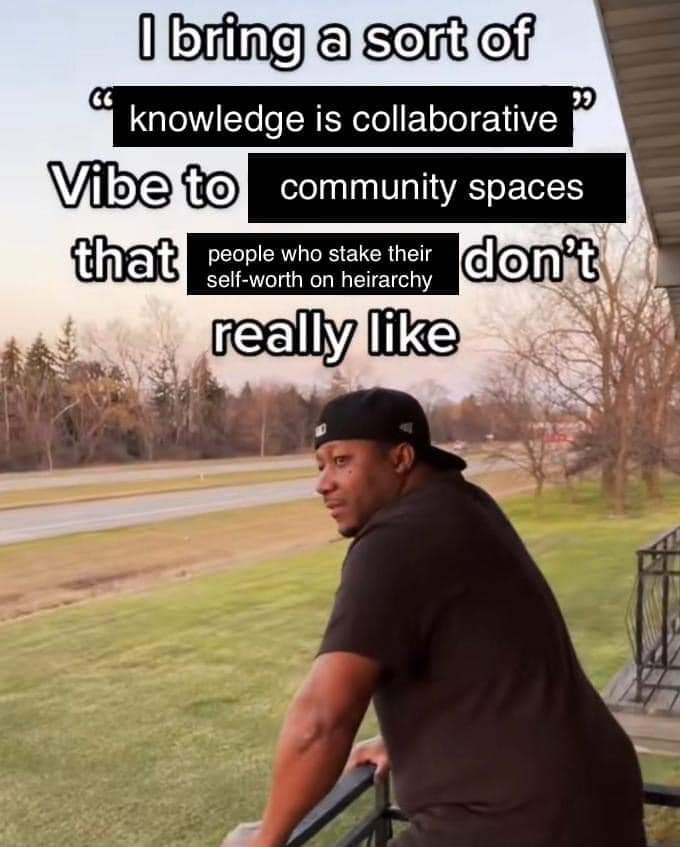
This meme explains the quote "knowledge is collaborative" to describe a personality trait where someone tries to project an open-minded, inclusive vibe. The joke is ironic because instead of inviting others, the speaker is just a "knowledgeable person" who tries to prove their superiority by showing off their skills. The caption concludes by saying that this type of ego-driven behavior is exactly what people who believe they are above others actually enjoy.
simple-description (llama3.2-vision_11b)
The meme is a humorous expression of frustration with the way people share their opinions without considering the audience or context. The image shows a person looking out at a beautiful view, but the text "I don't know how to explain this" is overlaid on top of it, implying that the person is struggling to articulate their thoughts. The meme is captioned "when you try to explain a complex topic to someone who doesn't understand the basics" and is meant to poke fun at the challenges of communicating complex ideas to others.
detailed-analysis (gemma3-27b-vision)
Okay, let's break down this meme through the requested theoretical lenses. It's a challenging image with a layered statement, so we'll see how far each framework takes us.
I. Visual Description
The image is a screen capture of a person, seemingly a Black man, seated on a metal chair outdoors. He's looking off to the side, appearing contemplative or perhaps dismissive. He's wearing a cap, glasses, and a t-shirt. The background is a residential street with greenery and a metal fence. The composition and the subject's body language suggest a sense of being detached, observing, and possibly judging a situation. The use of the word "vibe" as a layered text further suggests an attitude or feeling, rather than a concrete observation.
II. Foucauldian Genealogical Discourse Analysis
This image and statement is rife with possibilities from a Foucauldian lens.
- Discourse of Collaboration: The core statement "knowledge is collaborative" speaks to a particular discourse – a system of thought, language, and practice that constructs understanding. Historically, knowledge was often controlled by elites (clergy, aristocracy, academia) and disseminated downward. This statement attempts to challenge that, proposing a horizontal, networked model.
- Power/Knowledge: Foucault argues that power and knowledge are inextricably linked. This meme suggests a tension between how knowledge is constructed versus how some individuals desire to control knowledge and maintain a hierarchical system. The subject’s pose suggests that he is outside the usual power dynamics and observing them.
- Genealogy of Hierarchy: A genealogical analysis would trace how the concept of "hierarchy" itself came to be. It would examine the historical roots of hierarchical structures in social, political, and intellectual life. The phrase "people who stake their self-worth on hierarchy" reveals how deeply ingrained this need for ranking is, and how it's tied to individual identity.
- The "Vibe" as Discursive Practice: The casual use of "vibe" is itself a discursive practice – a way of framing experience and signaling belonging or difference. It's a modern form of social signalling.
III. Critical Theory
Critical Theory, drawing heavily on the Frankfurt School, focuses on power structures, ideology, and emancipation.
- Ideology Critique: The statement critiques the dominant ideology that equates worth with status and position within a hierarchical system. This meme implies that this ideology is damaging and that valuing collaboration over ranking is a more progressive stance.
- Domination and Resistance: The image can be seen as representing a form of resistance to the forces of domination. The subject, through his pose and statement, is refusing to participate in the hierarchical game.
- The Problem of Reason: The Frankfurt School was critical of "instrumental reason" – the tendency to reduce everything to calculations of efficiency and control. Hierarchy, as presented in the meme, can be seen as an extension of this kind of reason, valuing order and control over collaboration and creativity.
- False Consciousness: The meme implies that individuals who derive their self-worth from hierarchy are trapped in a form of "false consciousness" – they are unaware of the ways in which the system is manipulating them.
IV. Marxist Conflict Theory
From a Marxist perspective, the image speaks to class struggle and the ways in which power is maintained through economic and social structures.
- Class and Hierarchy: Hierarchy can be understood as a mechanism for maintaining class divisions. Those at the top of the hierarchy benefit from the exploitation of those below. The meme suggests a rejection of this system.
- Alienation: Individuals who derive their self-worth from hierarchy may be alienated from their own creative potential. They are focused on climbing the ladder rather than contributing to a collective good.
- Ideology as a Tool of Domination: The ideology of hierarchy serves to justify the existing class structure. The meme challenges this ideology and calls for a more egalitarian approach to knowledge and social relations.
- The Potential for Revolution: The meme's implicit call for collaboration could be seen as a step towards a revolutionary transformation of society.
V. Postmodernism
Postmodern thought emphasizes the instability of meaning, the deconstruction of grand narratives, and the celebration of difference.
- Deconstruction of Hierarchy: The meme implicitly deconstructs the concept of hierarchy by questioning its validity and its connection to self-worth.
- Rejection of Metanarratives: Postmodernism is skeptical of grand narratives (e.g., the belief in progress, the idea of universal truth). The meme suggests that there is no single, objective way to organize knowledge or evaluate worth.
- Emphasis on Subjectivity: Postmodernism acknowledges that knowledge is always situated and subjective. The “vibe” acknowledges the importance of personal experience.
- Playfulness and Irony: The meme itself is a playful and ironic intervention into a serious topic. This is characteristic of postmodern art and thought.
VI. Queer Feminist Intersectional Analysis
This lens requires careful application, as the image doesn’t explicitly address gender or sexuality. However:
- Critique of Dominant Structures: The meme challenges any dominant structure (hierarchy) that perpetuates inequality. Queer and feminist thought are inherently critical of systems of oppression.
- Intersectionality of Oppression: The meme can be expanded to consider how hierarchy intersects with other forms of oppression, such as sexism, racism, and homophobia. For example, individuals from marginalized groups may be particularly vulnerable to the pressures of hierarchy.
- Emphasis on Collaboration and Community: Queer and feminist movements often prioritize collaboration, mutual support, and the creation of inclusive communities. The meme's call for collaboration resonates with these values.
- Challenging Essentialism: Hierarchy can lead to essentialist thinking – the belief that individuals are defined by fixed categories. The meme implicitly challenges this by suggesting that worth is not tied to status or position.
Overall:
This meme is a surprisingly rich cultural artifact. It engages with multiple theoretical frameworks and invites us to question the ways in which we organize knowledge, assign worth, and build communities. It also feels very current in its language and visual aesthetic.
tesseract-ocr
1 bring € sort oF "i knowledge is collaborative ie Vibe to na thet Eon ef £ ! NG << ene 4 Ds |. - If
simple-description (llama3.2-vision)
This meme is a screenshot of a person looking out at a scenic view, with a caption that reads: "I bring a sense of 'I'm a good person' to the conversation, but I don't have any real skills or knowledge to share. I just want to be seen as a good person, so I'll bring a sense of 'I'm a good person' to the conversation, but I don't have any real skills or knowledge to share. I just want to be seen as a good person, so I'll just say 'I'm a good person' and then leave."
The meme is making a humorous comment about people who try to be seen as good people without actually doing anything to earn that reputation.