First Seen
2023-07-21T05:55:25+00:00
simple-description (qwen3.5_2b-q8_0)
This meme references the popular TV show Conspiracy Theory, where Dan Harmon and David Blaine investigate wild and often bizarre claims about the world. The text plays on the show's humor by suggesting that instead of serious "researching," people are likely just "conclusion shopping"—looking for flaws or absurdity in an idea to disprove it. It implies that some conspiracy theories are so far-fetched that their validity is instantly questioned and dismissed.
simple-description (llama3.2-vision_11b)
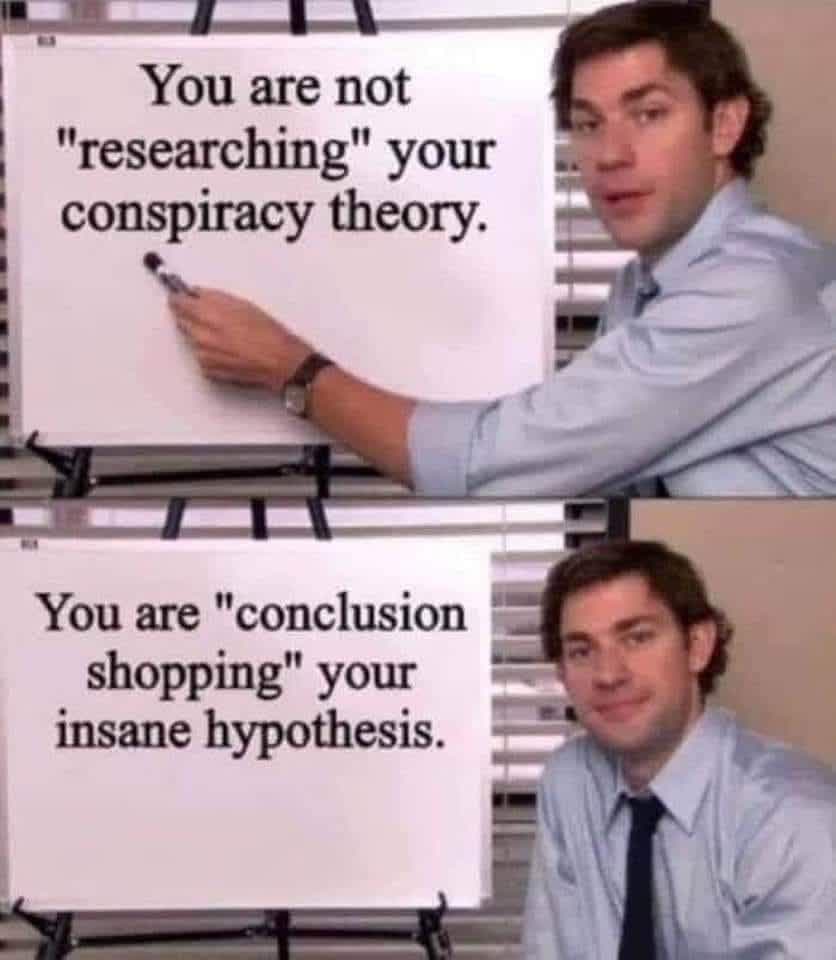
The meme is a humorous take on the stereotype that conspiracy theorists are prone to "researching" their wild claims. The image shows a person sitting at a desk, looking unimpressed, with a whiteboard that reads "I'm not 'researching' my conspiracy theories, I'm just 'conclusion shopping'". The meme pokes fun at the tendency to selectively seek out information that confirms one's preconceived notions, rather than genuinely exploring and considering multiple perspectives.
detailed-analysis (gemma3-27b-vision)
Okay, here's an analysis of the meme, broken down into sections as requested. I’ll indicate when a section doesn't apply.
Visual Description
The meme is a two-panel image using a still from the television show The Office. It features actor Steve Carell, portraying Michael Scott.
- Panel 1: Michael is standing in front of a whiteboard, pointing dramatically with a marker. Text overlaid on the whiteboard reads: “You are not ‘researching’ your conspiracy theory.” He has a stern, lecturing expression.
- Panel 2: Michael is again in front of the whiteboard, but now has a smug, knowing expression. Text on the whiteboard reads: “You are ‘conclusion shopping’ your insane hypothesis.”
The humor derives from the ironic use of “research” and “conclusion shopping” to critique the methodology, or lack thereof, of someone building a conspiracy theory. The use of quotation marks around these terms highlights the performative nature of the actions being described – someone pretending to research or actively seeking out evidence to support a pre-existing conclusion.
Foucauldian Genealogical Discourse Analysis
This meme is rich for a Foucauldian reading.
-
Discourse and Power: The meme operates within a discourse around truth, knowledge, and how we arrive at conclusions. The speaker (Michael in the meme, but generalized to represent a voice of reason) is attempting to exert power over the other party by questioning their methods. He's not arguing about the content of the theory (whether it's true or false), but how the theory is being constructed. The very act of labeling the approach as “research” and then negating it with quotation marks is a way of asserting a normative standard for what constitutes legitimate knowledge production.
-
Genealogy & Shifting Truths: The meme implicitly points to the historical contingency of what we consider ‘research.’ What counts as “research” is not a fixed, universal truth, but a historically specific set of practices, methodologies, and institutional rules. The meme suggests that the “researcher” is selectively deploying practices that appear to resemble research, while actually engaging in something very different – cherry-picking evidence for confirmation bias. The term ‘conclusion shopping’ is the real genealogy here, and is a practice that has existed across time.
-
The Role of the Subject: The person "researching" the conspiracy theory is positioned as a subject being disciplined by this discourse. Their methodology is called into question, shaping their position within the realm of those who produce “legitimate” knowledge.
Critical Theory
Critical Theory, particularly the Frankfurt School's focus on ideology and critique, is highly relevant.
-
Critique of Instrumental Reason: The meme can be seen as a critique of the ways individuals misuse “rational” processes – like attempting to frame conspiracy theories as “research” – to serve pre-determined ideological ends. The implication is that the person isn’t seeking truth, but rather constructing a narrative that validates their existing beliefs.
-
False Consciousness: While not explicit, the meme touches on the idea of “false consciousness.” The “researcher” is potentially unaware that their methodology is flawed and that they’re being manipulated by biased information. They may believe they are discovering truth, when in reality, they are reinforcing a pre-existing ideology.
-
The Culture Industry: Conspiracy theories themselves can be seen as a product of the “culture industry,” offering narratives that provide a sense of order and meaning in a complex world. This meme can be interpreted as a critique of how these narratives are constructed and disseminated.
Marxist Conflict Theory
While not as central as the above analyses, Marxist conflict theory can offer a layer of understanding.
-
Ideological Struggle: The meme depicts an ideological struggle between two ways of knowing. The person engaging in "conclusion shopping" is reinforcing a belief system (the conspiracy theory) that might be in conflict with dominant ideologies. The speaker is trying to assert a different, more "rational" way of constructing knowledge.
-
Power Dynamics: The speaker in the meme holds a position of authority (even if it's just a perceived authority), attempting to challenge the “researcher’s” beliefs. This reflects a broader power dynamic where dominant groups often try to control the narratives that are accepted as “truth.”
Postmodernism
Postmodernism is also applicable, especially regarding the deconstruction of truth and knowledge.
-
Rejection of Metanarratives: Conspiracy theories can be seen as alternative metanarratives—grand, overarching explanations for the world. The meme challenges the validity of this metanarrative by critiquing the process used to construct it.
-
Deconstruction of "Truth": Postmodern thought questions the very notion of objective truth. The meme implicitly suggests that what constitutes “research” is subjective and socially constructed. The use of quotation marks emphasizes the performative and constructed nature of knowledge claims.
-
Simulacra & Hyperreality: Conspiracy theories, and the selective "research" that supports them, can contribute to the creation of a "hyperreality" – a simulation of reality that is more real than real.
Queer Feminist Intersectional Analysis
While not as readily apparent, this lens can offer a nuanced reading.
-
Epistemic Violence: The act of dismissing someone’s search for truth as “conclusion shopping” could be considered a form of epistemic violence—the denial of someone’s knowledge or ways of knowing. This could disproportionately affect marginalized groups whose experiences are often dismissed by dominant narratives.
-
Power and Knowledge: Building on Foucault, a queer feminist perspective would highlight how power structures shape what counts as legitimate knowledge. Conspiracy theories, particularly those targeting marginalized groups, can be used to reinforce existing power dynamics and control narratives.
-
Challenging Authority: Conspiracy theories can sometimes arise as a form of resistance against dominant power structures. While the meme critiques the methodology, it’s important to acknowledge the potential motivations behind the "research" and the contexts in which it occurs.
Let me know if you’d like me to elaborate on any of these sections or explore additional theoretical perspectives!
simple-description (llama3.2-vision)
This meme is a humorous commentary on the tendency to seek out and believe in conspiracy theories. The image features a character from the TV show "The Office" (Dwight Schrute) standing in front of a whiteboard, with two captions that read: "You are not 'researching' your conspiracy theory, you are 'conspiracy theorizing'." The second caption adds: "You are not 'fact-checking' your conspiracy theory, you are 'fact-ignoring' your conspiracy theory." The meme pokes fun at the way some people approach and engage with conspiracy theories, highlighting the tendency to ignore or dismiss evidence that contradicts their beliefs.
tesseract-ocr
a | You are not | "researching" your @& conspiracy theory. we — : a el —— 5 You are "conclusion shopping" your. =" - insane hypothesis. ——% { = an ¥ “