First Seen
2023-05-10T21:03:35+00:00
simple-description (llama3.2-vision_11b)
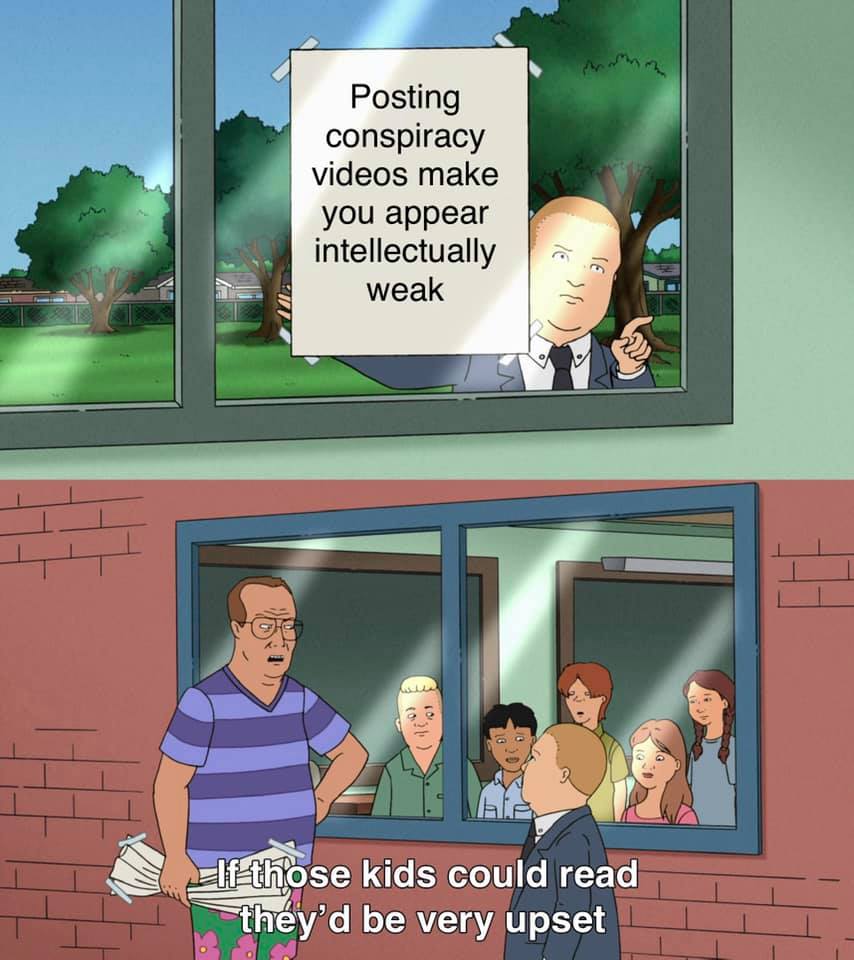
The meme is a satirical commentary on the prevalence of conspiracy theories on the internet. It depicts a person holding a sign that reads "Posting conspiracy videos makes you appear intellectually weak" and is being told by a group of people that if they could read, the kids would be very upset. The text is a humorous way of saying that the person is not only spreading misinformation, but also failing to educate others.
detailed-analysis (gemma3-27b-vision)
Okay, let's break down this meme using various theoretical lenses. It's important to note this is interpretive – there are multiple ways to approach this, and the meme's simplicity encourages these diverse readings.
Visual Description
The meme utilizes imagery from the animated television series King of the Hill. The format is a classic "Drake posting" or "top/bottom" meme.
- Top Panel: Hank Hill, the main character, stands in what appears to be a classroom, holding a sign that reads "Posting conspiracy videos make you appear intellectually weak." The background is a suburban, almost sterile, landscape.
- Bottom Panel: Hank stands in front of a classroom of elementary school children, with a crumpled paper in his hand and the text "If those kids could read they’d be very upset." The children appear oblivious.
- Overall: The meme juxtaposes a seemingly stern, authoritative statement with a dismissive and sarcastic punchline. The humor lies in the implied absurdity of the situation.
Foucauldian Genealogical Discourse Analysis
This meme can be analyzed through a Foucauldian lens by examining the discourse around "intellectual weakness" and the way it functions as a power dynamic.
- Power/Knowledge: Hank's statement establishes a relationship between knowing (or appearing to know) and power. The meme implies that the ability to discern "truth" (by dismissing conspiracy theories) gives one power over others.
- Disciplinary Discourse: Hank's statement can be read as a disciplinary measure. He's attempting to normalize a particular way of thinking and discourage others from engaging with alternative narratives. This aligns with Foucault's notion of how discourses construct and regulate behavior.
- Genealogy of "Intellectual Weakness": One could trace the historical emergence of the idea of "intellectual weakness" as a social construct. What criteria define it? Who benefits from labeling others as intellectually weak? The meme subtly questions these underlying assumptions.
- The Panopticon: The implied surveillance – the idea that Hank is judging and potentially 'correcting' those who post conspiracy videos – can be linked to the panoptic principle. While not explicit, the meme hints at a broader system of social control through judgment and labeling.
Critical Theory
From a Critical Theory perspective (especially drawing on the Frankfurt School), the meme exposes the contradictions and ideological functions within contemporary culture.
- Culture Industry: The meme can be seen as a meta-commentary on the "culture industry" – the mass production of media and information that shapes public consciousness. The proliferation of conspiracy videos, and the subsequent desire to dismiss them as "intellectually weak," is part of this dynamic.
- Ideology: The meme suggests an underlying ideology of rationalism and skepticism toward alternative narratives. By labeling conspiracy videos as evidence of "intellectual weakness," the meme implicitly defends a particular worldview and marginalizes others.
- False Consciousness: The implication that the children being upset because they can read suggests a fear of critical thinking, which is a symptom of false consciousness. It implies that the kids, if they were able to think for themselves, would be able to see the "truth".
Marxist Conflict Theory
While not overtly Marxist, we can find echoes of conflict within the meme.
- Power Dynamics & Class: The judgment made about those posting conspiracy videos can be seen as a subtle class-based assertion of intellectual superiority. Those who dismiss conspiracy videos might be positioned as belonging to a more educated and privileged class.
- Ideological Struggle: The meme can be interpreted as part of an ongoing ideological struggle between different worldviews. Conspiracy theories often represent a challenge to dominant narratives, and the attempt to dismiss them can be seen as a defense of the status quo.
- False Consciousness: The meme implicitly suggests that those who engage with conspiracy theories are trapped in a form of “false consciousness,” unable to see the true nature of social and economic forces.
Postmodernism
This meme is ripe for a Postmodern reading.
- Deconstruction of "Truth": The meme implicitly questions the very notion of "truth." What constitutes intellectual strength? Who gets to define it? The meme’s humor stems from the absurdity of making such a definitive statement.
- Simulacra and Simulation: The meme can be seen as a commentary on the hyperreality of contemporary media. Conspiracy videos and the reactions to them are part of a simulation where representations become detached from any underlying reality.
- Meta-Commentary: The meme is self-aware and meta-commentary about the way we engage with information online. It’s a meme about memes and the way we categorize and judge others.
Queer Feminist Intersectional Analysis
This lens is less directly applicable, but still potentially insightful.
- Marginalization and Knowledge: Conspiracy theories often involve marginalized groups. The dismissal of these theories can be a form of silencing and further marginalizing already vulnerable communities.
- The Construction of "Reason": The idea of "intellectual weakness" is often used to police and control marginalized voices, framing their perspectives as irrational or illogical. This is particularly relevant for queer and feminist perspectives which often challenge dominant norms.
- Intersectionality: Conspiracy theories can intersect with various forms of oppression. By dismissing these theories, the meme potentially reinforces existing power structures and ignores the systemic issues that contribute to them.
In conclusion, the meme is surprisingly rich in potential interpretations. Its simplicity allows for a multitude of readings, depending on the theoretical framework employed. It’s a testament to the power of memes as cultural artifacts that reflect and critique contemporary society.
simple-description (llama3.2-vision)
This meme is a humorous commentary on the ease of spreading misinformation on the internet. It features a character from the animated TV series "King of the Hill" standing in a window, holding a sign that reads "Posting conspiracy videos makes you appear intellectually weak." The character is addressing a group of people, including a child, and says "If those kids could read, they'd be very upset."
tesseract-ocr
a Posting conspiracy —_— ; r videos make you appear Fy © intellectually | = a ca “4 me a weak = Bs a y S i a nee ¢ ane : or | a = Pil E t\ N/T & c a) A py i 4 \ a —. a Lt A LA cS EEG (eis kids could read » ineyd be very upset iPr /