First Seen
2023-05-10T21:03:35+00:00
simple-description (llama3.2-vision_11b)
This meme uses a popular Star Wars character (Darth Vader) and a popular video game character (the Master Chief) to make a humorous comparison between the COVID-19 pandemic and the 2020-2021 United States Capitol attack. The text "COVID-19" is written above the image of the two characters facing off.
detailed-analysis (gemma3-27b-vision)
Okay, here's an analysis of the image, broken down by the requested theoretical frameworks, addressing only the areas that are applicable given the image's content and the lens of each theory. This is a rather unconventional image, so some connections are stretched, and the analysis may seem a bit playful at times.
Visual Description
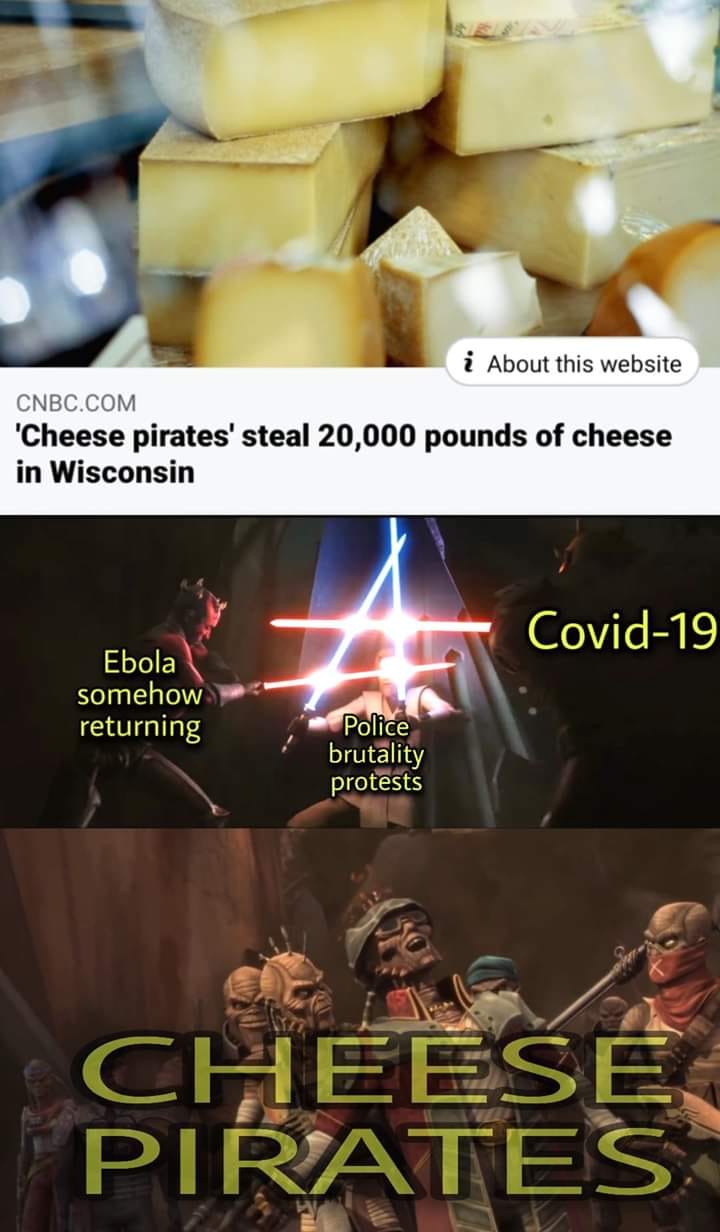
The image is a composite of three screenshots from what appears to be online news sources. The top one shows blocks of yellow cheese. The second shows a dark scene with overlaid text labels: "Ebola somehow returning," "Covid-19," and "Police brutality protests." The bottom image is a graphic rendering of a pirate crew with the words "CHEESE PIRATES" prominently displayed in a stylized font. The general effect is chaotic and jarring, suggesting a connection between these disparate elements in a way that isn't immediately logical. It appears to be a deliberately absurd juxtaposition.
Foucauldian Genealogical Discourse Analysis
This image is ripe for Foucauldian analysis. It's not about a simple truth of cheese piracy, but how the very concept of "Cheese Pirates" emerges as a discursive construct.
- Discursive Formation: The image brings together seemingly unrelated discourses – food supply chain (cheese), public health crises (Ebola, COVID-19), and socio-political unrest (police brutality protests). The act of naming these individuals "Cheese Pirates" is a power move, framing theft within a narrative of adventure and (potentially) legitimizing a particular view of the incident. The pirate archetype carries inherent meanings of rebellion, illegality, and taking what is rightfully “theirs” (by what logic, the image does not clarify).
- Power/Knowledge: The image suggests how power operates through the creation and dissemination of these discourses. Whoever created this image has the power to link these events, to construct this narrative. The image creates meaning where none inherently exists.
- Genealogy: We can trace the historical roots of the pirate archetype, the discourses around food security, and responses to public health crises to understand how this specific image emerges in a particular historical moment. Perhaps the image is commenting on the anxieties around resource access during times of crisis.
Critical Theory
The image prompts critical engagement with the way media constructs narratives. It exemplifies how information can be presented in a deliberately fragmented and disorienting way.
- Ideology: The image functions as a critique of media saturation and the loss of coherent narratives. It seems to be mocking the way news cycles conflate unrelated events, creating a sense of panic or absurdity.
- Commodification: Cheese, as a commodity, is at the heart of the image. The theft highlights the complexities of food systems and the power dynamics inherent in their control.
- The Culture Industry: The image can be seen as a parody of the culture industry – the mass production of information and images that often prioritize sensationalism over substance. It is a meta-commentary on the spectacle of news.
Marxist Conflict Theory
While seemingly absurd, the image can be read through a Marxist lens.
- Class Struggle: The "Cheese Pirates" can be interpreted as representing a form of resistance – a desperate act driven by economic hardship. Stealing 20,000 pounds of cheese could symbolize a challenge to the control of the food supply by capitalist interests.
- Means of Production: The cheese itself is a product of the means of production. The theft disrupts the flow of commodities and the accumulation of capital.
- Alienation: The image's chaotic nature can be seen as reflecting the alienation of individuals in a capitalist society – a sense of disconnection from the products of their labor and from each other.
Postmodernism
The image is a quintessential example of postmodern aesthetics.
- Fragmentation & Pastiche: The image is a fragmented collage of unrelated elements, creating a pastiche of news tropes. It rejects a singular, coherent narrative.
- Intertextuality: The image relies on the viewer's existing knowledge of pirates, cheese, disease outbreaks, and protests to create meaning. It's a conversation with existing cultural references.
- Deconstruction: The image deconstructs the traditional news format, challenging the notion of objective truth and presenting a deliberately subjective and ambiguous view of reality.
- Simulacra & Simulation: The "Cheese Pirates" are a simulated event - or a simulation of an event. This might highlight that the image is the reality, rather than representing some external truth.
Notes:
- The effectiveness of these analyses depends on the intended meaning behind the image. It could be a genuine commentary, a deliberate act of trolling, or simply a bizarre juxtaposition.
- The image is open to multiple interpretations, and each theoretical framework offers a unique lens through which to understand its meaning.
Let me know if you'd like me to delve deeper into any of these theoretical approaches or explore other possible interpretations of the image.
simple-description (llama3.2-vision)
This meme is a play on a news article about the "Cheese Pirates" stealing 20,000 pounds of cheese in Wisconsin. The meme uses a Star Wars reference, with a character saying "In a galaxy far, far away" and then listing various absurd and humorous reasons for the cheese heists, such as "In a galaxy far, far away, the Cheese Pirates stole 20,000 pounds of cheese in Wisconsin."
tesseract-ocr
a F e i About this website ‘Cheese pirates’ steal 20,000 pounds of cheese in Wisconsin M orem \ E © COVIC-If9 eel AW \ ols nT=l aCe) haa cleU leaned Peed llie= ee Tele] hay fey Rel te) . t E: £ eee gage) LL ZN ™