First Seen
2023-05-10T21:03:35+00:00
simple-description (llama3.2-vision_11b)
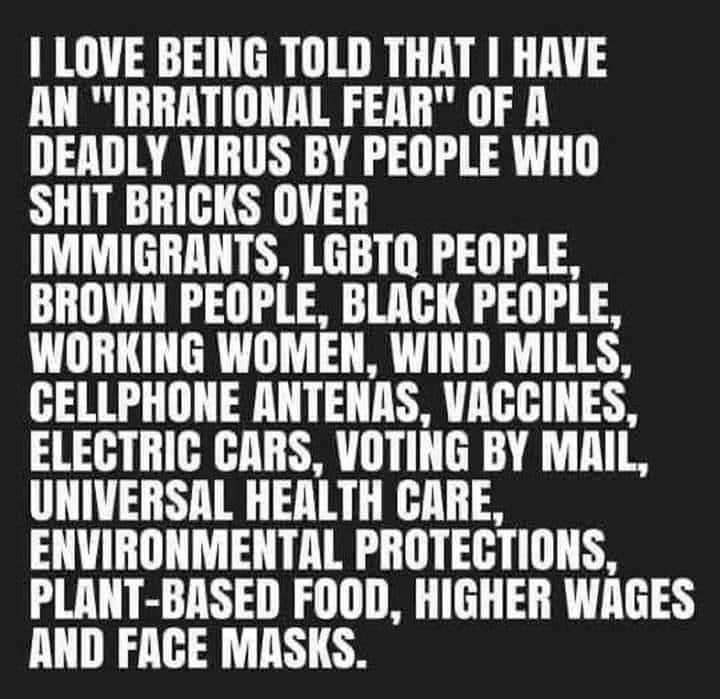
The meme is a humorous list of words and phrases that are often used to describe or fear something, but are actually used to describe the fear of the coronavirus pandemic. The text is a tongue-in-cheek list of "irrational fears" that people have been using to describe their fear of the virus, such as "I love being told I have to wear a mask" and "I love being told I have to get vaccinated".
detailed-analysis (gemma3-27b-vision)
Here's an analysis of the image, broken down into the requested theoretical frameworks, noting where they don't fully apply as well.
Image Description
The image is a white, sans-serif text on a solid black background. It is a declarative statement: "I love being told that I have an 'irrational fear' of a deadly virus by people who…" This is followed by a long list of items—social groups, technologies, political practices, and lifestyle choices—that the speaker claims are linked to the accusation of having an irrational fear. The phrasing uses irony; the "love" clearly implies the opposite: frustration or resentment.
Foucauldian Genealogical Discourse Analysis
This image is highly amenable to a Foucauldian approach. The core of Foucault's work revolves around power/knowledge and the ways discourses shape our understanding of reality. Here's how it applies:
- Discipline & Normalization: The statement implies an attempt to normalize a certain fear (fear of the virus) while simultaneously disciplining (labeling as "irrational") alternative perspectives or concerns. The accusation of having an "irrational fear" functions as a mechanism to control what is considered acceptable thought and behavior.
- Genealogy: The list itself reveals a historical trajectory (a “genealogy”) of anxieties and power dynamics. The items are not randomly chosen; they represent contemporary "culture wars" issues. Examining these issues historically would reveal how they became associated with "irrationality" or threats to a specific social order.
- Power/Knowledge: The statement is not simply about a virus; it's about who gets to define what is reasonable or irrational. Those labeling others' fears as such are exercising power through knowledge—the power to define, categorize, and control. The list highlights that this "knowledge" isn’t neutral, it's tied to specific ideological positions.
- Biopower: The focus on a "deadly virus" positions the statement within the realm of biopower, where governing technologies focus on the regulation of life, bodies, and populations. The "irrational fear" accusation is a way to control and govern behavior, framed as a public health issue.
Critical Theory
This image resonates strongly with themes central to Critical Theory.
- Ideology Critique: The statement serves as a critique of dominant ideologies—the unstated beliefs and assumptions that justify social hierarchies and power relations. The list reveals how seemingly disparate issues are often linked by underlying ideological concerns—fear of change, resistance to progress, defense of privilege.
- Hegemony: The statement suggests a struggle against hegemonic forces—those who attempt to impose their worldview as universal or natural. The accusation of "irrational fear" is a way to maintain hegemony by silencing dissenting voices and framing alternative perspectives as unreasonable.
- Instrumental Reason: The list implies a critique of instrumental reason, where rationality is reduced to mere efficiency and control, ignoring social and ethical considerations. The focus on "irrational fear" can be seen as a way to bypass genuine engagement with complex issues.
Marxist Conflict Theory
Marxist theory, while relevant, is less directly applicable, but still present.
- Class Conflict (Subtle): The list implicitly touches on class conflict. Issues like higher wages, universal healthcare, and environmental protections are often associated with demands for economic justice and challenges to capitalist systems.
- False Consciousness: The accusation of "irrational fear" could be seen as an attempt to create "false consciousness"—to obscure the true nature of social inequalities and maintain the status quo.
- Ideological State Apparatus: The accusation is an example of an ideological state apparatus – a mechanism that reinforces and perpetuates dominant ideology.
Postmodernism
Postmodernism is also applicable, but with nuance.
- Deconstruction: The statement can be "deconstructed" to reveal the hidden assumptions and power dynamics embedded within the accusation of "irrational fear." It challenges the idea that there is a single, objective truth about what constitutes a reasonable fear.
- Relativism: Postmodernism highlights the relativity of truth and knowledge. The statement implies that what is considered "rational" or "irrational" is often socially constructed and depends on one’s perspective.
- Meta-Narratives: The statement challenges grand narratives – overarching explanations of reality – like the idea of a unified "rational" response to the virus. It embraces fragmentation and acknowledges multiple perspectives.
Queer Feminist Intersectional Analysis
This framework is highly relevant, as several items on the list explicitly engage with identity and oppression.
- Intersectionality: The list clearly demonstrates intersectionality—the interconnected nature of social categorizations such as race, class, gender, and sexual orientation. Issues like LGBTQ+ rights, black people, brown people, working women are not isolated; they are connected by systems of power and oppression.
- Queer Critique of Normativity: The inclusion of LGBTQ+ people challenges heteronormative assumptions and highlights the ways in which dominant social norms can marginalize and oppress minority groups.
- Feminist Critique of Gender Roles: The inclusion of "working women" and broader gender issues critiques patriarchal structures and challenges traditional gender roles.
- Critique of Power and Oppression: The statement as a whole critiques systems of power and oppression that marginalize and disenfranchise vulnerable groups. The accusation of "irrational fear" is a way to silence and discredit those who challenge the status quo.
In conclusion:
This image is a complex statement that can be analyzed through various critical lenses. While some frameworks are more directly applicable than others, all of them offer valuable insights into the underlying power dynamics, ideological assumptions, and social inequalities that shape our understanding of reality. It functions as a powerful critique of those who attempt to define what is rational or irrational, and a call for greater recognition of diverse perspectives and experiences.
simple-description (llama3.2-vision)
This meme is a humorous list of words and phrases that are often associated with fear or anxiety, such as "immigrants", "LGBTQ", "brown people", "black people", and "vaccines". The text is presented in a bold, white font on a dark background, with each phrase separated by a line break. The overall tone is sarcastic and ironic, implying that the speaker has an "irrational" or "irrational" fear of these things.
tesseract-ocr
PS 3 YM PR ae eT De aT LY SHIT BRICKS OVER UST BROWN PEOPLE, BLACK PEOPLE, PS HSS AAS SS USA EELS SUR LTS PU aA Ae