First Seen
2023-05-10T21:03:35+00:00
simple-description (llama3.2-vision_11b)
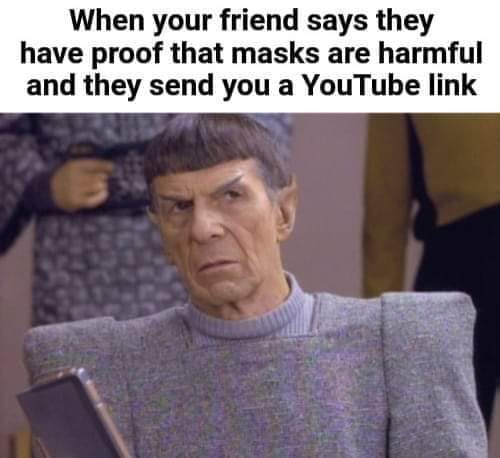
The meme is a humorous take on the COVID-19 pandemic, specifically the widespread use of masks to prevent the spread of the virus. The image is likely a screenshot of a news anchor or a public figure, with a caption that reads "When your friend says they have proof that masks are harmful and they send you a YouTube link". The meme pokes fun at the idea that someone would try to prove a point about the effectiveness of masks by sending a link to a YouTube video, implying that the person is trying to prove a point that is not supported by credible sources.
detailed-analysis (gemma3-27b-vision)
Okay, let's break down this meme through several theoretical lenses. Here's a sectioned analysis, focusing on the most relevant frameworks.
Visual Description
The image features Spock, the logical Vulcan character from Star Trek, looking skeptical and unimpressed. He’s in uniform (grey turtleneck and shoulder pads), and his expression is one of critical scrutiny and disbelief. He's glancing to the side, as if dismissing something. The meme's text overlay reads: "When your friend says they have proof that masks are harmful and they send you a YouTube link." This combination sets up a humorously ironic situation, implying that a dubious source (a random YouTube link) is being presented as definitive proof.
Foucauldian Genealogical Discourse Analysis
This meme beautifully illustrates how "truth" and "knowledge" are not objective realities, but are constructed through discourse. Michel Foucault's work highlights the relationship between power and knowledge, arguing that discourses create the very categories of what is considered true or false.
- Discursive Formation: The claim that "masks are harmful" isn't based on established scientific consensus, but is a claim made within a specific (and often fringe) discourse. This discourse constructs “harm” in a particular way, often through cherry-picked data, misinformation, and appeals to individual “freedom” or perceived health risks.
- Power/Knowledge: The friend, by presenting a YouTube link, is attempting to exercise power by defining what constitutes “proof.” The YouTube link isn’t presented as a peer-reviewed study, but as a self-proclaimed authority. This highlights how individuals can attempt to create their own "regimes of truth."
- Genealogy: A Foucauldian genealogical analysis would trace the history of this anti-mask discourse. Where did this idea originate? What social, political, and cultural forces contributed to its emergence? The meme suggests that the "proof" is not based on a long, rational line of inquiry, but rather emerges from a specific network of online beliefs.
Spock’s reaction serves as a visual representation of the critique of this discourse – a rejection of the claim as illogical and unsupported.
Critical Theory
The meme touches on central tenets of the Frankfurt School's Critical Theory, specifically regarding the concept of the "Culture Industry" and the manipulation of information.
- The Culture Industry: The YouTube link represents a product of the culture industry – a mass-produced form of information that isn’t necessarily based on rational thought or objective truth, but is designed to circulate and influence beliefs.
- Ideology: The claim that masks are harmful, spread through online videos, can be seen as a form of ideology. It's a belief system that serves to reinforce certain values (like individual liberty over collective health) and potentially maintain existing power structures (e.g., resisting public health measures).
- Enlightenment Critique: Spock's skeptical expression embodies the Enlightenment values of reason and logic. The meme suggests a contrast between this rational approach and the acceptance of unverified information.
Postmodernism
The meme indirectly reflects a postmodern sensibility by highlighting the deconstruction of objective truth and the rise of subjective interpretations.
- Meta-Narratives: Postmodernism challenges "grand narratives" or universal truths. The meme implicitly mocks the idea that a single YouTube video can provide conclusive "proof" – rejecting the notion of absolute, unquestionable knowledge.
- Simulacra and Simulation: The YouTube video itself can be seen as a simulacrum – a copy without an original. It presents itself as evidence, but is potentially divorced from genuine research or expertise.
- Relativism: While not explicitly endorsing relativism, the meme acknowledges that individuals may construct their own "truths" based on readily available, often unverified, information.
Let me know if you would like any of these analyses elaborated on or if you would like me to add another perspective.
simple-description (llama3.2-vision)
This meme is an image of William Shatner's character, Mr. Spock, from the Star Trek franchise. The text at the top of the image reads: "When your friend says they have proof that masks are harmful and they send you a YouTube link." The meme is a humorous take on the common experience of receiving unsolicited or unhelpful information from friends, and the image of Mr. Spock's raised eyebrow and disapproving expression adds to the comedic effect.
tesseract-ocr
When your friend says they have proof that masks are harmful and they send you a YouTube link * a. * “| ees a