First Seen
2023-05-10T21:03:35+00:00
simple-description (llama3.2-vision_11b)
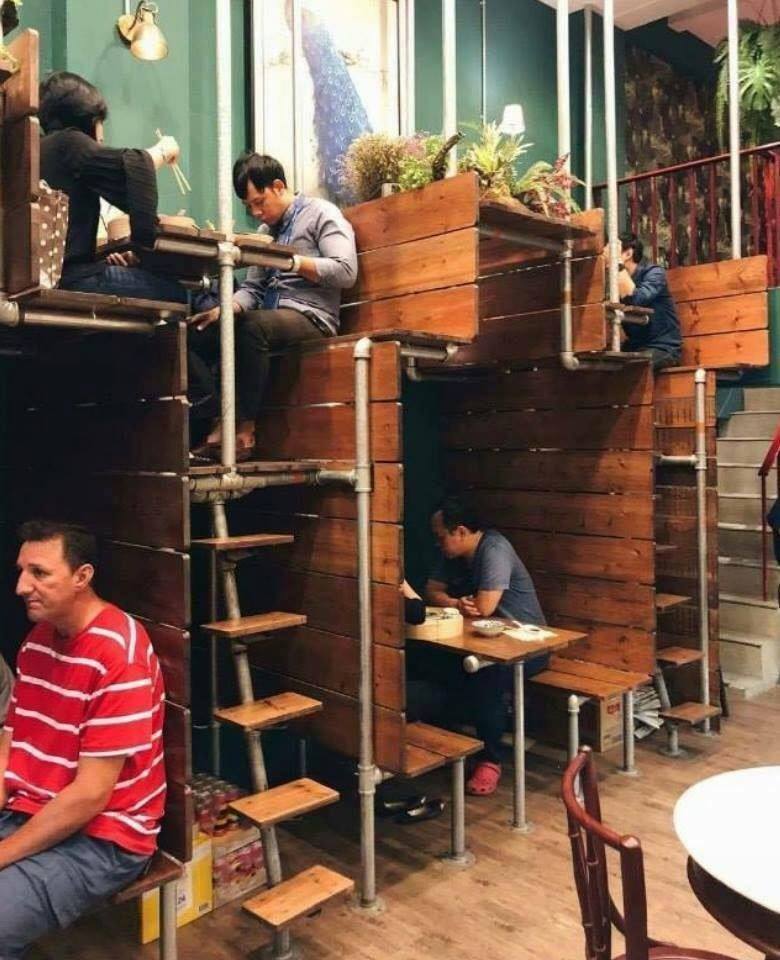
The meme is an image of a crowded restaurant where people are sitting on top of each other, with some even on top of tables. The caption reads "When you're trying to social distance but everyone else is still having dinner".
detailed-analysis (gemma3-27b-vision)
Okay, here's an analysis of the image broken down into the requested theoretical frameworks, only including sections where the theory genuinely applies. It’s important to remember this is an interpretation based on a single image, so it will have limitations.
Visual Description
The photograph depicts the interior of what appears to be a cafe or restaurant. The most striking feature is a series of wooden cubicles, constructed with a scaffolding-like system of metal pipes, and elevated at different heights. These cubicles act as individual dining booths. Some have small wooden tables inside, and people are seated within them, engaged in eating or working on laptops. The booths are not uniform; some are more open, while others are quite enclosed. The overall aesthetic is rustic and slightly industrial, with exposed wood and metal. The walls are painted a dark green, and there is some decorative foliage visible. Several patrons are visible, and the space feels somewhat cramped, with a focus on individualized, partitioned dining. The lighting is somewhat dim.
Foucauldian Genealogical Discourse Analysis
This image is ripe for Foucauldian analysis, specifically concerning power dynamics and spatial control. The architecture is the discourse.
-
Discipline and Panopticism: The cubicle structure evokes a subtle form of panoptic control. While not a perfect panopticon, the individual booths create a feeling of being visible (to potentially anyone walking past or to staff) while also being somewhat isolated. The elevated nature of some cubicles also introduces a hierarchical element. This contributes to a feeling of self-surveillance; patrons are, unconsciously, aware of being potentially watched or observed. The structure itself enforces a certain behavior – keeping to oneself, a controlled consumption experience.
-
Genealogy of Space: Historically, restaurants were often designed to facilitate social interaction. This space actively resists that, creating individualized zones. A genealogical approach would question how we arrived at a point where individualized, almost cell-like, dining is acceptable or even desirable. This could be tied to increasing privatization of life, a need for personal space in crowded environments, or the commodification of "experience" even in basic activities like eating.
-
Normalization: The very existence of this design normalizes a certain type of behavior. It suggests that being alone while in a public space is acceptable, even preferable, and encourages a type of detached consumption.
Critical Theory
This space can be analyzed through a Critical Theory lens, specifically relating to alienation and the commodification of experience.
-
Commodification of Experience: The cubicle booths aren't simply providing a place to eat; they are selling an experience—a unique, "Instagrammable" dining experience. This space transforms even a basic need, like eating, into a commodity, a transaction that is about more than just sustenance. It is about acquiring a certain aesthetic and signaling status through that experience.
-
Alienation & Social Interaction: The design actively discourages genuine social interaction. While a cafe traditionally fostered community, this space promotes isolation and individualized consumption. The fragmentation of space physically mirrors a potential fragmentation of social bonds. This can be tied to broader anxieties about modernity and the loss of community.
-
The Culture Industry: This space exemplifies a facet of the culture industry where even dining is curated, packaged, and sold as a unique, marketable experience.
Marxist Conflict Theory
While not immediately obvious, a Marxist lens can identify underlying class dynamics at play.
- Spatial Control & Consumption: The design creates a tiered experience. Some cubicles are more desirable (e.g., higher up, more private) than others. This creates a subtle form of spatial stratification, suggesting that even access to space is unequal. The willingness of consumers to pay for a unique or more desirable booth demonstrates the operation of market forces.
- Commodification of Basic Needs: It's a clear example of how even basic needs like eating can be commodified and used to generate profit. The unique design isn't about providing a functional space; it's about creating a demand for a product that offers an experience that can be sold.
Postmodernism
This space heavily embodies postmodern aesthetic principles.
-
Pastiche and Irony: The combination of rustic wood, industrial metal piping, and playful cubicle design is a clear example of pastiche – mixing different styles and eras without a clear unifying vision. This can be interpreted as ironic, as it simultaneously evokes a sense of "authenticity" (rustic wood) and artificiality (industrial pipes).
-
Fragmentation & Deconstruction: The fragmented spatial arrangement reflects postmodern ideas about the breakdown of grand narratives and the rejection of traditional forms. The space is not a unified whole but a collection of individualized zones.
-
Simulacra & Hyperreality: The design is arguably more about the image of a cafe experience than the experience itself. The aesthetic is so stylized that it becomes a simulacrum—a copy without an original, creating a hyperreal environment.
Important Considerations:
- Limited Information: This analysis is based on a single photograph. Further context (location, target audience, etc.) would be helpful.
- Multiple Interpretations: Theoretical frameworks are tools for analysis, not definitive answers. Different interpretations are possible.
Let me know if you'd like me to elaborate on any particular aspect or theoretical framework.
simple-description (llama3.2-vision)
The meme is an image of a crowded restaurant with people sitting on tables, stairs, and even the floor, with others sitting on top of tables and even on the ceiling. The image is captioned "When you're trying to get a table at a popular restaurant and you're still waiting". The meme pokes fun at the frustration of waiting for a table at a busy restaurant, exaggerating the situation to absurdity.
tesseract-ocr
i ee | reas — PE aes 4 E iF a zt af sie ef os ? i" ; wey E baad, = Wie | Bee y E = awe ase | an),