First Seen
2023-05-10T21:03:35+00:00
simple-description (llama3.2-vision_11b)
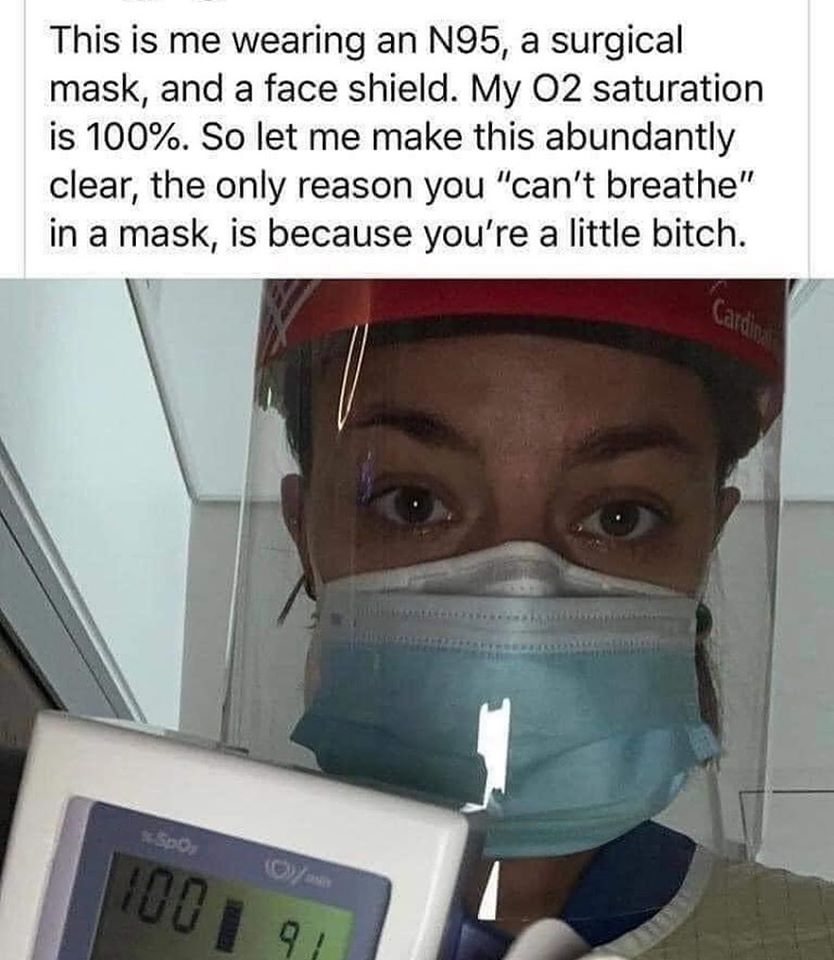
This meme is a humorous take on the COVID-19 pandemic, featuring a nurse wearing a ridiculous amount of protective gear, including a face shield, mask, and N95 respirator. The text above the image reads, "This is me wearing an N95, a surgical mask, and a face shield. My O2 saturation is 100%. So let me make this abundantly clear, the only reason you 'can't breathe' in a mask, is because you're a little b****." The meme pokes fun at the common misconception that wearing a mask can cause breathing difficulties, and instead, it's the person's own incompetence that's causing the problem.
detailed-analysis (gemma3-27b-vision)
Okay, let's break down this image and the accompanying text through the lenses you've provided. It's a complex piece, particularly given the aggressive language used, so a nuanced approach is vital.
Visual Description
The image features a healthcare worker (likely a nurse, given the cap) wearing multiple layers of personal protective equipment (PPE): a surgical mask, an N95 mask over that, and a clear face shield. They are holding up a pulse oximeter, which displays a reading of “100” (likely indicating 100% oxygen saturation). The background appears to be a medical setting, possibly a hospital hallway or patient room. The person's facial expression is direct and appears defiant. The lighting is somewhat harsh and clinical.
Foucauldian Genealogical Discourse Analysis
This image is ripe for a Foucauldian analysis. The "discourse" around mask-wearing and its effects on breath is central. Foucault would be interested in how the idea that masks restrict breathing became a common refrain (often connected to resistance against public health measures).
- Power/Knowledge: The image actively challenges the claim that masks are physiologically debilitating. The healthcare worker is using a tool (the pulse oximeter) to demonstrate medical knowledge to disprove the perceived “truth” of those who claim breathing difficulties. The display of "100%" aims to establish a dominance in the discourse, an assertion of objective truth.
- Genealogy: The genealogy of this specific claim (masks = suffocation) could be traced back to a number of sources. It ties into a distrust of scientific expertise and authority, a preference for anecdotal evidence over data, and a broader anti-establishment sentiment. Examining how this claim gained traction within specific communities and online networks would be crucial.
- Discipline/Biopower: The context of the pandemic is vital. Public health measures like mask-wearing were (and are) exercises of biopower – the power to regulate life, health, and bodies. The resistance to mask-wearing, exemplified in the statement, can be seen as a resistance to this form of power.
Critical Theory
This image invites a critical examination of several related concepts.
- Ideology: The statement is deeply ideological. It’s not just a factual claim about breathing, but a statement reflecting a broader worldview, likely one involving distrust of authority, rejection of collective responsibility, and/or individualistic values. The use of a pejorative ("little bitch") is a direct expression of this ideology, aiming to denigrate anyone who disagrees.
- Hegemony: The resistance to masks can be understood in terms of a challenge to hegemonic norms—the prevailing social beliefs and assumptions. The healthcare worker is acting as a counter-hegemonic force, challenging the narrative that masks are harmful.
- Commodification of Health: The presence of the pulse oximeter and the emphasis on quantifiable data highlight the increasing commodification of health. Health is reduced to a number, a measurable metric, reinforcing a medicalized view of the body.
Marxist Conflict Theory
While not the most immediately obvious application, a Marxist reading can be productive.
- Class Conflict: The pandemic and its response have disproportionately affected marginalized communities (based on race, socioeconomic status, etc.). This image could be interpreted as a reaction against the measures taken to protect vulnerable populations, reflecting a sense of resentment or entitlement by those who perceive themselves as more privileged.
- Power Dynamics: The healthcare worker, as a representative of the medical establishment, holds a position of power. The aggressive language is a display of that power, a warning to those who challenge the established order. It could also be seen as a response to the pressure and frustrations healthcare workers faced during the pandemic.
- False Consciousness: The rejection of masks, based on misinformation or ideological beliefs, could be seen as a form of false consciousness—a state of being unaware of one's true interests or the systemic forces shaping one's beliefs.
Postmodernism
Postmodernism is a bit trickier here, but relevant.
- Deconstruction of Truth: The image challenges the very idea of objective truth. The claim that masks are harmful is presented not as a matter of fact, but as a matter of opinion or personal experience. The statement aims to destabilize the authority of scientific expertise.
- Subjectivity and Perspective: The image emphasizes the subjective experience of breathing, suggesting that any claim about its restriction is ultimately a matter of individual perception.
- Hyperreality: The intense focus on quantifiable data (the 100% reading) can be seen as contributing to a hyperreal environment—where signs and simulations (the number on the screen) become more real than the actual lived experience.
Queer Feminist Intersectional Analysis
This is perhaps the most complex and nuanced application.
- Aggression & Power: The use of a violent and misogynistic slur ("little bitch") is central. This is not merely an expression of anger, but an attempt to exert power and control through verbal abuse and the assertion of dominance. It demonstrates the intersection of sexism, aggression, and potentially other forms of oppression.
- Gendered Resistance: The slur is gendered. It's meant to diminish and invalidate. The fact that the healthcare worker uses this language, even if in response to resistance, is problematic. A feminist analysis would question the necessity and impact of using such language, even when facing hostility.
- Intersectional Vulnerabilities: The intersection of being a healthcare worker (often dominated by women and people of color) and facing resistance from individuals who refuse to comply with public health measures can create specific vulnerabilities. The healthcare worker may be facing a combination of professional challenges, emotional strain, and potential threats to their safety.
- Racial dynamics: While this isn't immediately apparent, the background of the individual and the context of racial disparities in healthcare access and experience are important considerations.
In conclusion:
This image is a multi-layered statement that reflects broader social, political, and ideological tensions. It's a provocation, an expression of frustration, and a demonstration of power. A variety of critical lenses can illuminate the complex dynamics at play, revealing the image’s deeper meanings and implications. It is important to note that the use of derogatory language in the image is problematic and cannot be excused, even when considering the context of frustration or resistance.
Disclaimer: This analysis is based on the information available in the image and the accompanying text. It is open to interpretation and does not necessarily represent a definitive or exhaustive analysis.
simple-description (llama3.2-vision)
The meme is a humorous image of a person wearing a face mask, a shield, and a N95 respirator, with a caption about their frustration with having to wear all this protective gear due to someone else's lack of mask-wearing. The text at the top of the image reads: "This is me wearing a N95, a shield, and a mask because of you."
tesseract-ocr
This is me wearing an N95, a surgical mask, and a face shield. My O2 saturation is 100%. So let me make this abundantly clear, the only reason you “can’t breathe” in a mask, is because you're a little bitch. y ‘er / A F | | — | | , SS