First Seen
2023-05-10T21:03:35+00:00
simple-description (llama3.2-vision_11b)
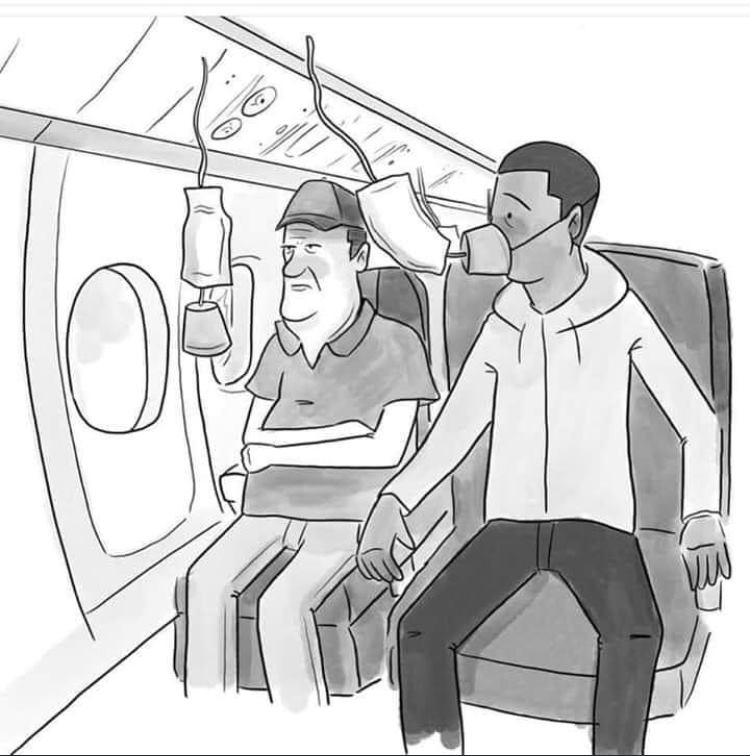
The meme depicts two passengers on a plane, one of whom is wearing a mask and the other is not. The text "I'm not arguing, I'm just explaining why I'm right" appears above the passengers, implying that the non-mask-wearer is trying to justify their decision to not wear a mask during the COVID-19 pandemic. The meme is a humorous commentary on the tendency to argue rather than listen to others' perspectives.
detailed-analysis (gemma3-27b-vision)
Okay, let's break down this image with analyses as requested.
Visual Description
The image is a black and white cartoon-style drawing depicting the interior of an airplane cabin. Two men are seated next to each other. The man on the left is older, wearing a baseball cap, a short-sleeved shirt, and appears relaxed. He has an oxygen mask connected to a portable concentrator. The man on the right is younger, wearing a collared shirt, and is wearing a face mask. He is looking pointedly at the man on the left with a disgusted or frustrated expression. The airplane cabin is rendered in simple lines, with the window and overhead air vents visible. The composition suggests a moment of tension or conflict between the two passengers, likely related to differing views on health precautions, given the presence of the mask and oxygen concentrator.
Foucauldian Genealogical Discourse Analysis
This image can be viewed through a Foucauldian lens, specifically concerning the discourses surrounding health, illness, and control.
- Discipline and Biopower: The airplane cabin itself is a site of discipline. Rules around masking, health declarations, and spacing represent exercises of power over the bodies of passengers. This aligns with Foucault’s concept of biopower – the ways in which political power increasingly focuses on regulating life itself. The man with the oxygen concentrator and the man with the mask represent different positions within this disciplinary field. The concentrator points towards a medical condition that necessitates deviation from the “norm” of healthy travel, while the mask represents adherence to a discourse of prevention and collective safety.
- Genealogy of Health Discourses: A genealogical analysis could trace the historical evolution of anxieties around airborne illness, leading to the contemporary emphasis on masking and sanitation. The image captures a specific moment in this history, reflecting current anxieties about contagion.
- Power Dynamics: The image highlights the power dynamics at play. The man in the mask may be attempting to enforce a “correct” behavior, reflecting a power imbalance where certain interpretations of health and safety are privileged. The man with the concentrator, by needing medical equipment, occupies a different position, potentially viewed as “risky” or needing to be regulated. The man wearing the mask is projecting his power over the man with the oxygen concentrator.
Critical Theory
Through a Critical Theory lens, this image can be interpreted as revealing underlying social anxieties and power structures.
- Ideology and the "Healthy" Body: The image implicitly raises questions about the ideology of health and the social construction of the “healthy body.” The man with the mask embodies a perceived ideal of responsible citizenship and disease prevention. The man with the oxygen concentrator, while possibly legitimately in need of it, can be viewed as "other," and thus can create anxiety.
- Social Control: The airplane cabin, as a space of enforced rules (masking, sanitation), becomes a microcosm of broader societal trends towards increased surveillance and control. Critical theorists would ask: Who benefits from these controls? How do they shape our behavior and our understanding of risk?
- Alienation: The pointed look of disgust from the man in the mask implies alienation. The simple fact that the man needs oxygen can cause anxiety and fear and can disconnect people.
Marxist Conflict Theory
A Marxist analysis might focus on how class and access to healthcare (or lack thereof) play out in this scenario.
- Access to Healthcare: The man with the oxygen concentrator may represent someone who requires ongoing medical support, potentially due to socioeconomic factors that have impacted his health. This highlights the unequal access to healthcare and the ways in which systemic inequalities can manifest in individual needs.
- Class-Based Anxieties: The man with the mask may be representing a socioeconomic class that has the means to protect themselves through precautions (masks, travel insurance, etc.). The potential for resentment or judgment towards someone requiring medical assistance could be seen as a manifestation of class-based anxieties.
- Control of Resources: The man in the mask is showing a power dynamic over the man with the oxygen concentrator. This power dynamic can stem from a perceived control of resources in a capitalist society.
Postmodernism
Postmodern interpretations would deconstruct the certainty of meanings and focus on the image’s instability.
- Deconstruction of "Health": Postmodernism challenges the idea of a singular, objective definition of "health." The image embodies this by highlighting the different ways in which health is experienced and perceived. What is considered "healthy" or "safe" is culturally constructed and subject to interpretation.
- Fragmentation of Meaning: The image lacks a clear narrative, leaving the viewer to construct their own meaning. This reflects the postmodern emphasis on the fragmentation of experience and the rejection of grand narratives.
- Simulation and Hyperreality: The mask, in particular, can be seen as a symbol of simulation. It creates a sense of protection that may be more symbolic than real, reflecting the postmodern preoccupation with the blurring of reality and representation.
Queer Feminist Intersectional Analysis
While the image doesn’t directly depict gender or sexuality, an intersectional analysis can explore how social categories intersect to create power dynamics.
- Vulnerability and Othering: The man with the oxygen concentrator is marked as "different" and potentially "vulnerable." This vulnerability could be exploited or subject to judgment, reflecting the ways in which societal norms marginalize those who deviate from expectations.
- Care and Burden: The man with the oxygen concentrator may be placing a burden on those around him. Queer feminist theories recognize how care work is often gendered and undervalued.
- Body Politics: The image is a commentary on body politics. It reveals how bodies are policed, judged, and subjected to social control.
I hope this analysis provides a thorough examination of the image through different theoretical frameworks. Let me know if you’d like me to elaborate on any of these points or explore additional interpretations.
simple-description (llama3.2-vision)
This meme is a cartoon of two men, one on the left with a mask covering his nose and mouth, and the other on the right without a mask. The text "I'm not arguing, I'm just explaining why I'm right" appears above the two men, implying that the man on the right is not wearing a mask to avoid an argument. The joke is that the man on the right is trying to avoid a disagreement by not wearing a mask, but is actually just being obstinate.
tesseract-ocr
j aN Leh yy | ! \ N | ae | ») | Vi \ yi = |