First Seen
2023-05-10T21:03:35+00:00
simple-description (llama3.2-vision_11b)
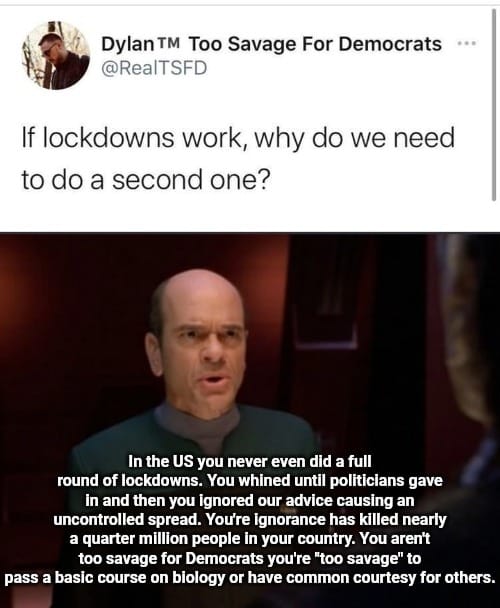
This meme is a commentary on the COVID-19 pandemic and the lockdowns that were implemented to slow its spread. The meme is a quote from the TV show Star Trek: The Next Generation, where the character Captain Jean-Luc Picard is quoted as saying "The needs of the many...". However, in this meme, the quote is modified to say "The needs of the many... are to stay home and not go out during the pandemic". The meme is poking fun at the fact that people were being told to stay home and not go out during the pandemic, but are now being told to go out and get the vaccine.
detailed-analysis (gemma3-27b-vision)
Okay, let's break down this social media post using the frameworks you've requested. It's important to note this is an interpretation based on the image and text provided, and these analyses can be complex with multiple layers.
1. Visual Description
The image is a screenshot of a tweet from the account "@RealTSFD", with a profile picture of a man with an aggressive expression. The tweet poses a rhetorical question regarding the need for a second lockdown if lockdowns were effective. Below the text is a video still of a man, identifiable as Dr. Drew Pinsky, speaking directly to the camera. He appears to be in a formal setting, perhaps a television studio. He looks stern and appears to be reprimanding the audience. The framing is tight, focusing on his head and shoulders, emphasizing the directness of his address. The lighting is professional, typical of broadcast media.
2. Foucauldian Genealogical Discourse Analysis
- Discourse of Health & Biopower: This post operates within the discourse of public health, and specifically the debate surrounding responses to the COVID-19 pandemic. Foucault’s concept of “biopower” is relevant here. Biopower refers to the ways in which political power increasingly focuses on regulating and optimizing life – things like public health measures (lockdowns, vaccinations, masking) are key aspects of this. The post attempts to assert a certain truth about the effectiveness (or lack thereof) of lockdowns, positioning the speaker as an authority on this matter.
- Genealogy of Lockdown Logic: Examining the historical development ("genealogy") of lockdown measures reveals that they were not a universally accepted response to pandemics, but evolved from quarantine practices, combined with new understandings of epidemiology and disease transmission. The post implicitly challenges the legitimacy of the lockdown logic, questioning its consistency and effectiveness.
- Power/Knowledge: The post leverages the perceived authority of Dr. Drew Pinsky, a medical professional, to bolster its claims. This is an example of “power/knowledge” – the ways in which knowledge is always tied to power relations, and how knowledge is used to legitimize certain actions and suppress others. The speaker’s use of language (“whined,” “ignorance”) is an attempt to wield power through discourse.
3. Critical Theory
- Critique of Enlightenment Rationality: The post indirectly critiques the idea that scientific solutions (lockdowns) are inherently rational and objective. It suggests a failure in implementation, not necessarily the concept itself, but the framing implies a deeper question about the limitations of applying “rational” solutions to complex social problems.
- Hegemony & Counter-Hegemony: The post can be seen as an attempt to disrupt the "hegemony" of the pro-lockdown narrative that was dominant in some circles. The speaker positions themselves as an alternative voice, challenging the dominant discourse and attempting to construct a counter-narrative.
- The Role of Expertise: The post highlights the complex relationship between expertise and public opinion. While Dr. Drew is presented as an expert, the post's framing suggests a distrust of experts and a belief that their advice has been ignored or misinterpreted.
4. Marxist Conflict Theory
- Ideology & Class: While not explicitly class-based, the post subtly taps into anxieties about government overreach and control. This can resonate with a segment of the population that feels alienated from political power and distrustful of institutions. The suggestion of "ignorance" implies a dismissal of perspectives different from the speaker's.
- Power Structures: The post critiques the actions of "politicians," implying they were swayed by public pressure ("whined") rather than following sound scientific advice. This implicitly suggests a power struggle between experts and political actors.
- Control & Surveillance: The question about repeated lockdowns can be interpreted as an expression of resistance to perceived forms of social control. Lockdowns, in this view, represent a limitation of individual freedom and an expansion of state power.
5. Postmodernism
- Deconstruction of Truth: The post questions the validity of a single “truth” about the effectiveness of lockdowns. It implies that truth is not objective, but rather constructed through social discourse and interpretation.
- Fragmentation of Narratives: The post contributes to the fragmentation of narratives surrounding the pandemic. By challenging the pro-lockdown narrative, it reinforces the idea that there are multiple perspectives and no single, authoritative account.
- Metanarratives: The post undermines the "metanarrative" that scientific expertise can solve all social problems. It suggests that even with expert knowledge, implementation and social factors can lead to failure.
6. Queer Feminist Intersectional Analysis
This framework is less directly applicable, but can offer some nuance.
- Power Dynamics & Marginalization: The tone of the post – scolding and accusatory – can be viewed as reflective of broader power dynamics. The accusation of “ignorance” can be seen as a silencing tactic that marginalizes certain perspectives.
- Intersectional Impact of Lockdowns: While the post doesn’t address this explicitly, it's worth noting that lockdowns had a disproportionate impact on marginalized groups, particularly women, people of color, and low-income individuals. These groups faced increased rates of job loss, domestic violence, and healthcare disparities during lockdown periods.
- Critique of Authoritative Voice: Feminist theory often critiques the use of authoritative voices that claim to speak for others. The speaker’s assertive tone and accusatory language can be seen as reinforcing patriarchal power dynamics.
Important Considerations:
- This analysis is interpretive and can be approached from different angles.
- The post is a snippet of a larger conversation, and its meaning is shaped by the context in which it was shared.
- These frameworks are tools for understanding the complexities of social phenomena, and they should not be used to impose rigid interpretations.
I hope this detailed breakdown provides a comprehensive analysis of the post based on the frameworks you requested.
simple-description (llama3.2-vision)
This meme is a humorous response to a tweet about the COVID-19 pandemic lockdowns. The meme features a screenshot of a Star Trek: The Next Generation character, Captain Jean-Luc Picard, with a caption that reads "In the US you never even did a full lockdown. You whined until politicians gave in and then you ignored our advice causing an uncontrolled spread. You're ignorance has killed nearly a quarter million people in your country. You are not a good leader. You're not a good person. You're a disaster for humanity. And if you don't stop it you'll kill your entire country." The meme is a satirical commentary on the US response to the pandemic and the lack of leadership and responsibility shown by some individuals.
tesseract-ocr
ip Dylan™ Too Savage For Democrats @RealTSFD If lockdowns work, why do we need to do a second one? In the US you never even did a full CaM Bee Cd in and then you ignored our advice causing an uncontrolled spread. You're Ignorance has killed nearly Pmt AN Ce cas Dee Sm au ecicp noie coke ct a O} PSE Eee tot ie Cece mre