First Seen
2023-05-10T21:03:35+00:00
simple-description (llama3.2-vision_11b)
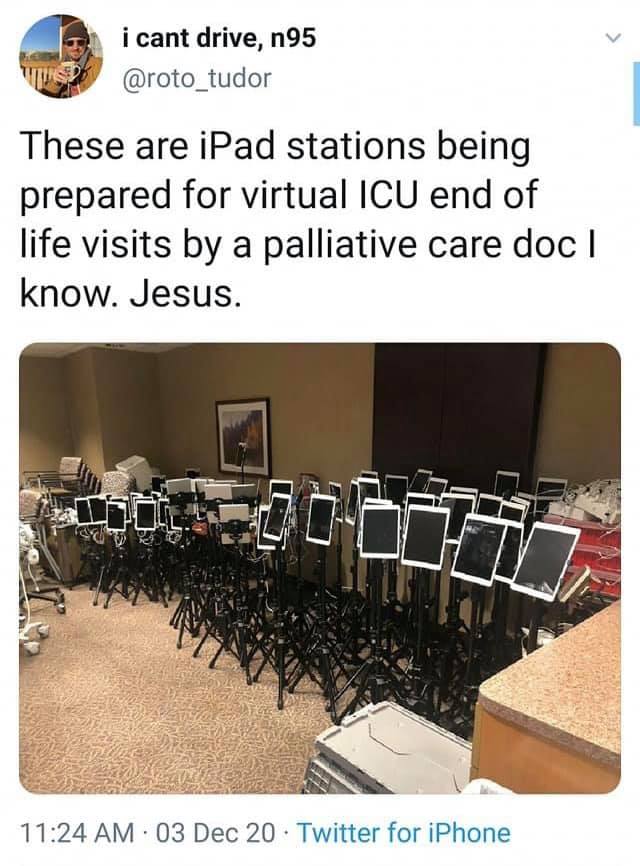
This meme is a joke about the COVID-19 pandemic, specifically about the use of iPads in hospitals to allow patients to have video calls with their loved ones. The image shows a room filled with rows of iPads, implying that the hospital is using them as a temporary solution to keep patients connected with their families during the pandemic. The text "These are iPad stations being prepared for virtual ICU end of life visits by a palliative care doc I know. Jesus." is a humorous and ironic comment on the situation, implying that the use of iPads in this way is a last resort, and that the doctor is shocked and possibly even shocked by the situation.
detailed-analysis (gemma3-27b-vision)
Okay, let's break down this image and accompanying tweet using the requested theoretical frameworks. Given the content, several of these frameworks will be quite relevant, while others might have less direct application.
1. Visual Description
The image depicts a room, likely a hospital or healthcare facility. Dominating the foreground is a dense arrangement of black iPad stands, each displaying a blank white iPad screen. They're set up in rows on the floor, as if preparing for a deployment or a class. The room itself is fairly sterile and unremarkable—beige walls, standard institutional flooring. In the background are other pieces of medical equipment, and a chair with a purple cover. A framed picture is visible on the wall, adding a touch of domesticity. A brown counter is visible in the bottom right corner.
The overall effect is one of orderliness, but also a slight eeriness. The sheer number of iPads, all uniformly displaying blank screens, creates a sense of potential, but also of an empty, somewhat impersonal experience.
2. Foucauldian Genealogical Discourse Analysis
This image is ripe for Foucauldian analysis. Foucault would be interested in how power operates through discourses and technologies that shape our understanding of life, death, and care.
- Discipline & Surveillance: The neat rows of iPads, and the implication they will be used for remote visits, speak to a disciplining of care. Healthcare is increasingly mediated by technology, allowing for greater control and "efficiency," but at the potential cost of human connection. The technology enables a form of surveillance, with doctors and potentially families able to remotely monitor patients.
- Biopower: The deployment of these iPads is deeply connected to biopower—the ways in which modern states (and increasingly, institutions like hospitals) seek to regulate and control life itself. Palliative care, while compassionate, also falls within this framework, as it’s about managing the process of dying. Technology is now a key tool in exerting this control.
- Genealogy: Examining the genealogy (historical development) of this practice would reveal how palliative care has evolved, and how technology has increasingly become integrated into end-of-life care protocols. The image illustrates a specific moment in this historical trajectory.
- The "Medical Gaze": The iPad mediates the "medical gaze," distancing the doctor from the patient's lived experience. While offering access, it also presents a filtered, technologically mediated view of illness and dying.
3. Critical Theory
Critical Theory focuses on exposing power structures and challenging established norms.
- Commodification of Care: The image highlights the increasing commodification of care. While palliative care is essential, deploying technology like iPads can feel less about genuine human connection and more about a standardized, scalable service. The iPads are tools facilitating care, but also represent the monetization of empathy and support.
- Alienation: The technology may contribute to alienation—both for the patient, who receives care through a screen, and for the doctor, who may lose some of the nuanced understanding that comes from direct physical contact.
- The “Culture Industry”: One could see this image as reflective of the "culture industry"—the mass production of standardized experiences. Remote end-of-life care becomes another product in this system, rather than a uniquely human interaction.
- The Loss of Authentic Experience: The use of technology mediates the experience of dying, potentially obscuring the raw, messy, and profoundly human aspects of it.
4. Marxist Conflict Theory
While not the most prominent lens, Marxist ideas can be applied.
- Class Disparities: Access to technology and palliative care is not equal. The deployment of iPads implies a certain level of resources and infrastructure that may not be available in all healthcare settings or accessible to all patients. This could exacerbate existing class disparities in end-of-life care.
- The Commodification of Life and Death: From a Marxist perspective, even palliative care can be seen as part of the capitalist system, where everything, including life and death, becomes a commodity to be managed and controlled.
- Capital's Expansion: The reliance on technology represents capital's constant expansion into new areas of life, even the most intimate and vulnerable moments.
5. Postmodernism
Postmodernism questions grand narratives and emphasizes the fragmentation of meaning.
- The Loss of Authenticity: The image speaks to the postmodern concern with the loss of authenticity. Is a remote visit via iPad truly a meaningful connection, or simply a simulation of care?
- Hyperreality: The image could be seen as contributing to a hyperreality where the simulation (the iPad visit) becomes more real than the actual experience of presence.
- Deconstruction of Traditional Care: The deployment of iPads deconstructs the traditional notion of the doctor-patient relationship, replacing direct physical contact with a technologically mediated exchange.
- The Fragmentation of Experience: The image could represent the fragmentation of experience that is characteristic of postmodern life. The patient's final moments are mediated by technology, disconnecting them from a more holistic and embodied experience.
6. Queer Feminist Intersectional Analysis
This framework is less directly applicable, but still relevant.
- Care Work & Gender: Traditionally, care work (including palliative care) has been disproportionately performed by women. The increasing reliance on technology could lead to the de-skilling of care work and the potential for further exploitation of care workers.
- Access to Care & Marginalized Identities: Intersectional analysis would highlight how access to palliative care (and technology-mediated care) is shaped by intersecting identities (race, class, gender, sexuality, disability). Marginalized groups may face greater barriers to accessing quality end-of-life care.
- The Body & Technology: Queer theory often explores the relationship between the body and technology. In this context, the image could raise questions about how technology mediates our experience of the body, particularly in the context of illness and dying.
- Challenging Traditional Norms: Feminist critiques of care often focus on the ways in which traditional care norms can reinforce patriarchal power structures. The image could be seen as embodying a shift towards a more technologically mediated, potentially less personal form of care.
Let me know if you'd like me to elaborate on any of these theoretical analyses, or if you'd like me to explore other perspectives!
simple-description (llama3.2-vision)
This meme is a screenshot of a Twitter post showing a room filled with iPads, each with a patient's chart and a doctor's notes displayed on the screen. The text accompanying the image reads, "These are iPad stations being prepared for virtual ICU end of life visits by a palliative care doc I know. Jesus." The meme is humorous because it's a tongue-in-cheek comment on the use of technology in healthcare, implying that the doctor is so overwhelmed by the number of patients that they're using iPads to visit them virtually, to the point that they're jokingly invoking a higher power to help them cope.
tesseract-ocr
» icant drive, n95 y fie @roto_tudor | These are iPad stations being prepared for virtual ICU end of life visits by a palliative care doc | know. Jesus. fl ca ated H ¥ 4 | oa >] re eee te wa iS Ee a is Leite a e / VS Y e 11:24 AM - 03 Dec 20 - Twitter for iPhone