First Seen
2023-05-10T21:03:35+00:00
simple-description (llama3.2-vision_11b)
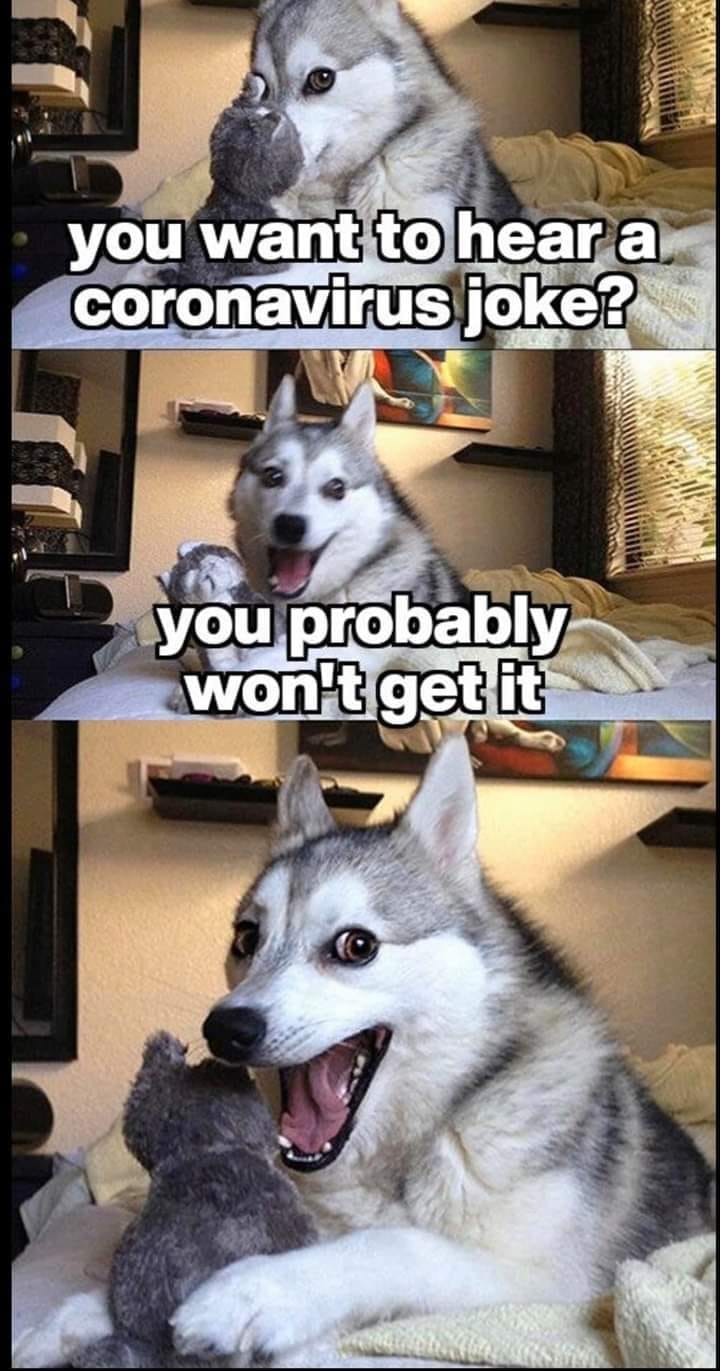
The meme features a dog with a confused expression, followed by a surprised one, and finally a laughing one. The text reads "You want to hear a coronavirus joke? You probably won't get it." This meme is a play on the idea that the COVID-19 pandemic was a major global event, and the joke is a lighthearted way to poke fun at the fact that many people were struggling to understand the virus's impact.
detailed-analysis (gemma3-27b-vision)
Okay, let's break down this meme through the lenses of the requested theoretical frameworks.
Visual Description
The image is a multi-panel meme featuring a Siberian Husky. Each panel uses a different close-up shot of the same dog, progressively changing its facial expression.
- Panel 1: The dog looks inquisitively upwards and to the left. Text overlay reads "you want to hear a coronavirus joke?".
- Panel 2: The dog is looking forward, somewhat with narrowed eyes, a slight pursing of the lips, and a more judgmental look. The text reads "you probably won't get it".
- Panel 3: The dog is positioned close to the camera, with its mouth wide open in a kind of exaggerated, almost manic grin. This panel communicates a sense of amusement or superiority.
The background appears to be a typical home interior, with a rug, and a glimpse of furniture. The overall aesthetic is simple and relies on the dog's expressions for comedic effect. The meme structure is a common "expectation vs. reality" or "setup/punchline" trope.
Postmodernism
This meme operates deeply within postmodern sensibilities.
- Meta-commentary: The meme isn’t telling a coronavirus joke. It's commenting on the possibility of telling one, or the likelihood of comprehension. This is a self-referential quality typical of postmodern art. The joke is the anticipation of a joke that never arrives.
- Irony and Humor: The humor stems from a subversion of expectations. We expect a punchline; instead, we get a commentary on the audience's potential lack of understanding. It plays on the idea that some humor requires a certain level of shared cultural or intellectual knowledge.
- Deconstruction of Meaning: The joke suggests that meaning isn’t inherent in the content (the "joke" itself) but is constructed by the audience. The meme essentially states that the joke’s success depends on the recipient's ability to "get it," implying a hierarchy of understanding.
- Simulacra and Simulation: The meme, as a digital image, is already a simulation. The "joke" exists only as a promise of a joke, a representation that lacks a real referent. It's a hyperreality where the image of a joke is more important than the joke itself.
Critical Theory
Critical Theory can be applied through the lens of the meme's implied power dynamics.
- Cultural Capital: The meme implies a division between those "in the know" and those who are not. “Getting” the joke likely requires a level of cultural awareness about the coronavirus pandemic, media surrounding it, and possibly a specific (dark) humor style. This suggests that understanding the joke is a form of cultural capital – something that provides social status.
- Dominant Discourse: The meme reflects the dominance of certain ways of thinking about the pandemic. The implicit assumption is that a coronavirus joke exists and is potentially funny. This normalizes the idea of finding humor in a traumatic event. Critical Theory would question who benefits from this normalization.
- Critique of Spectacle: The meme, being a piece of internet content, participates in the "spectacle" – a term used by Guy Debord to describe the way society is increasingly dominated by images and representations. The meme is part of the distraction and commodification of lived experience.
Marxist Conflict Theory
While not the most obvious application, a Marxist reading can focus on the meme's subtle assertion of social stratification.
- Class & Access to Culture: "Getting" the joke could be seen as a marker of a certain level of education, media exposure, or leisure time. Those with limited access to these resources might be less likely to understand the reference, reinforcing existing social inequalities.
- Ideology & Normalization: The joke's existence and implicit acceptance of finding humor in a crisis serve to naturalize certain ideologies – the idea that even trauma can be commodified and consumed. This potentially diverts attention from systemic problems.
- Alienation: While subtle, the dog's smug expression in the final panel could be interpreted as a reflection of alienation—a separation from shared human experience—that is common in capitalist society.
Foucauldian Genealogical Discourse Analysis
Foucault's approach would examine the historical power dynamics around the humor and the pandemic itself.
- Discourse of the Pandemic: The meme participates in a broader discourse surrounding the coronavirus. This includes the way the pandemic was framed in media, the policies enacted, the social responses, and the resulting narratives. The joke, even in its absent state, contributes to this discourse.
- Power/Knowledge: The ability to “get” the joke is linked to possessing certain kinds of knowledge. This knowledge is not neutral; it's shaped by power relations. For example, those who controlled the flow of information about the pandemic (governments, media outlets) also shaped the kinds of jokes that were deemed acceptable or funny.
- Genealogy of Humor: A genealogical approach would trace the historical evolution of finding humor in crises. What kinds of jokes were considered acceptable in previous epidemics? How has the way we respond to crises changed over time? This would reveal the changing power dynamics that shape our sense of humor.
Queer Feminist Intersectional Analysis
This is the most challenging lens to apply directly, but an interpretation is possible.
- The "Gatekeeping" of Humor: The meme can be seen as subtly gatekeeping humor. The implication that only certain people will "get" the joke can be connected to broader patterns of exclusion and silencing. Who gets to define what is funny, and whose experiences are marginalized?
- Trauma and Representation: A queer feminist perspective would question the assumption that finding humor in a crisis is always appropriate or helpful. For many marginalized groups, the pandemic has been a particularly traumatic experience, and jokes can be deeply invalidating.
- Intersectionality and Vulnerability: The pandemic disproportionately affected marginalized communities. A queer feminist analysis would point out that those who were most vulnerable to the virus are also likely to be the least amused by jokes about it. The meme's focus on "getting" the joke ignores the diversity of experiences and perspectives.
Disclaimer: These are interpretations based on theoretical frameworks, and the meme is open to multiple readings. The analysis can be subjective and depend on the interpreter's own biases and assumptions.
Let me know if you’d like me to delve deeper into any specific theoretical lens!
simple-description (llama3.2-vision)
This meme features a dog with a surprised expression, followed by a second image of the same dog with a shocked and angry face. The text "you want to hear a coronavirus joke? you probably won't get it" is overlaid on the images, implying that the dog is trying to warn someone that a coronavirus joke is unlikely to be funny. The meme pokes fun at the idea that coronavirus jokes are often not well-received or funny.
tesseract-ocr
ee NS ae = we Yen = you wantito)hearaie a@icoronavirus joke?, = “7 es + ff. SS 4 i ie As "Celt oTcel oye] +) \\ eae om wonit Li iz = Ye PS / a ‘\ { , my - a . caer ue! 3 - § r - ¥ ¢