First Seen
2023-05-10T21:03:35+00:00
simple-description (llama3.2-vision_11b)
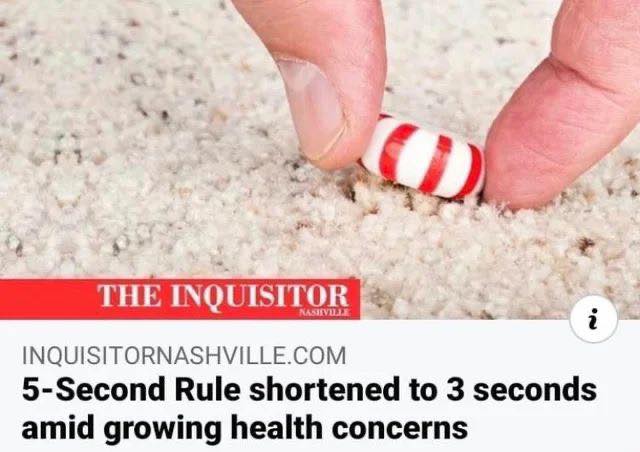
This meme is a satirical take on the 5-Second Rule, a popular internet challenge where participants have to eat a spoonful of a disgusting substance within 5 seconds. The image shows a person eating a spoonful of a substance (likely a food item) while the text "5-Second Rule" is written above it, but instead of "5-Second" it says "3-Second" to poke fun at the growing health concerns during the COVID-19 pandemic.
detailed-analysis (gemma3-27b-vision)
Okay, let's break down this image and its implied headline ("5-Second Rule shortened to 3 seconds amid growing health concerns") through a few theoretical lenses. It's important to note that applying these frameworks can be somewhat interpretive, and the depth of analysis will vary depending on the relevance of the theory to the subject matter.
1. Visual Description
The image shows a close-up of a human hand, with a visibly manicured nail (red and white striped) hovering directly over a light-colored, textured carpet. The depth of field is shallow, focusing primarily on the nail and carpet fibers immediately below it. The overall aesthetic is somewhat sterile, as if taken in a laboratory or clean environment. The image is stark; it emphasizes the boundary between the hand/nail (representing the potentially contaminating agent) and the carpet (representing the surface it could fall upon). There’s a clear sense of "impending contact" or a moment suspended in time.
2. Foucauldian Genealogical Discourse Analysis
- Discourse & Power/Knowledge: The headline and image immediately engage with a deeply ingrained societal "discourse" – the "5-second rule." This isn't a natural or inherent truth, but a constructed rule developed and perpetuated through shared understanding. Michel Foucault would argue this rule isn't about actual cleanliness, but a way of managing risk, anxiety around contamination, and establishing norms of acceptable behavior. The shortening of the rule to 3 seconds signifies a shift in this discourse – a new configuration of power/knowledge. It suggests an increased anxiety around germs and a stricter enforcement of hygiene standards.
- Genealogy: Tracing the "genealogy" of the 5-second rule would reveal that its origins aren't scientifically based, but likely emerged from cultural habits, practical considerations (avoiding waste), and perhaps a sense of playfulness or risk-taking. The changing from 5 to 3 seconds is not an objective discovery of a lower 'safe' time, but a restructuring of these habits under a perceived 'growing health concerns'.
- Discipline: The 3-second rule is a form of self-discipline – a way we internalize and enforce hygiene standards upon ourselves. We police our own behavior based on this rule, and the shortening of the rule represents a tightening of this self-regulation.
3. Critical Theory
- Commodification & Rationalization: The obsession with hygiene and the reduction of risk embodied by the shorter rule can be linked to the broader trends identified by the Frankfurt School. The reduction of 'safe' time to 3 seconds reflects the commodification of health and a rationalized, bureaucratic approach to daily life. The rule becomes a standardized procedure, prioritizing efficiency and control over other considerations.
- Culture Industry: The media's coverage of this change (as implied by the headline) contributes to the "culture industry" – the production and dissemination of standardized cultural norms and values. The headline, rather than presenting scientific evidence, relies on the already-established narrative of hygiene and risk.
4. Marxist Conflict Theory
- Ideology & Class: While less direct, we can consider how anxieties about contamination and hygiene can be used to reinforce class divisions. Access to cleaning products, sanitized environments, and healthy food are not equally distributed. A heightened emphasis on hygiene can implicitly blame individuals for illness, obscuring the social and economic factors that contribute to health disparities.
- Control & Surveillance: The obsession with cleanliness can be seen as a form of social control, promoting conformity and suppressing dissent. A society fixated on eliminating germs is a society more easily monitored and regulated.
5. Postmodernism
- Hyperreality & Simulation: The 3-second rule is a prime example of a “hyperreal” construct. It appears to be grounded in objective reality (germs, contamination), but it's actually a symbolic construct – a simulation of cleanliness that has little to do with actual safety. The rule gains meaning not from its scientific validity, but from its social and cultural significance.
- Deconstruction: A postmodern analysis would “deconstruct” the 5/3-second rule, revealing its inherent contradictions and ambiguities. The rule is arbitrary, based on an illogical premise, and ultimately fails to address the complex reality of microbial life. The arbitrary change to 3 seconds highlights the constructed nature of the 'rule'.
- Loss of Grand Narratives: The change reflects the breakdown of grand narratives about health and safety. Rather than trusting in universal principles, we are subjected to ever-changing guidelines and expert opinions, leading to a sense of uncertainty and anxiety.
6. Queer Feminist Intersectional Analysis
- The Politics of Care: The focus on hygiene is often linked to gendered expectations around domestic labor and caregiving. Women are disproportionately expected to maintain cleanliness and protect others from contamination. The 3-second rule can reinforce these expectations, placing a greater burden on women to manage risk and maintain a "safe" environment.
- Bodily Autonomy & Risk: The obsession with eliminating germs can be seen as a form of control over the body, denying individuals the right to engage with their environment and develop their own immune systems. It’s a form of disciplinary power that restricts bodily autonomy.
- Intersectional Concerns: Access to resources (cleaning supplies, sanitation) and the ability to adhere to hygiene standards are not evenly distributed. Marginalized communities – those facing poverty, discrimination, or limited access to healthcare – are often disproportionately affected by health concerns and face greater scrutiny around cleanliness.
Let me know if you’d like any of these sections elaborated upon, or if you'd like me to explore a different theoretical lens!
simple-description (llama3.2-vision)
The meme is a screenshot of an article from The Inquisitor, a satirical news source. The article's title is "5-Second Rule Shortened to 3 Seconds Amid Growing Health Concerns". The image is likely a joke about a food safety rule, but I couldn't find the actual image or text.
tesseract-ocr
J © . i ey \ rae a 3 eee 7, we is 1 ey Fee i |S ‘ . Te MONSON INQUISITORNASHVILLE.COM 5-Second Rule shortened to 3 seconds amid growing health concerns