First Seen
2023-05-10T21:03:35+00:00
simple-description (llama3.2-vision_11b)
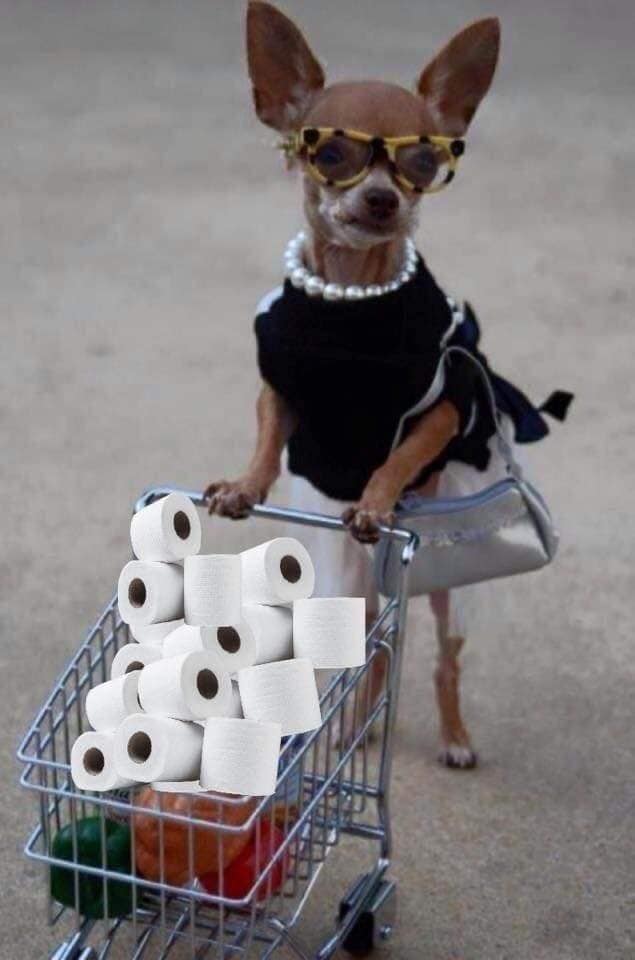
The meme features a dog wearing a human-like outfit and pushing a shopping cart filled with toilet paper, a popular item during the COVID-19 pandemic. The image is captioned "I'm not hoarding, I'm just preparing for the apocalypse."
detailed-analysis (gemma3-27b-vision)
Okay, here's an analysis of the image, broken down into sections addressing the requested theoretical lenses, only where relevant. Given the nature of the image, some sections will be more robust than others.
Visual Description
The image features a small, hairless chihuahua dog dressed in a stylized, somewhat theatrical outfit. The dog is wearing sunglasses, a pearl necklace, and a black, fitted dress with white trim. It is ‘shopping’ with a miniature silver shopping cart overflowing with rolls of toilet paper. The background is a gray concrete surface, likely a parking lot or sidewalk. The lighting is bright, suggesting an outdoor setting. The dog's forward gaze and positioning suggest it is actively "shopping" or presenting itself as a consumer. The overall effect is humorous and slightly absurd, creating a sense of artificiality and performance.
Foucauldian Genealogical Discourse Analysis
This image can be analyzed through a Foucauldian lens by examining how power dynamics are manifested through the construction of "dogness" and consumption.
- Discipline & Subjectification: The act of dressing the dog in human clothing and placing it in a human-like situation (shopping) disciplines the animal, imposing human norms onto it. This creates a subject – a "dressed-up dog consumer" – that wouldn't naturally exist. The dog, through this performance, is constructed as a specific kind of object within a human system of meaning.
- Power/Knowledge: The image demonstrates the power dynamic where humans define and categorize animals, shaping our understanding of what is "normal" for them. The knowledge that dogs don't shop is central to the humor. The image plays with that knowledge, challenging it in a playful, if superficial, way.
- Genealogy of "Pet": The image hints at the historical development of the concept of the “pet” – an animal constructed as a companion and object of human affection and display. The elaborate clothing and "shopping" can be seen as an extension of historical trends of objectifying and controlling animals for aesthetic or social purposes.
- Toilet Paper as Discourse: The abundance of toilet paper itself can be interpreted as a discourse – a system of thought and meaning. In the context of the COVID-19 pandemic, excessive toilet paper purchasing became a symbol of anxiety and hoarding, making its prominence in the image subtly loaded.
Critical Theory
The image can be seen as a commentary on consumer culture and the construction of identity.
- Commodity Fetishism: The dog, dressed up and engaged in the act of "shopping," can be seen as an extension of commodity fetishism – the attribution of value to objects beyond their practical use. The dog becomes a spectacle, an object of entertainment, rather than a living creature.
- The Spectacle: The staged scene contributes to "the spectacle" (as theorized by Guy Debord). The dog's performance of shopping is not about genuine need but about display and image-making. The act of shopping is divorced from its functional purpose and transformed into a visual experience.
- Alienation: The dog’s participation in human consumer behavior could be seen as a metaphorical representation of alienation. It is removed from its natural state and inserted into a system that is not designed for its well-being, albeit in a comical and playful manner.
- Artificiality & Simulation: The entire scene feels deeply artificial. The dog is a simulation of a consumer, the shopping is staged, and the abundance of toilet paper feels contrived. This speaks to a broader trend of increasing simulation and hyperreality in contemporary culture.
Marxist Conflict Theory
While not overtly addressing class struggle, the image subtly touches upon themes that can be interpreted through a Marxist lens.
- Consumerism & Capital: The image epitomizes consumerism. It highlights the act of buying and accumulation – in this case, toilet paper – as a driving force in society. The abundance of toilet paper can be seen as a symbol of excess and waste within a capitalist system.
- Commodification of Animals: The dog, as a "dressed-up shopper," is a commodity—an object to be consumed for entertainment or aesthetic pleasure. This reflects the commodification of all aspects of life under capitalism.
- False Needs: The image indirectly touches on the creation of "false needs" under capitalism. The abundance of toilet paper is arguably beyond what is necessary, suggesting a system that encourages excess and accumulation beyond genuine needs.
Postmodernism
The image embodies several key characteristics of postmodernism:
- Pastiche & Hyperreality: The image is a playful pastiche – a combination of seemingly incongruous elements (a hairless dog, designer clothes, a shopping cart). This creates a sense of hyperreality – a simulation that blurs the lines between reality and representation.
- Irony & Self-Reflexivity: The image is inherently ironic. It mocks the conventions of consumerism and the human tendency to project meaning onto non-human entities. It's a self-reflexive commentary on our own culture.
- Deconstruction of Meaning: The image undermines traditional notions of "dogness" and "shopping." It challenges our assumptions about what these concepts mean and suggests that meaning is fluid and constructed.
- Playfulness & Absurdity: The image is fundamentally playful and absurd. It embraces a sense of humor and challenges the seriousness of conventional representations.
Queer Feminist Intersectional Analysis
This is the most challenging lens to apply directly to the image, but some points can be made:
- Performance & Gender: The act of dressing the dog in clothing, especially the dress and pearls, can be seen as a performance of femininity—a construction of gender rather than an inherent quality. The dog, as a non-human entity, disrupts the binary of gender by embodying a performance of femininity in a way that challenges conventional understandings.
- Objectification: The dog is being objectified—turned into a visual spectacle for human consumption. This can be linked to broader feminist concerns about the objectification of bodies—both human and animal.
- Non-Human Animal Agency: While the dog is being dressed by a human, and thus its agency is limited, the image can be read as an exploration of animal subjectivity and the complexities of human-animal relationships. It prompts us to consider how we perceive and interact with non-human beings.
Let me know if you'd like me to elaborate on any of these sections or explore a different theoretical framework!
simple-description (llama3.2-vision)
The meme features a photo of a dog, likely a Chihuahua, dressed in a miniature business suit and wearing sunglasses. The dog is standing in front of a shopping cart filled with toilet paper rolls, with the text "When you realize you're going to need a lot of toilet paper for the next 4 years" appearing above the image. The meme is a humorous commentary on the COVID-19 pandemic and the subsequent toilet paper shortages.
tesseract-ocr
“Lace th kA y rae , id)... iT / \ oo .< . ° &: 4 J + Vi; > go 2 \ > z Pol i zu, ® e 4 Kun Mae sy ia Mae ct see C |. we i f Mas t aie d F <u 4 i Vp eyes = eye