First Seen
2023-05-10T21:03:35+00:00
simple-description (llama3.2-vision_11b)
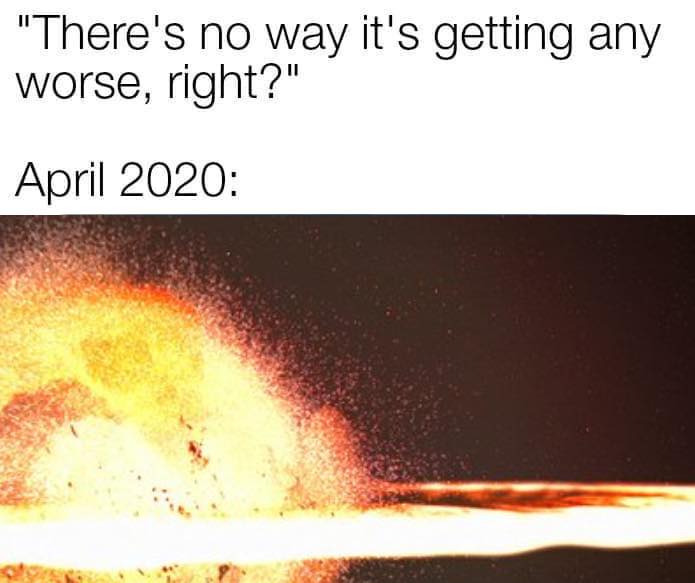
The meme is a humorous commentary on the chaotic and unpredictable nature of 2020, particularly during the COVID-19 pandemic. The image shows a massive explosion, symbolizing the chaos and turmoil of that year. The text "There's no way things could get worse, right?" is a tongue-in-cheek comment on the absurdity of the year's events, implying that even the most catastrophic events were still possible.
detailed-analysis (gemma3-27b-vision)
Okay, here's an analysis of the image, broken down into sections based on the requested theoretical frameworks. It's important to note that applying all of these frameworks to a single meme is a bit of an exercise—these are complex theories and aren't necessarily meant to be layered this way. I'll highlight how aspects of the image resonate with each, even if it feels somewhat stretched in places.
Visual Description
The image is a two-panel meme. The top panel features text in white against a dark background that reads: “There’s no way it’s getting worse, right?” followed by "April 2020." The bottom panel displays a dramatic image of a massive, fiery explosion. The explosion dominates the visual field with intense orange and yellow flames radiating outwards against a dark backdrop. The scale of the explosion is vast and evokes a sense of overwhelming chaos and destruction. The imagery is clearly intended to be hyperbolic and dramatic, using a visually striking representation of disaster.
Foucauldian Genealogical Discourse Analysis
The meme speaks to a shift in the discourse surrounding the beginning of the COVID-19 pandemic. The question “There’s no way it’s getting worse, right?” represents a moment before the full scope of the pandemic’s impact was understood. Foucault's genealogical method would trace the historical emergence of this question and the assumptions underlying it. What pre-existing power/knowledge structures informed the initial framing of the pandemic?
- Power/Knowledge: Initially, there was a struggle to define the “truth” of the pandemic. The question implies a belief that the worst of the early panic was behind us. The explosive image disrupts that narrative, revealing how initial assumptions about containment and severity were fundamentally flawed.
- Disciplinary Practices: The image implicitly critiques the early attempts to “normalize” the pandemic—to reassure people things weren't that bad. It reveals how such narratives functioned as a disciplinary practice, attempting to control anxiety and shape public behavior.
- Historical Contingency: The explosion illustrates that the situation was not fixed or inevitable. The question, and the image’s response to it, highlight the contingency of the pandemic's trajectory. The situation was constantly evolving, and the early optimistic framing was revealed as a misinterpretation of unfolding events.
Critical Theory
From a critical theory perspective, the meme reveals the contradictions inherent in late-capitalist society and its attempts to control and rationalize crisis.
- Reason & Irrationality: The question represents a desire for rational reassurance—a need to believe in a predictable and controllable world. The explosion is the irrational counter-response—the breakdown of that order. Critical theorists (like Adorno and Horkheimer) would argue that this represents the inherent tensions within the "Enlightenment project"—the promise of reason constantly undermined by the realities of social and political power.
- Commodification of Crisis: The meme itself participates in a culture that frequently commodifies crisis—turning it into a meme or shared cultural moment. This can serve to neutralize the seriousness of the issue and mask underlying systemic problems.
- Dominant Ideology: The initial question, implicitly, represents the perspective of a privileged position – one where containment or a return to “normal” feels possible. The explosion challenges that perspective, exposing the disproportionate impact of the crisis on marginalized communities.
Marxist Conflict Theory
From a Marxist lens, the image can be understood as representing the inherent contradictions within capitalism and how crises exacerbate existing class conflict.
- Exploitation & Crisis: The pandemic and its associated economic fallout disproportionately impacted working-class communities and exposed the vulnerabilities of essential workers. The explosion could be seen as a metaphor for the breakdown of the existing economic system.
- The State & Crisis: The initial question represents a belief in the state's ability to manage the crisis and restore order. The explosion suggests the failure of those mechanisms, highlighting the limitations of capitalist institutions in addressing systemic problems.
- Class Struggle: The image implicitly points to a situation where the costs of the crisis are not evenly distributed. The initial optimism of the question might be linked to those who were insulated from the worst effects of the pandemic, while the explosion represents the devastation experienced by those who were most vulnerable.
Postmodernism
From a postmodern perspective, the meme's effectiveness lies in its ironic and self-referential quality. It operates on multiple levels, acknowledging the absurdity of the situation and challenging the idea of a single, coherent narrative.
- Simulacra & Simulation: The explosion itself is a simulacrum—a representation of a crisis that has become detached from its reality. It’s a visual metaphor that stands in for the complex and overwhelming experience of the pandemic.
- Deconstruction of Grand Narratives: The meme implicitly deconstructs the “grand narrative” of progress and stability. It exposes the fragility of our social and economic systems and challenges the idea that we can ever fully control the forces of history.
- Irony & Parody: The contrast between the naive question and the explosive image creates a sense of ironic distance. It acknowledges the absurdity of the situation and invites the viewer to question the dominant narratives surrounding the pandemic.
Queer Feminist Intersectional Analysis
While not as directly evident, an intersectional analysis can highlight how the pandemic disproportionately impacted queer, trans, and non-binary people, and how those experiences were often ignored or minimized.
- Multiple Oppressions: The pandemic exacerbated existing inequalities based on gender, race, sexuality, and disability. Queer and trans individuals, particularly those from marginalized communities, faced increased rates of unemployment, housing instability, and violence.
- Erasing Marginalized Experiences: The initial question, reflecting a privileged perspective, implicitly erases the experiences of those who were most vulnerable during the pandemic. The explosion can be seen as a metaphor for the way in which the voices and needs of marginalized communities were silenced or ignored.
- Care Work & Exploitation: The pandemic exposed the vital role of care work, which is disproportionately performed by women and gender-nonconforming individuals. The explosion could represent the breaking point – the exhaustion and burnout experienced by those who were forced to shoulder the burden of care during the crisis.
I hope this provides a thorough analysis, covering all the requested theoretical frameworks. Let me know if you'd like me to expand on any specific point or delve deeper into a particular theory!
simple-description (llama3.2-vision)
This meme is a humorous commentary on the chaotic and unpredictable nature of 2020. The image is likely a dramatic and intense visual, such as a massive explosion or a catastrophic event. The text "In 2020: 'There's no way things can get worse'" is a sarcastic commentary on the year's many challenges and disasters, implying that the year's struggles were already at a peak by April.
tesseract-ocr
"There's no way it's getting any worse, right?" April 2020: = Baila Oe