First Seen
2023-05-10T21:03:35+00:00
simple-description (llama3.2-vision_11b)
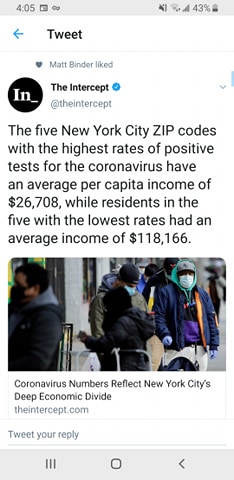
The meme is a tweet from "The Intercept" that highlights the five New York City zip codes with the highest rates of positive COVID-19 tests. The tweet notes that these areas have an average per capita income of $26,708, which is lower than the average income of $118,166 in the five other areas with the lowest rates.
detailed-analysis (gemma3-27b-vision)
Here’s an analysis of the image of the Twitter post broken down by the requested theoretical frameworks. It's worth noting that applying all of these frameworks to one image can be somewhat forced, but I'll aim to provide relevant insights for each applicable one.
Visual Description
The image is a screenshot of a Twitter post from "The Intercept". The post features text stating that the five New York City ZIP codes with the highest rates of positive coronavirus tests have an average per capita income of $26,708, while the five ZIP codes with the lowest rates have a per capita income of $118,166. Below the text is an image of a group of delivery drivers (likely food delivery) on motorcycles/scooters. They are wearing masks, helmets, and protective gear. They appear to be stopped, likely at a traffic light or intersection. The background suggests a city street. The Twitter post also includes a link to an article titled "Coronavirus Numbers Reflect New York City’s Deep Economic Divide."
Marxist Conflict Theory
This tweet is highly relevant to Marxist Conflict Theory. The core of this theory revolves around class struggle and the inherent contradictions within capitalist systems.
- Class Disparity: The presented data directly illustrates the connection between socioeconomic status and vulnerability to a public health crisis. The higher incidence of positive tests in lower-income zip codes demonstrates how economic inequality creates unequal access to resources needed to protect oneself from the virus (healthcare, ability to work from home, quality housing, nutritious food).
- Exploitation & Essential Workers: The image of the delivery drivers reinforces this idea. These are workers performing “essential” labor, often at low wages and with increased risk of exposure, because their labor is needed to keep the economy functioning. They symbolize the working class who disproportionately bear the brunt of crisis.
- Systemic Issues: The post isn’t merely about individual circumstances; it points to systemic failures within the capitalist structure that lead to such stark inequalities. It's not an accident that poorer neighborhoods are more affected – it's a result of the way the system is organized.
- Ideology: The media (here, “The Intercept”) highlighting this issue can be seen as countering the dominant ideology that often obscures class-based disparities.
Critical Theory
Critical Theory, in general, expands upon Marxist ideas and focuses on power structures and the domination of one group over another.
- Power & Knowledge: The post demonstrates how knowledge (in this case, epidemiological data) is intimately tied to power. The collection of this data, the interpretation of it, and the dissemination of it all happen within power dynamics. "The Intercept" is using this knowledge to expose imbalances in power.
- Critique of Rationality: A critical theorist might question the "rationality" of a system that allows such disparities to exist. A supposedly “efficient” system is clearly creating massive health risks for certain groups.
- Emancipation: Implicit in the post is a call for social change. By highlighting the problem, "The Intercept" is implicitly advocating for policies and systems that would reduce inequality and improve public health.
Foucauldian Genealogical Discourse Analysis
A Foucauldian approach would focus on the discourse surrounding the pandemic and the way this discourse shapes our understanding of it.
- Discourse of Health & Risk: The post is part of a broader discourse around health, risk, and social vulnerability. The way we talk about the virus (e.g., focusing on “individual responsibility” vs. “systemic failures”) shapes how we respond to it.
- Power/Knowledge: Foucault would emphasize that the very categories we use to understand the pandemic (e.g., “positive cases”, “economic divide”, “essential workers”) are not neutral but are shaped by power relations.
- Genealogy of Inequality: A genealogical analysis might trace the historical development of the economic inequalities that have made these zip codes more vulnerable. It wouldn't simply look for a cause of the problem but would examine the complex historical forces that have shaped the present situation.
- Biopower: This tweet can be connected to Foucault’s concept of “biopower”, which refers to the ways in which states and institutions seek to regulate and control populations through interventions in public health, hygiene, and sanitation. The disparities in rates of infection suggest that biopower is not equally applied to all segments of the population.
Postmodernism
A postmodern perspective would question the notion of objective truth and emphasize the subjective and fragmented nature of reality.
- Deconstruction of Narratives: Postmodernists might deconstruct the narrative of a "unified" response to the pandemic, highlighting how different groups experience it in radically different ways.
- Rejection of Grand Narratives: The idea of a single, universal solution to the pandemic would be viewed with skepticism. Postmodernists would emphasize the importance of local knowledge and context-specific solutions.
- Simulacra and Simulation: One could argue that the representation of the pandemic in media (like this tweet) is a simulation of reality, potentially obscuring more complex underlying issues.
Queer Feminist Intersectional Analysis
While not the primary focus of this tweet, an intersectional lens can add nuance:
- Interlocking Systems of Oppression: Intersectional feminism recognizes that inequalities based on class are often intertwined with other forms of oppression (e.g., race, gender, sexuality). It’s likely that residents in those zip codes are also disproportionately from marginalized racial/ethnic groups.
- Gendered Impact: The economic impact of the pandemic and lockdown measures often disproportionately affect women, particularly women of color, who are overrepresented in low-wage essential work.
- Care Work: The burdens of care work (childcare, eldercare) often fall disproportionately on women, and those in lower-income zip codes may have less access to affordable care.
Important Note: These are just interpretations, and different theoretical frameworks can lead to different readings of the same image. The richness of these frameworks lies in their ability to illuminate different aspects of complex social phenomena.
simple-description (llama3.2-vision)
The meme is a screenshot of a tweet from The Intercept, a news organization. The tweet reports on a study that found the top 5 zip codes in New York City with the highest rates of COVID-19 testing are also among the city's poorest areas. The text reads, "The five New York City ZIP codes with the highest rates of positive tests for the coronavirus have an average per capita income of $26,708, while residents in the five with the lowest rates have an average income of $18,166."
tesseract-ocr
< Tweet @ ‘The Intercept © The five New York City ZIP codes with the highest rates of positive tests for the coronavirus have an average per capita income of $26,708, while residents in the five with the lowest rates had an average income of $118,166. Coronavirus Numbers Reflect New York Citys Deep Economie Dvide MW o <