First Seen
2023-05-10T21:03:35+00:00
simple-description (llama3.2-vision_11b)
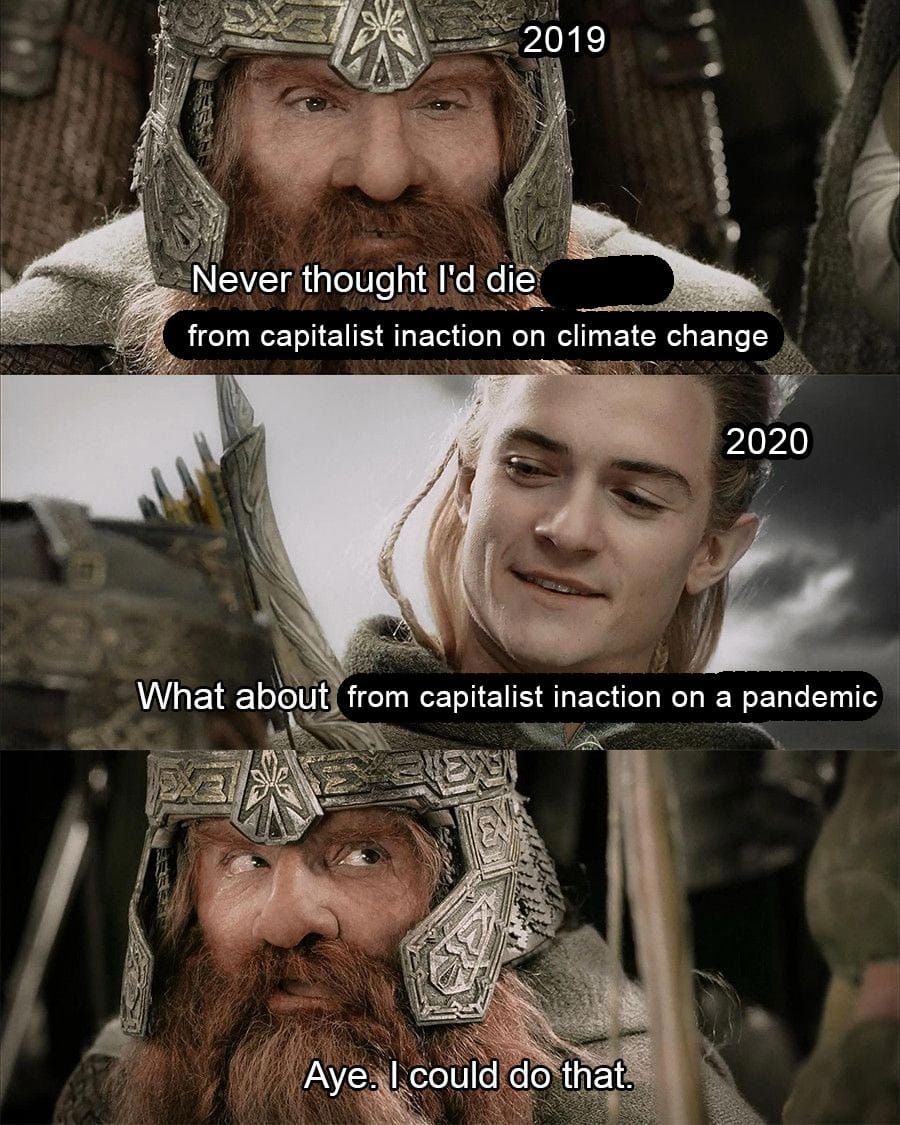
The meme is a humorous take on the COVID-19 pandemic, comparing the fear of death from the virus to the fear of death from climate change. The image features a character from the Lord of the Rings, a dwarf named Dwarflord, who is saying "Never thought I'd die from capitalist inaction on climate change" in 2019, and then in 2020, "What about from capitalist inaction on a pandemic?" The joke is that the character is now worried about dying from a pandemic, which is ironic given the previous concern about climate change.
detailed-analysis (gemma3-27b-vision)
Okay, here's an analysis of the meme, broken down into sections according to your requested theoretical frameworks. Note that not every framework neatly applies – this is intentional, as forcing them would be unproductive. I'll explain why in certain cases.
Visual Description
The meme utilizes a three-panel format based on a scene from The Lord of the Rings: The Two Towers. The scene features Aragorn, Legolas, and Gimli, seemingly in a somber or reflective moment.
- Panel 1 (2019): Aragorn looks pensive, with text overlaid reading, "Never thought I'd die from capitalist inaction on climate change."
- Panel 2 (2020): Legolas is shown looking at Aragorn, and the text asks, "What about…from capitalist inaction on a pandemic?"
- Panel 3: Gimli, in the final panel, responds with a firm "Aye. I could do that."
The meme plays on the dramatic tone of the scene and subverts it by applying it to socio-political concerns—first climate change, then the pandemic— framing them as potential causes of death attributable to systemic failures driven by capitalism. The use of characters from a fantasy epic adds a layer of ironic commentary, contrasting grand narratives of heroism with mundane and tragic contemporary realities.
Foucauldian Genealogical Discourse Analysis
This framework is highly relevant. The meme relies heavily on the construction of “truths” about the causes of death (climate change and pandemic) and how those are linked to “capitalist inaction.” A Foucauldian analysis would examine the historical discourses (the ways we talk about these issues) that have led to this specific framing.
- Power/Knowledge: The meme implies a power dynamic where those in control of capital produce the knowledge that minimizes environmental damage or pandemic preparedness. This isn’t necessarily a direct conspiracy, but rather how the focus of discourse, funding, and policy are shaped to prioritize profit.
- Genealogy: The meme isn't just stating a fact, but tracing a line of causality from historical capitalist practices to contemporary crises. The "inaction" is not a single event but a process, a lineage of decisions rooted in a specific economic system. The meme implies a genealogy of disaster – tracing the roots of these crises back to the structures and ideologies of capitalism.
- Discipline & Normalization: The meme subtly challenges the "normal" narratives around death (natural causes, accident, etc.) and re-frames it as a consequence of systemic issues. It pushes for a shift in understanding that recognizes how societal structures contribute to mortality.
Critical Theory
Critical Theory is also strongly applicable. The meme directly critiques existing power structures.
- Ideology: The meme deconstructs the ideology that capitalism is a neutral or inherently beneficial system. It points to how it can generate conditions that lead to harm and death, challenging the idea that “progress” and “growth” always come at a positive cost.
- Emancipation: Though concise, the meme carries an implied call for emancipation. By framing death as a consequence of systemic injustice, it suggests the need to fundamentally alter the systems that produce such outcomes. It’s a subtle plea for a more just and sustainable social order.
- Reason & Rationality: The meme suggests a failure of “instrumental reason” – the belief that reason should be used solely to achieve practical ends (like profit) without regard for ethical or social consequences. The “inaction” implies a prioritization of short-term gain over long-term well-being.
Marxist Conflict Theory
This is a foundational layer for understanding the meme.
- Class Struggle: The “capitalist inaction” directly points to the interests of the ruling class (capitalists) and their prioritization of profit over the welfare of the working class and the environment. The meme suggests that those who benefit from the system are unwilling to address issues that might threaten their economic power.
- Base & Superstructure: The meme connects the “base” (the economic system) to the “superstructure” (social institutions, ideologies, and even death). It suggests that the fundamental economic arrangements shape the social conditions and ultimately determine who lives and who dies.
- Alienation: The meme implicitly speaks to a sense of alienation – a feeling of powerlessness and disconnection from the systems that govern our lives. The implication is that people are dying because of forces beyond their control, orchestrated by those who profit from the status quo.
Postmodernism
Postmodernism's relevance is more nuanced.
- Meta-Narratives: The meme subverts the grand narrative of heroic fantasy by applying it to contemporary political concerns. It questions the idea that there is a single, overarching narrative about how the world works, instead suggesting a fragmented and ironic reality.
- Deconstruction: While not a fully developed deconstruction, the meme starts to dismantle the notion that capitalism is inherently neutral or beneficial. It asks us to question the assumptions underlying our economic system.
- However, the meme doesn't fully embrace the relativism central to postmodernism. There's a clear moral judgment being made—capitalist inaction is bad.
Queer Feminist Intersectional Analysis
This framework is the least directly applicable, but not entirely absent.
- Intersectionality: While the meme doesn't explicitly address issues of gender, race, or sexuality, it’s important to note that the impacts of climate change and pandemics are disproportionately felt by marginalized communities. A queer feminist analysis would highlight how these crises exacerbate existing inequalities and target vulnerable populations. The meme, implicitly, is applicable to anyone harmed by this system.
- Power Dynamics: The meme speaks to broader power dynamics that intersect with capitalism. The prioritization of profit over human well-being reflects patriarchal, colonial, and other oppressive systems.
In Conclusion:
The meme is surprisingly rich in theoretical layers. It’s most directly informed by Marxist Conflict Theory and Critical Theory, which provide the foundational framework for understanding its critique of capitalism. Foucauldian Discourse Analysis helps unpack the construction of knowledge around these crises, while Postmodernism adds a layer of ironic subversion. While Queer Feminist Intersectional Analysis isn’t central, it reminds us of the unequal impacts of these systems. The meme's effectiveness lies in its concise and ironic application of a fantasy trope to a deeply serious contemporary issue, prompting viewers to consider the systemic factors that shape our lives and deaths.
Let me know if you'd like me to elaborate on any of these points, or analyze the meme from a different theoretical perspective.
simple-description (llama3.2-vision)
This meme is a humorous commentary on the challenges of adapting to the COVID-19 pandemic. The image features a character from the Lord of the Rings, Aragorn, responding to a friend's existential crisis about the pandemic. The text reads: "Never thought I'd die from capitalist inaction on climate change" and "What about from capitalist inaction on a pandemic?"
tesseract-ocr
USO ENN FSS IWAN ee Py - F SUR ye on ie TAs e > 7 a “ = | , ’ fe. ES Se Ba ii : Cy ey < ‘SI a ° é Ay ee ee ANN a alelie) asi Ke Kel a from capitalist inaction on climate change aes, 64 . a PK TS “Se er 2 | = _ Bed a) / jal ‘ ee rs rN . eee r : » . ia 7 y) ' What about ‘from capitalist inaction on a pandemic Ps a al = es es ; el C\ aN © ws EAN. ~~ \ Ak je see SQ Ct a a Os SI q wee y al N ee SIS om ee Mile Lt J a Se oe oO adie eceliliecleiiicle |