First Seen
2023-05-10T21:03:35+00:00
simple-description (llama3.2-vision_11b)
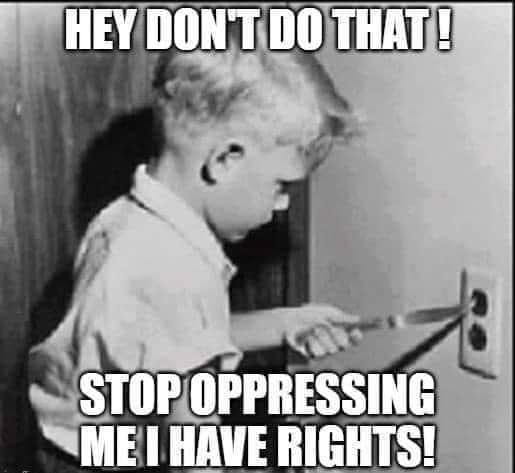
This meme is a black-and-white image of a young boy standing on a chair to reach a light switch, with a caption that reads "Hey don't do that! Stop oppressing me, I have rights!" The image is a humorous commentary on the challenges of growing up and the need for independence. The boy's request to be treated as an adult is ironic, as he is still a child and should not be expected to have the same level of autonomy.
detailed-analysis (gemma3-27b-vision)
Okay, let's break down this meme through the lenses of various theoretical frameworks. It's a complex image, and each framework offers a distinct perspective.
Visual Description
The image is a black and white photograph of a young boy attempting to insert a knife into an electrical socket. The boy appears focused and determined. The photograph is overlaid with text: "HEY DON'T DO THAT!" in white lettering at the top and "STOP OPPRESSING ME I HAVE RIGHTS!" in white lettering at the bottom. The overall effect is jarring and darkly humorous, playing on the juxtaposition of a dangerous act with a melodramatic assertion of rights. The quality suggests it’s an older photograph, possibly sourced from a safety campaign or educational material.
Foucauldian Genealogical Discourse Analysis
This meme is rife with potential for a Foucauldian analysis. Foucault’s concepts of power/knowledge and discourse are relevant.
- Power/Knowledge: The image evokes a discourse of safety and discipline. Traditionally, the warning "DON'T DO THAT!" is an exercise of power aimed at controlling the child’s behavior. However, the child's counter-assertion "STOP OPPRESSING ME I HAVE RIGHTS!" reinterprets this control as oppression. It frames the safety measure not as a benevolent act, but as a denial of the child's autonomy. This is a fascinating shift in the power dynamic.
- Discourse of Rights: The child appropriates the language of "rights," a discourse usually associated with legal and political contexts. By applying it to a simple act of self-endangerment, the meme disrupts the expected boundaries of this discourse. The phrase has become so ubiquitous in modern culture that it's often used without clear reference to what those rights actually are or the responsibilities that accompany them. This leads to a situation in which it is divorced from its original context, and used as a tool to avoid accountability.
- Genealogy of Safety: A genealogical approach could trace the historical development of safety discourses – how we’ve come to define dangerous behavior, and the justifications we use for intervening. This meme can be seen as a parody of that history, exaggerating the sense of control and restriction.
Critical Theory
From a Critical Theory perspective, the meme highlights the potential for resistance against systems of control and normalization.
- Ideology Critique: The warning "DON'T DO THAT!" represents a societal norm aimed at enforcing a specific behavioral standard. The child's retort can be seen as a rejection of this norm, even if it's a nonsensical one. The meme exposes the underlying power dynamics within seemingly benign instructions.
- Subject Formation: Critical Theory emphasizes how individuals are shaped by social forces. The child's assertion of rights suggests a growing awareness of subjectivity and a desire to assert agency, even in a reckless manner. The act can be seen as an attempt to escape the limitations imposed by adult authority.
- The Rationality of Domination: The meme also touches on the idea that even ostensibly rational attempts to protect others can be forms of control. The child's response implies that even well-intentioned interventions can be perceived as oppressive.
Marxist Conflict Theory
Although less direct, a Marxist interpretation can be attempted.
- Power Struggle: The meme can be seen as a miniature depiction of class conflict. The adult (represented by the warning) embodies the dominant force attempting to impose its will, while the child represents a subordinate group challenging that authority.
- False Consciousness: The child's irrational assertion of rights could be viewed as a form of "false consciousness" – a misdirected sense of empowerment that doesn’t address the underlying structural inequalities. The child thinks they are asserting agency, but their actions are ultimately self-destructive.
- Rebellion: It represents a rebellious act against the established order, a rejection of conventional wisdom.
Postmodernism
The meme screams Postmodernism.
- Deconstruction of Meaning: The image deliberately disrupts the expected relationship between warning and action. The text undermines the authority of the warning, creating a sense of absurdity.
- Irony and Parody: The meme is highly ironic, juxtaposing a dangerous act with a melodramatic claim of rights. It parodies both safety discourses and the current obsession with individual rights.
- Rejection of Grand Narratives: Postmodernism challenges overarching explanations of reality. This meme rejects the idea of a single, universal standard of safety. It embraces a fragmented, subjective understanding of the world.
Queer Feminist Intersectional Analysis
This is the most tenuous application, but some connections can be drawn.
- Subversion of Expectations: The image subverts expectations of childhood innocence and obedience. It represents a challenge to the traditional power dynamics between adults and children.
- The Right to Self-Destruction: A Queer Feminist reading might examine the idea of the right to self-determination, even when that determination leads to self-destructive behavior. This could be linked to debates about bodily autonomy and the rejection of societal norms.
- Intersectional Power Dynamics: While the image focuses on the child-adult dynamic, it’s possible to see it as a metaphor for broader power imbalances. The child’s claim of rights could represent a marginalized group demanding recognition and autonomy.
Important Note: It's crucial to recognize that these theoretical frameworks are tools for analysis. The meme is open to multiple interpretations, and the most relevant framework will depend on the specific context and goals of the analysis. Some frameworks fit the image better than others.
Let me know if you’d like me to expand on any of these analyses!
simple-description (llama3.2-vision)
This meme is a black-and-white image of a young boy, likely from the 1950s or 60s, standing in front of a TV or radio, with a shocked expression on his face. The text "I have rights!" is written above his head, and the text "I have a right to know" is written below. The image is captioned with the phrase "I have rights! I have a right to know!" which is a quote from the 1954 Supreme Court case Brown v. Board of Education.
tesseract-ocr
SL TL Ey . ey | FR SU a SL SETA