First Seen
2023-05-10T21:03:35+00:00
simple-description (llama3.2-vision_11b)
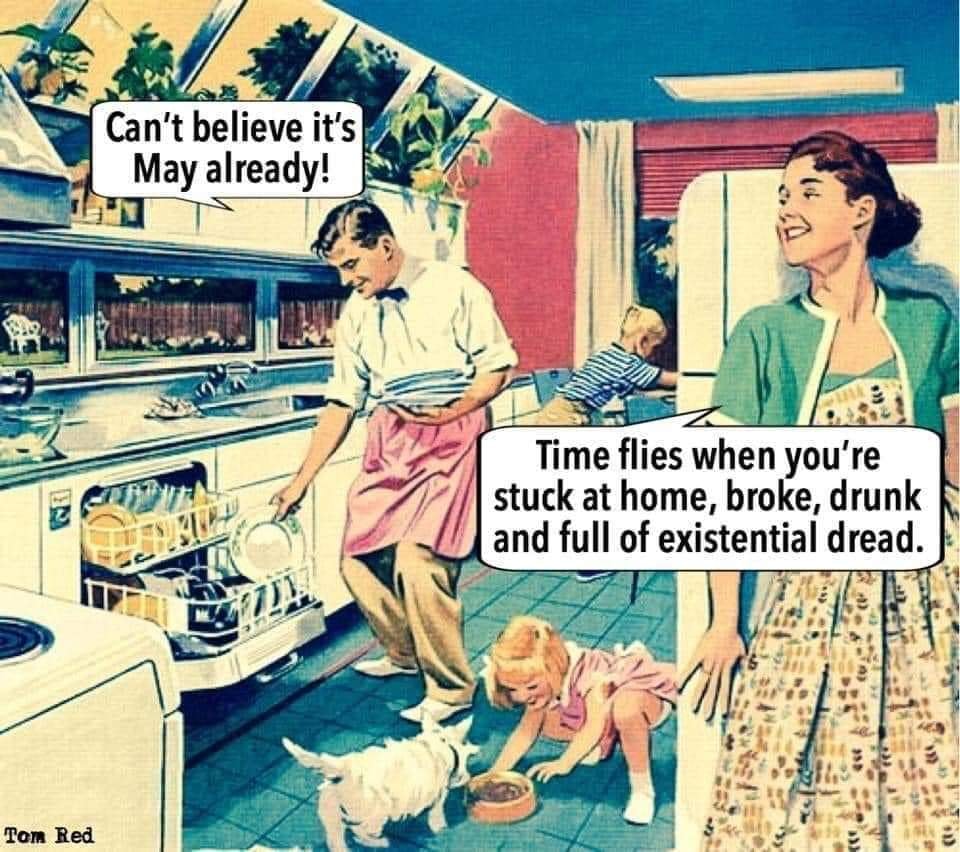
This meme is a humorous commentary on the COVID-19 pandemic's impact on daily life, with a focus on the irony of a family's normal routine being disrupted by the virus. The image shows a family in a 1950s-style kitchen, with a father saying "Can't believe it's already May" and a mother responding with a darkly humorous comment about the current state of the world. The text "Time flies when you're stuck at home, broke, drunk and full of existential dread" is a witty commentary on the challenges of living through a pandemic.
detailed-analysis (gemma3-27b-vision)
Okay, here's an analysis of the image, broken down into the requested sections, applying relevant theoretical frameworks. I will only include sections where the image lends itself to that framework.
Visual Description
The image is a digitally altered vintage advertisement or illustration, likely from the 1950s, in the style of Norman Rockwell. It depicts a domestic scene: a man is frantically (and comically) taking dishes out of a dishwasher, looking distressed. A woman stands near a doorway, looking equally unsettled, though less actively chaotic. Two small children are present. One is standing looking at the father, and one is attempting to feed a small dog something off a plate. The background shows a mid-century modern kitchen, with bright colors and a large window.
The image is overlaid with text, presented as thought bubbles. The man's thought bubble reads, "Can’t believe it’s May already!” The woman's reads, "Time flies when you’re stuck at home, broke, drunk and full of existential dread." The artist's signature, "Tom Red," is visible in the bottom left corner. The contrast between the idyllic, seemingly happy, vintage aesthetic and the bleak, modern text is a key feature.
Critical Theory
This image functions as a powerful critique of the idealized family portrait historically presented in mid-century advertising. The vintage aesthetic evokes a specific era of societal expectations regarding gender roles and domesticity. Critical Theory, particularly drawing on the Frankfurt School, examines how such images are not neutral representations, but rather contribute to the construction of social norms and ideologies.
- Deconstruction of the Ideal: The text directly undermines the visual representation of domestic bliss. The idyllic scene is ironically juxtaposed with statements of financial hardship, substance abuse, and existential despair. This deconstruction challenges the notion of the “happy homemaker” and the “breadwinner,” revealing the underlying anxieties and frustrations that were often masked by this idealized image.
- Repressive Desublimation: The image can be read through Herbert Marcuse’s concept of repressive desublimation. The vintage aesthetic offers a surface level of comfort and nostalgia, yet it's subverted by the deeply unsettling text. This creates a tension, indicating the ways in which societal constraints force individuals to suppress authentic experience and desire.
- Culture Industry: The image can be viewed as a meta-commentary on the "culture industry." It appropriates the aesthetic of vintage advertising to convey a different message, a form of resistance against the manufactured consensus of consumer culture.
Marxist Conflict Theory
The image is deeply resonant with Marxist conflict theory, specifically regarding the alienation of labor and the constraints of class.
- Alienation from Labor: The frantic emptying of the dishwasher can be interpreted as a metaphor for alienated labor. The man is performing a repetitive, meaningless task – a symbol of the drudgery of domestic work and the pressures of capitalist demands – even in the ostensibly private sphere. It's not enjoyable labor, it is a requirement.
- Economic Precarity: The phrase "stuck at home, broke" points directly to economic hardship and the lack of upward mobility, particularly as it relates to the constraints placed on women. It highlights the vulnerabilities of families facing financial insecurity, and the limited options available to them.
- Class and Gender Roles: The image also subtly critiques the gendered division of labor. The woman's despair suggests a sense of entrapment, likely stemming from the societal expectations that confined her to the domestic sphere and limited her economic and personal freedom. The "broke" situation reinforces how women were often dependent on men and lacked independent financial resources.
Postmodernism
The image embodies several core tenets of postmodernism.
- Intertextuality and Pastiche: The image is fundamentally intertextual. It draws on the visual language of mid-century advertising but recontextualizes it with a modern, ironic twist. This appropriation and remixing of styles is a hallmark of postmodern art.
- Irony and Parody: The text-image combination is heavily ironic. The cheerful aesthetic clashes sharply with the bleak, honest message. This irony deconstructs the sincerity and authority of the original advertising.
- Deconstruction of Grand Narratives: The image challenges the "grand narrative" of the nuclear family and the American Dream. It exposes the anxieties, frustrations, and economic realities that often lie beneath the surface of this idealized image, demonstrating that the dream is not universally attainable or fulfilling.
- Playfulness and Self-Reflexivity: The image has a playful quality, acknowledging its own artifice. It’s a commentary about imagery and its construction of meaning.
Queer Feminist Intersectional Analysis
While the image doesn't explicitly depict queer or trans individuals, a queer feminist intersectional analysis can unpack its implications related to gender, domesticity, and societal pressures.
- Challenging Heteronormative Domesticity: The image destabilizes the idealized heteronormative family structure. By exposing the unhappiness within the seemingly perfect home, it questions the assumption that traditional family arrangements necessarily lead to fulfillment.
- The Burden of Emotional Labor: The woman's apparent despair suggests a heavy burden of emotional labor. She is likely expected to maintain a cheerful facade despite her internal struggles, a pattern that disproportionately affects women.
- The Interplay of Class and Gender: The intersection of economic hardship ("broke") and gender roles ("stuck at home") is significant. The woman's limited economic options likely contribute to her sense of entrapment.
- Reclaiming Narrative: The inclusion of "drunk" and "existential dread" can be seen as a form of reclaiming narrative and speaking honestly about the less palatable aspects of domestic life—a challenge to the silencing of women's experiences.
I hope this comprehensive analysis provides a useful understanding of the image's layers of meaning! Let me know if you'd like me to expand on any particular section or theoretical framework.
simple-description (llama3.2-vision)
This meme is a play on the classic "I'm not a morning person" joke, but with a sci-fi twist. The image shows a 1950s-style family in their kitchen, but with a futuristic twist: the father is saying "I'm not a morning person" while the mother is responding with a humorous and absurd reason for his lack of morningness. The text "I'm not a morning person" is overlaid on the image, with a caption that reads "I'm not a morning person... I'm not a morning person... I'm not a morning person...".
tesseract-ocr
Ee fy fice § a ! Nal Can't believe it's Zug | ees ™=- May already! [ae 70/ I aS) om. my ff ) Sa a | 3 =, B = SS : | |i, > aa] "i 5) eeeee: pep bane teat ‘ a a. : \ Ry i re aie | es. A NB F > ay) ‘a gar Se) Se es ie sy “i 72| Timeflieswhenyou're | 5 CTT 4 —Y////| stuck at home, broke, drunk ff Be we S| //) and full of existential dread. | ee Ko) ‘| and full of existential dread. bacco vA, fe PEE Fiscal ek re ei er ) ec ae: APTS Mie er ke fy > A 3 Yi ne py fe eviehe nd e Pe } a Go iifiice. hae =piey © s ea oie LS J ay?) hen. y ot seal “ag a aa | ten Bits abee! cee ere Fen FRE Se Tom Red ee, Zé Sey Ae $ret 2 ie Vie