First Seen
2024-01-28T09:16:02.251800+00:00
simple-description (qwen3.5_2b-q8_0)
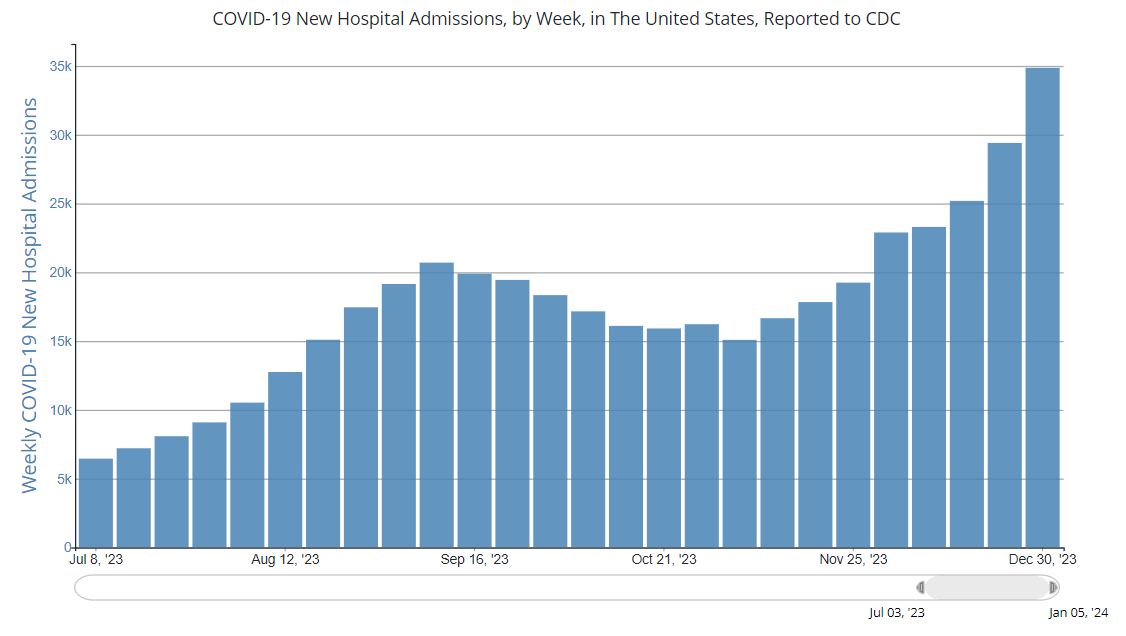
This chart depicts the relentless, grim ascent of the pandemic, showing how steadily and deeply the crisis deepened in the United States over time. It illustrates the slow, dangerous upward tide of the virus, spiking from roughly 5,000 weekly admissions in mid-July to nearly 35,000 by late December.
(Note: The text "COVID-19 New Hospital Admissions" and "Reporting to CDC" on the chart underscores the bureaucratic and systemic nature of the data being presented.)
simple-description (llama3.2-vision_11b)
The meme is a chart showing the number of COVID-19 cases in the United States, with a significant spike in January 2022. The text "COVID-19 cases" is displayed on the y-axis, and the chart is titled "COVID-19 Cases in the United States". The chart shows a steady increase in cases over time, with a sharp spike in January 2022.
detailed-analysis (gemma3-27b-vision)
Okay, let's break down this chart of weekly COVID-19 hospital admissions, applying the requested theoretical lenses where relevant.
Visual Description
The image is a bar chart illustrating the number of new COVID-19 hospital admissions in the United States per week, as reported to the CDC, from July 8, 2023, to approximately January 5, 2024. The Y-axis shows the number of admissions (ranging from 0 to 35,000) and the X-axis represents the weeks.
The chart shows a general trend of increasing admissions over the period. Initially, from July through late August, the numbers remain relatively low, fluctuating around 8,000-10,000 admissions per week. From late August into September, we see a steady climb. The trend remains higher into October, with fluctuations. The chart shows a significant increase in admissions starting around mid-November, culminating in a steep rise in the last weeks shown, reaching just over 30,000 admissions in the final week. The chart shows consistent reporting and clear numerical data.
Foucauldian Genealogical Discourse Analysis
This chart becomes a powerful visual document for a Foucauldian analysis. It's not simply about “truth” about the spread of disease, but a production of knowledge about COVID-19.
- Discipline and Surveillance: The chart represents the systems of power/knowledge at play in public health. The CDC collecting and reporting these numbers is an act of biopower—the control of populations through management of life itself. It constitutes a system of surveillance, creating “readable” bodies that can be monitored and categorized (hospitalized vs. not hospitalized, cases by week).
- Genealogy of “COVID-19”: The very category "COVID-19" is not natural or pre-existing. It is a discourse created by medical and scientific institutions. Examining the historical emergence of this category—its changing definitions, diagnostic criteria, and the shifting ways it's understood—reveals the power structures embedded within it.
- Normalization and Exclusion: The chart normalizes certain understandings of the disease—the focus on hospitalization as a key metric. This creates a hierarchy of experience—those hospitalized become “visible” in the data, while those with milder symptoms or those who avoid healthcare become less visible, effectively excluded from the official narrative.
- Power/Knowledge: The data is not neutral. It is constituted by power relations. The data informs policy decisions, resource allocation, and public health interventions, all of which reinforce existing power structures.
Critical Theory
Applying a Critical Theory lens, the chart is not just a data visualization but a reflection of broader societal problems and ideological forces.
- Commodification of Health: The focus on hospitalization emphasizes a medicalized model of health – a system where health becomes a commodity to be bought and sold. The data implies that “health” is defined by the absence of needing hospitalization, rather than the promotion of holistic well-being.
- Ideology and Representation: The chart reinforces the ideology of "risk" and "control". The data fosters the idea that the problem is "managed" through metrics and tracking, obscuring the underlying social and economic factors that contribute to vulnerability to the virus.
- Instrumental Reason: The emphasis on quantifiable data aligns with the principles of instrumental reason – the idea that everything is measured and optimized for efficiency. This can lead to a dehumanizing approach to healthcare, focusing on numbers rather than individual needs.
- Social Inequality: Critical Theory asks who is disproportionately represented in those hospital admissions. While the chart doesn't directly show this, it begs the question of whether certain racial, ethnic, or socioeconomic groups are experiencing higher rates of hospitalization due to systemic inequities in access to healthcare, pre-existing health conditions, or exposure to the virus due to occupational hazards.
Marxist Conflict Theory
A Marxist perspective would view the chart through the lens of class struggle and capitalist exploitation.
- Capitalist Health System: The increasing hospital admissions could be interpreted as a failure of the capitalist healthcare system to adequately provide preventative care and accessible health services to the working class.
- Exploitation and Vulnerability: The chart reflects the pre-existing vulnerabilities of the working class. Workers in essential jobs (e.g., healthcare, food processing, delivery) are more likely to be exposed to the virus due to the demands of labor, putting them at higher risk of hospitalization.
- Profit Motive: The increased hospitalizations could be linked to the profit motive in healthcare. A surge in patients generates revenue for hospitals, creating a perverse incentive to prioritize profits over preventative care.
- Commodification of Life: The chart highlights the commodification of life under capitalism, where health becomes a commodity to be bought and sold.
Postmodernism
A Postmodern lens would deconstruct the seemingly objective “truth” of the chart and emphasize the constructed nature of knowledge.
- Deconstruction of "Truth": The chart presents data as “objective truth”, but a postmodern perspective would argue that all data is constructed through specific frameworks and interpretations. The choice of what to measure (hospitalizations) and how to categorize it (weekly admissions) shapes the narrative.
- Fragmentation and Local Narratives: The chart presents a totalizing view of COVID-19 in the US. A postmodern analysis would emphasize the fragmented and diverse experiences of the pandemic, recognizing that different communities and individuals experience it in unique ways.
- Simulacra and Simulation: The chart itself becomes a simulation of reality, a representation that may bear little resemblance to the actual experiences of those affected by the virus.
- Metanarratives: The chart contributes to a broader metanarrative of public health crises and the need for control. A postmodern perspective would challenge this overarching narrative and seek out alternative interpretations.
Queer Feminist Intersectional Analysis
This analysis would focus on how multiple intersecting identities—gender, sexuality, race, class, ability, etc.—shape experiences of the pandemic and access to healthcare.
- Disproportionate Impacts: The chart does not reveal the gender, racial, sexual orientation, or socioeconomic status of those hospitalized. A queer feminist intersectional lens asks who is disproportionately represented in those admissions, and why. For example, LGBTQ+ individuals may face discrimination in healthcare, leading to delayed access to care. Women may face higher rates of burnout and mental health issues during the pandemic, contributing to health vulnerabilities.
- Gendered Division of Labor: The chart does not reveal that women are disproportionately employed in healthcare, as nurses and careworkers, thus putting them at greater risk.
- Marginalized Communities and Access: Marginalized communities (e.g., Black, Indigenous, People of Color) may face systemic barriers to healthcare access, pre-existing health conditions, and exposure to environmental hazards, all of which contribute to higher rates of hospitalization.
- Care Work and Emotional Labor: The pandemic disproportionately burdened women and marginalized communities with care work and emotional labor, impacting their health and well-being.
- Challenging Binary Categories: A queer feminist analysis would challenge binary categories (e.g., male/female, healthy/sick) and recognize the fluidity and diversity of human experiences.
I hope this detailed breakdown provides a comprehensive analysis of the chart from various theoretical perspectives! Let me know if you'd like me to elaborate on any of these points.
tesseract-ocr
COVID-19 New Hospital Admissions, by Week, in The United States, Reported to CDC 35k uv < 2 20k 2 £ 3 Lon £ ao a Z 20K| = G Zz D 15K Q = © 10x > x g S| Jul 8, '23 Aug 12, '23 Sep 16,'23 Oct 21, '23 Nov 25, '23 Dec 30, 23 a » Jul 03,°23 Jan 05, 24
simple-description (llama3.2-vision)
This meme is an image of a chart showing a significant spike in COVID-19 hospitalizations in the United States, with a sharp increase in late December 2022. The chart has a title "COVID-19 Hospitalizations by Week" and the x-axis shows the dates from July 2022 to January 2023. The text above the chart reads "The COVID-19 hospitalizations have been increasing in the US, but I'm sure it's just the flu".