First Seen
2024-01-28T09:23:41.825389+00:00
simple-description (qwen3.5_2b-q8_0)
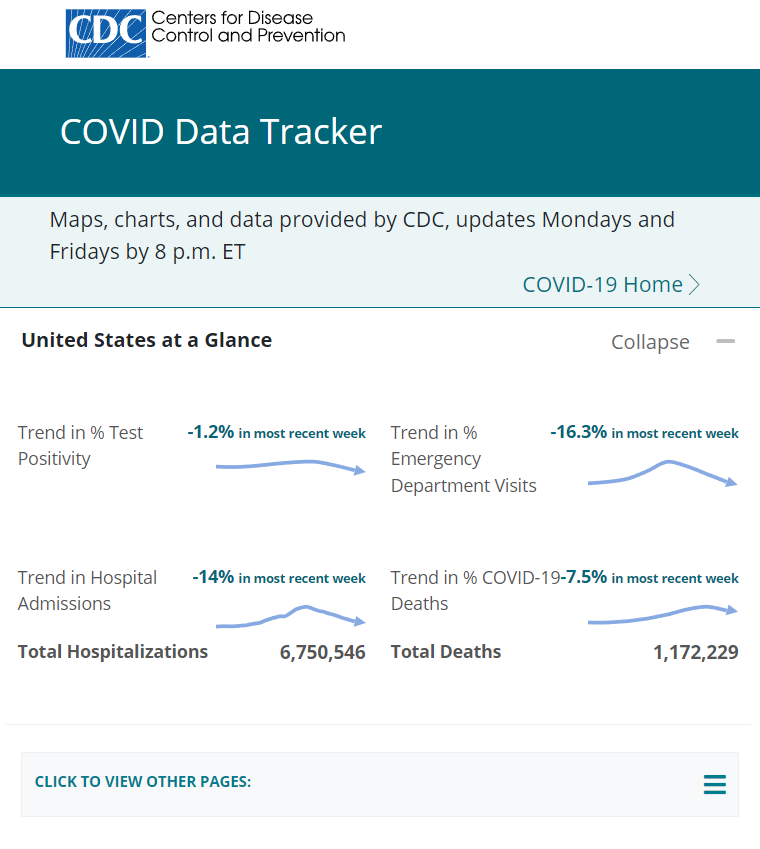
This image is a CDC dashboard, but the declining statistics act as a "meme" of the current crisis—specifically, a "data decline" meme. It humorously tells the story of a falling pandemic by highlighting that hospitals are admitting fewer people and patients are testing less positive than last week.
For someone who cannot read, it’s a simple visual of a graph going down, proving that the disease is under control. The specific data points include:
* Trend in % Test Positivity: -1.2% in most recent week
* Trend in % Emergency Department Visits: -16.3% in most recent week
* Trend in Hospital Admissions: -14% in most recent week
* Total Hospitalizations: 6,750,546
* Trend in % COVID-19 Deaths: -7.5% in most recent week
* Total Deaths: 1,172,229
simple-description (llama3.2-vision_11b)
This meme is a screenshot of a COVID-19 data tracker webpage from the Centers for Disease Control and Prevention (CDC). The image shows a graph with a downward trend in COVID-19 cases and deaths, with a caption "Cases and Deaths Down" and a note that "The number of new cases, deaths, and hospitalizations have decreased in the US over the past few weeks." The image also includes a table with updated numbers on COVID-19 cases, deaths, and hospitalizations in the US.
detailed-analysis (gemma3-27b-vision)
Okay, let's break down this image of the CDC's COVID data tracker through various theoretical lenses.
Visual Description
The image is a screenshot of a webpage from the Centers for Disease Control and Prevention (CDC) titled "COVID Data Tracker." The page presents key data points related to COVID-19 in the United States. The background is a deep, saturated blue. The layout is clean and minimalist, organized into lines of data.
The data presented includes:
- Trend in % Test Positivity: A line graph showing a -1.2% trend in the most recent week.
- Trend in % Emergency Department Visits: A line graph showing a -16.3% trend in the most recent week.
- Trend in % Hospital Admissions: A line graph showing a -14% trend in the most recent week.
- Trend in % COVID-19 Deaths: A line graph showing a -7.5% trend in the most recent week.
- Total Hospitalizations: 6,750,546
- Total Deaths: 1,172,229
The data is presented with a sense of objective measurement, indicated by the use of percentages and numerical totals. A link to a "COVID-19 Home" page and a link to view other pages of data are provided at the bottom of the image.
Foucauldian Genealogical Discourse Analysis
The CDC’s "COVID Data Tracker" is a perfect example of discourse in the Foucauldian sense. It doesn't merely reflect reality; it constructs it.
- Power/Knowledge: The CDC, as an authoritative body, produces knowledge about COVID-19. This knowledge isn’t neutral; it's deeply tied to power. By defining what counts as “data,” how it’s measured, and how it’s presented, the CDC shapes the understanding of the pandemic. The very act of quantifying and categorizing experiences (hospitalizations, deaths) is an exercise of power.
- Genealogy: A genealogical analysis would trace how the categories of tracking this data emerged. What historical practices and institutional arrangements led to the creation of these specific metrics? What does it mean to focus on these specific statistics and not others? (e.g., Long COVID, socio-economic impacts)
- Discipline: The data tracker functions as a form of surveillance, a means of disciplining populations. Knowing the trends allows for the implementation of public health measures (mask mandates, lockdowns) which are, in turn, forms of social control. The visual presentation (graphs, precise numbers) creates a sense of objectivity and legitimacy, reinforcing the authority of the CDC.
- Normalisation: The repeated presentation of these statistics "normalizes" certain ways of understanding the pandemic. It frames it as a problem that can be managed through data, measurement, and intervention.
Critical Theory
Critical Theory (influenced by thinkers like the Frankfurt School) examines how power structures maintain dominance and how ideology operates to obscure this dominance.
- Ideology: The “COVID Data Tracker” appears to be an objective source of information, contributing to a technocratic ideology that suggests problems can be solved through data-driven solutions. This can obscure underlying social and economic factors that contribute to the spread of the virus and disproportionately impact certain communities.
- Instrumental Reason: The focus on quantifiable data (numbers of hospitalizations, deaths) exemplifies “instrumental reason,” which prioritizes efficiency and control over broader human concerns. It reduces complex experiences to measurable units, potentially overlooking qualitative aspects of suffering, the social context of illness, and the human cost of the pandemic.
- Commodification of Health: Tracking and analyzing this data can be seen as part of a larger trend toward the commodification of health. Health becomes something to be managed, measured, and optimized, rather than a fundamental human right.
- False Consciousness: By presenting a seemingly objective picture of the pandemic, the data tracker can contribute to a “false consciousness” among the public, obscuring the systemic factors that contribute to health inequalities.
Marxist Conflict Theory
From a Marxist perspective, the image can be examined through the lens of class struggle and unequal access to resources.
- Disproportionate Impact: The data, while presented as universal, masks the fact that the pandemic disproportionately impacted working-class communities and communities of color. These communities often lack access to adequate healthcare, face higher rates of pre-existing conditions, and are more likely to work in essential jobs that expose them to the virus.
- Capitalism and Health: The pandemic revealed the contradictions of a capitalist system that prioritizes profit over public health. The image doesn't show the economic forces that shaped the pandemic response (e.g., the pharmaceutical industry, healthcare costs, the lack of paid sick leave).
- Data as Control: The collection and analysis of data can be seen as a means of social control, used to manage the workforce and ensure the continuation of production.
- Access to Information: While the data is publicly available, the ability to interpret and act on this information is not equally distributed. Those with greater resources and education are better positioned to protect themselves and their families.
Postmodernism
A postmodern reading would deconstruct the image’s claim to objective truth and highlight the constructed nature of reality.
- Deconstruction of Data: Postmodernism questions the very notion of “data” as neutral and objective. The categories used to collect and analyze the data are themselves social constructs, shaped by power relations and cultural biases.
- Simulacra and Simulation: The data tracker can be seen as a “simulacrum” – a representation of reality that has become detached from the real thing. The focus on numbers and graphs can create a sense of distance from the actual suffering and loss caused by the pandemic.
- Multiple Narratives: Postmodernism emphasizes the importance of multiple narratives and perspectives. The data tracker presents a single, authoritative account of the pandemic, but it ignores the diverse experiences of individuals and communities.
- Relativism: The meaning of the data is relative to the context in which it is interpreted. Different individuals and communities may draw different conclusions from the same information.
Queer Feminist Intersectional Analysis
This perspective would explore how the pandemic exposed and exacerbated existing inequalities based on gender, sexuality, race, class, and other intersecting identities.
- Gendered Impacts: The pandemic had disproportionate impacts on women, who were more likely to lose jobs, take on caregiving responsibilities, and experience increased rates of domestic violence.
- Racial and Ethnic Disparities: Communities of color experienced higher rates of infection, hospitalization, and death, reflecting systemic racism and health inequities.
- LGBTQ+ Marginalization: LGBTQ+ individuals, particularly transgender and non-binary people, faced unique challenges accessing healthcare and social support during the pandemic.
- Intersectionality: The image doesn’t capture the complex ways in which these identities intersect to create unique vulnerabilities and experiences. For example, a Black transgender woman might face multiple forms of discrimination and marginalization.
- Absence of Qualitative Data: The emphasis on quantitative data obscures the lived experiences of marginalized communities. A queer feminist analysis would call for the inclusion of qualitative data that captures the emotional, social, and cultural impacts of the pandemic on diverse populations.
Let me know if you'd like me to elaborate on any of these theoretical perspectives, or explore other ways of analyzing the image!
tesseract-ocr
CDC Centers for Disease Control and Prevention COVID Data Tracker Maps, charts, and data provided by CDC, updates Mondays and Fridays by 8 p.m. ET COVID-19 Home > United States at a Glance Collapse Trend in % Test 1.2% in most recent week Trend in % -16.3% in most recent week Positivity —_—_— Emergency _—™ Department Visits Trend in Hospital -14% inmost recent week Trend in 9% COVID-19-7.5% in most recent week Admissions _ = Deaths __e Total Hospitalizations 6,750,546 Total Deaths 1,172,229 CLICK TO VIEW OTHER PAGES: =
simple-description (llama3.2-vision)
The meme is an image of a COVID-19 data tracker page from the Centers for Disease Control and Prevention (CDC). The page displays a graph showing a significant decrease in COVID-19 cases and hospitalizations, with a bolded text reading "COVID-19 Cases and Hospitalizations Continue to Decline".