First Seen
2023-05-10T21:03:35+00:00
simple-description (llama3.2-vision_11b)
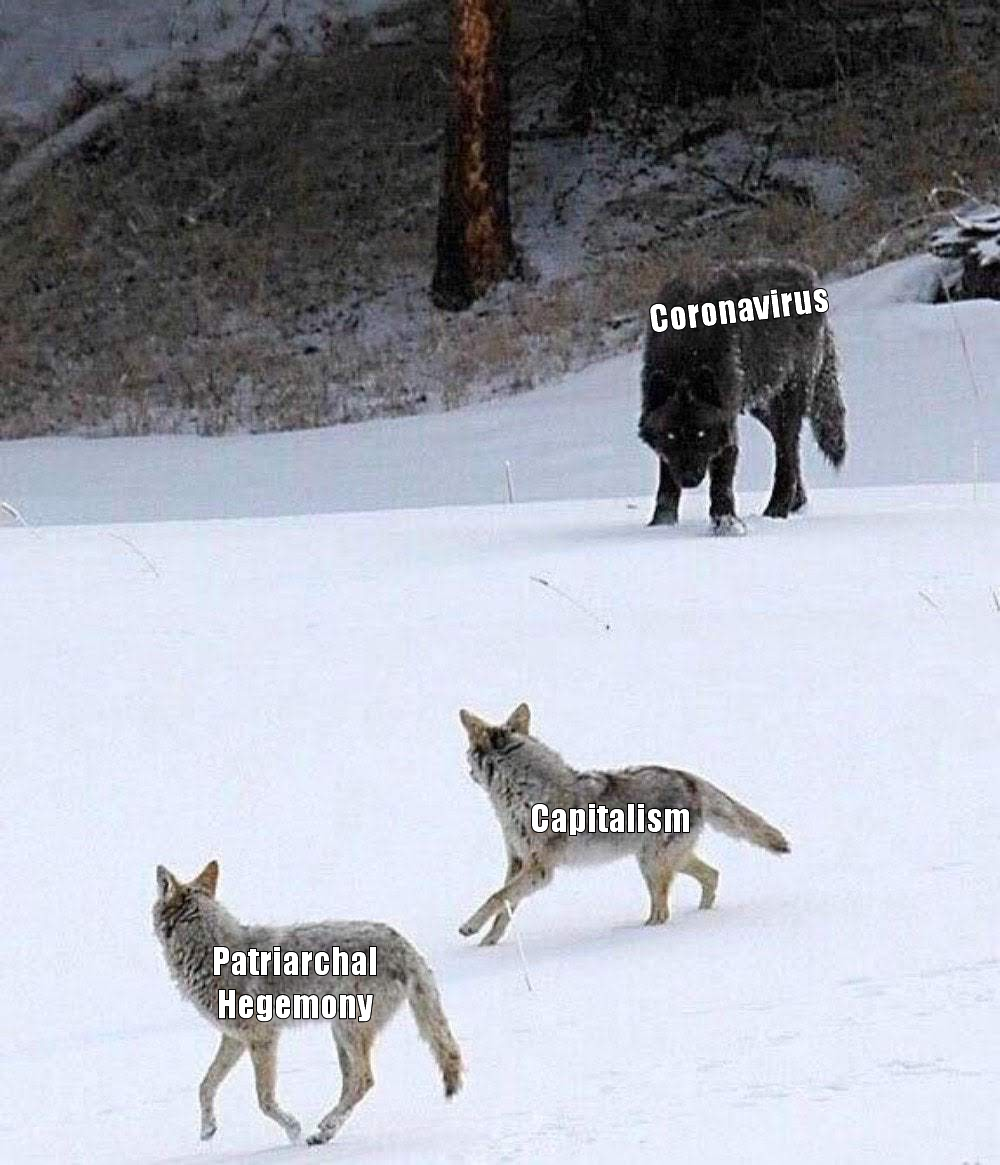
This meme depicts a wolf chasing three coyotes, with each coyote labeled as a different form of government or ideology: "Patriarchal Hegemony", "Capitalism", and "Communism". The wolf, labeled "Coronavirus", is chasing them down. The image is a commentary on how the COVID-19 pandemic has affected various forms of government and ideology, with the virus representing a force that can disrupt and challenge them.
detailed-analysis (gemma3-27b-vision)
Okay, let's analyze the image through the requested lenses. Given the labels applied to the wolves, the analysis will necessarily be quite conceptual and interpretive.
Visual Description
The image depicts a snowy landscape, presumably mountainous, with three wolves. Two wolves are in the foreground, moving forward. One is lighter in color, and the other appears to be grey or brown. A darker, more imposing wolf is positioned in the background, significantly further away and looming over the other two. The landscape is almost entirely covered in snow, creating a stark and cold visual atmosphere. The lighting is somewhat flat, but highlights the texture of the snow and the forms of the wolves. The image quality is good, suggesting a recent photograph.
Critical Theory
The image immediately evokes themes of power dynamics. The placement of the “Coronavirus” wolf in the background, looming over the other two (labeled “Capitalism” and “Patriarchal Hegemony”), suggests a situation where a crisis (Coronavirus) exacerbates existing structural inequalities. Critical theory would read this not as a mere depiction of natural predator-prey relations, but as a metaphor for the ways in which global crises are never neutral, but tend to reinforce or reveal existing power imbalances. The landscape—harsh, cold, isolating—could be seen as representing the social conditions that make certain groups more vulnerable to crises. It implies a critique of systems that allow such vulnerabilities to exist.
Marxist Conflict Theory
From a Marxist perspective, the image is ripe for interpretation. “Capitalism” and “Patriarchal Hegemony” represent inherently conflicting forces, but also ones that historically operate in tandem to maintain class and gender hierarchies. “Coronavirus” acts as a catalyst that reveals the inherent contradictions within these systems. The snow-covered landscape represents the alienation and precarity inherent in capitalist modes of production. The wolves are positioned in a sort of chase, suggesting ongoing struggle. The distant "Coronavirus" wolf implies an external force amplifying these existing tensions and vulnerabilities, possibly causing systemic collapse or requiring re-organization.
Foucauldian Genealogical Discourse Analysis
From a Foucault-inspired perspective, we'd focus on the discourse surrounding each label. "Coronavirus" represents a biomedical discourse of disease, control, and biopower. "Capitalism" evokes the discourse of economic rationality, accumulation, and competition. "Patriarchal Hegemony" points to a system of power built on gendered norms and the construction of masculinity as dominant. The image asks how these discourses intersect and mutually reinforce each other. The placement implies a history of how these discourses have become intertwined and normalized. Rather than seeing the image as a fixed representation, a Foucauldian analysis would emphasize the construction of these categories and their changing meanings over time. This image can be seen as a visual record of power/knowledge in the current moment.
Postmodernism
A postmodern interpretation would likely deconstruct the labels and challenge the idea of a singular, unified meaning. The image, instead of offering a clear political statement, could be seen as a pastiche, a fragmentation of meaning. The juxtaposition of "Coronavirus," "Capitalism," and "Patriarchal Hegemony" is provocative, but doesn't necessarily offer a solution or even a clear diagnosis. The interpretation becomes highly subjective, depending on the viewer's own experiences and perspectives. The image may be seen as reflecting the complexity and contingency of contemporary experience, and the impossibility of grand narratives.
Queer Feminist Intersectional Analysis
This lens is particularly resonant. "Patriarchal Hegemony," as a label, immediately draws attention to the systemic oppression of women and gender non-conforming individuals. The other two labels—"Coronavirus" and "Capitalism"—intersect with patriarchal structures to create unique vulnerabilities. For example, during the pandemic, women disproportionately bore the burden of caregiving, while also being overrepresented in precarious employment sectors (connecting to the "Capitalism" label). The positioning of the wolves could be interpreted as "Coronavirus" exacerbating existing inequalities in ways that specifically impact marginalized gender identities. The snow-covered landscape could represent the isolation and lack of resources experienced by those facing multiple forms of oppression.
Important Notes:
- Subjectivity: All these interpretations are inherently subjective and depend on the theoretical frameworks being applied.
- Metaphorical Reading: This is a highly metaphorical analysis. The image’s power comes from the evocative association of the wolves with these social and political concepts.
- Complexity: The image lends itself to a layered analysis, where these different theoretical lenses can inform and enrich each other.
Let me know if you'd like me to elaborate on any of these sections or explore other theoretical perspectives!
simple-description (llama3.2-vision)
The meme depicts a wolf chasing three coyotes in the snow. The wolf is labeled "Coronavirus", while the coyotes are labeled "Patriarchal Hegemony", "Capitalism", and "Feminism". The image is meant to be humorous and satirical, implying that the three coyotes are working together to evade the wolf, representing the struggle against oppressive systems.
tesseract-ocr
ae PTC a == Vere eee wie «ie » & TIEN oj » ae 4 # a VATE r LTT pn OUT Cf A y 5