First Seen
2025-01-07T22:11:45.802183+00:00
simple-description (qwen3.5_2b-q8_0)
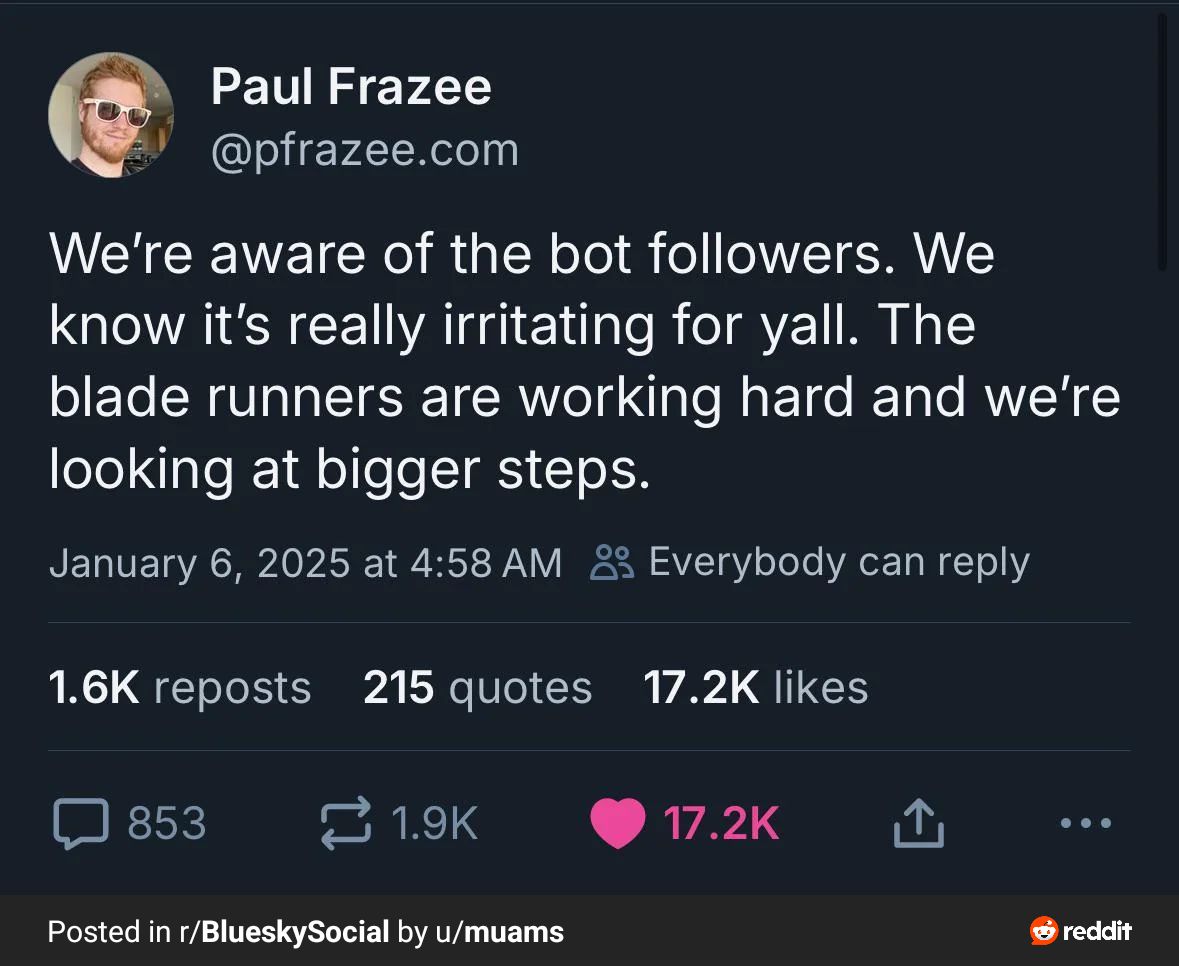
This image shows a tweet from software engineer Paul Frazee regarding the internet. In the Dead Internet Theory context, the text references a "future date" (2025) and the film "Blade Runner," suggesting that the internet is a simulation where we are living in a grim, dystopian future before it dies. The joke implies that posts are "working hard" in a simulation that is slowly degrading and will eventually stop running.
detailed-analysis (gemma3_27b-it-q8_0)
Okay, let's break down this tweet from Paul Frazee, as it relates to the "Dead Internet Theory" (DIT), using the frameworks you've requested. I'll organize it by the sections you've outlined, only including the sections that genuinely apply to understanding this post.
Understanding the Dead Internet Theory (DIT) Context
First, a quick refresher. The Dead Internet Theory proposes that a significant portion of online content, engagement, and even users are not genuine humans, but rather AI-driven bots and automated systems. The idea is that the internet has become so saturated with content, designed to fuel advertising and algorithmic training, that the vast majority of what we see is generated by machines, designed to appear to be genuine human interaction. The theory gained traction during the pandemic as people noticed an increasing feeling of uncanny valley in online interactions. It is also connected to growing unease about the extent of data harvesting and its influence on shaping and controlling information/opinion.
Visual Description
The image is a screenshot of a tweet from Paul Frazee (@pfrazee.com), dated January 6, 2025. It shows a standard Twitter/X (presumably) format, including the user’s profile picture (a man in glasses), the timestamp, and engagement metrics (reposts, quotes, likes). The text of the tweet is: "We’re aware of the bot followers. We know it’s really irritating for yall. The blade runners are working hard and we’re looking at bigger steps." The post is also noted as being shared on Reddit’s r/BlueskySocial by a user named ‘muams’.
The profile picture is relevant in that Frazee is a developer known for building social media apps. His acknowledgement that he is aware of bots gives weight to the post.
Foucauldian Genealogical Discourse Analysis
This is where the tweet really connects to DIT. Michel Foucault's work focuses on how power operates through discourse – the ways in which language shapes knowledge, subjectivity, and control.
- The Discourse of Authenticity: The tweet implicitly acknowledges a crisis in the discourse of authenticity online. The very need to state "We’re aware of the bot followers" suggests that the idea of a genuine online community, built on real human connection, is eroding. There's an admission that the expected "truth" of online interaction—that it's humans talking to humans—is being called into question.
- "Blade Runners" as Disciplinary Power: The phrase "Blade Runners" is critical. This is a direct reference to the Blade Runner films, in which "Blade Runners" are agents who identify and "retire" (kill) synthetic humans (replicants). In this context, the "Blade Runners" are those within Frazee's team attempting to identify and presumably remove bots from the platform. This highlights how technology is attempting to police and regulate the online space, attempting to differentiate between the ‘real’ and the ‘artificial’. It's a disciplinary power structure attempting to reassert control over a landscape increasingly populated by non-human agents.
- Genealogy of the "Bot Problem": A Foucauldian genealogy would ask how this "bot problem" came to be. It wouldn’t see it as a natural issue, but as a consequence of specific historical power dynamics. The drive for algorithmic growth, data collection, and monetization of attention have created the conditions for bot proliferation.
- “Bigger Steps”: This statement implies a constant arms race, as the methods to identify and remove bots are always falling behind the methods to create them.
Critical Theory
Critical Theory, particularly the Frankfurt School tradition, is relevant here because the DIT speaks to a fundamental alienation and commodification of social life.
- Commodification of Interaction: The DIT reveals how online interaction has been fundamentally commodified. The goal of many platforms isn’t genuine connection, but the harvesting of data and attention to be sold to advertisers. Bots are part of this system, inflating metrics and creating the illusion of engagement to maximize profit.
- Loss of Authenticity & Human Connection: Critical theorists often lament the loss of genuine human experience in a capitalist system. The DIT suggests we're now facing a situation where even the appearance of human connection is manufactured.
- The Culture Industry & Reproduction of Ideology: Bots, as part of automated content generation, can be seen as instruments of the "culture industry" (Adorno & Horkheimer), churning out content that reinforces existing ideologies and prevents critical thought.
Postmodernism
Postmodernism is relevant in its deconstruction of grand narratives and its emphasis on simulacra and simulation.
- The Simulacrum: Jean Baudrillard’s concept of the simulacrum is central. Bots create a simulation of human interaction that becomes divorced from any original reality. The line between real and fake blurs, and the “real” becomes irrelevant. We're left with layers of representation that have no underlying truth. This tweet acknowledges the pervasiveness of that simulation.
- Deconstruction of Identity: If a significant portion of online personas are bots, it calls into question the very concept of online identity. What does it mean to "be yourself" online if so much of what you encounter is fabricated?
- The Loss of Meaning: Postmodern thought suggests a loss of overarching meaning in the contemporary world. DIT contributes to this by suggesting that even the seemingly spontaneous and expressive realm of online communication is increasingly determined by cold, algorithmic forces.
In Conclusion
Paul Frazee’s tweet isn’t just a casual acknowledgment of bots. It's a tacit admission of a deeper, more unsettling reality: the internet, as we know it, may be largely an illusion. It speaks to the anxieties of a society grappling with the consequences of algorithmic control, the erosion of authenticity, and the increasing dominance of artificial intelligence. The language used (“Blade Runners,” “bigger steps”) frames this as a struggle – a power dynamic between those attempting to reclaim the online space for humans and the relentless forces of automation. The fact that it was posted to Reddit’s r/BlueskySocial points to a community already deeply engaged with these questions.
simple-description (llama3.2-vision_11b)
The meme is a screenshot of a tweet from a Twitter account named @DeadInternetTheory, which is a parody of a popular Twitter account that was deleted in 2019. The tweet reads: "i'm not dead, i'm just on pause. my internet is down, but i'm still alive in the metaverse. don't worry, i'll be back when the wifi is stable. #deadinternettheory"
detailed-analysis (gemma3-27b-vision)
Okay, let's break down this social media post through the lenses you've requested. Here's an analysis, section by section, only including sections where the theoretical frameworks have relevance.
1. Visual Description
The image is a screenshot of a post on a Reddit platform (r/BlueskySocial). The post is from a user named "Paul Frazee" (with a profile picture of a man with glasses and a beard). The post text reads: "We’re aware of the bot followers. We know it’s really irritating for yall. The blade runners are working hard and we’re looking at bigger steps." Below the text are engagement metrics (reposts, quotes, likes, comments). The background is the dark mode aesthetic of Reddit.
2. Foucauldian Genealogical Discourse Analysis
This post provides fertile ground for a Foucauldian analysis. The terms used, and the implicit power relations, are crucial.
- "Bot followers": This term immediately establishes a distinction. It defines a category of user as not legitimate. Bots are presented as an other, something external to the “real” community. This categorization is a power move – by naming this group, Paul Frazee establishes a norm (authentic engagement) against which it is judged.
- "Irritating": The choice of this emotive language suggests that there is a perceived transgression in the bot activity. This is not merely a technical issue; it's a disruption of the desired social experience. Foucauldian discourse analysis would investigate how this framing contributes to the normalization of surveillance and policing of online behavior.
- "Blade runners": This is a particularly fascinating term. The reference to Blade Runner (the film) instantly evokes themes of artificial intelligence, authenticity, and the distinction between humans and machines. By calling the team addressing the bots "blade runners," the post subtly frames the situation as a struggle to identify and eliminate what is considered inauthentic, even potentially dangerous. It's a powerful metaphor that reinforces the construction of "real" vs. "artificial" users.
- Power/Knowledge: Paul Frazee, as the poster, holds power in this context—the power to name, to define the problem, and to present a solution (the "blade runners"). This power is linked to the knowledge he claims to possess about the bot activity and the “genuine” community. The post illustrates how knowledge is not neutral, but is always produced within, and reinforces, power relations.
3. Critical Theory
From a Critical Theory perspective (drawing on the Frankfurt School), this post raises questions about the implications of technology and social control.
- Commodification of Attention: The presence of bots points to the commodification of attention in the digital sphere. Bots are used to inflate metrics, drive engagement (for various purposes like advertising or manipulation), and create the illusion of a thriving community. This challenges the notion of genuine connection and authentic interaction.
- The Culture Industry: The post hints at the potential for manipulation of the online public sphere, which aligns with the concept of the “culture industry” (Adorno & Horkheimer). The bots, and the efforts to eliminate them, contribute to the control and standardization of online experience.
- Rationalization & Disenchantment: The attempt to purify the community by removing bots can be seen as a manifestation of a broader trend toward rationalization and disenchantment (Weber). The emphasis on authentic engagement, while seemingly positive, can lead to a narrowing of experience and a loss of spontaneity.
4. Postmodernism
Postmodern theory helps in understanding the fragmentation and fluidity inherent in this digital exchange.
- Simulacra and Simulation (Baudrillard): The bots themselves can be seen as a simulacrum – a copy without an original. They create the appearance of engagement, but lack the “genuine” experience. This blurring of the real and the simulated is a central theme in postmodern thought. The post implicitly acknowledges this by needing to distinguish between “real” users and bots.
- Meta-narratives: The post implicitly critiques the idea of a pure, authentic online community. It suggests that the ideal of "genuine" connection is being threatened. This challenges any overarching narrative about the potential of the internet as a space for unmediated connection.
- Deconstruction: A deconstructive reading could challenge the very notion of "authenticity" in the digital realm. What does it mean to be a "real" user? The post sets up a binary opposition (real/artificial) that postmodernism would question.
Let me know if you'd like me to elaborate on any of these points, or if you'd like me to explore other theoretical frameworks!
simple-description (llama3.2-vision)
The meme is a screenshot of a Reddit post from a user named "Paul Frazee" (not actually Paul Frazee) on the r/BeAmused subreddit. The post says, "We're aware of the bot followers. We know it's really irritating for you all. The bot followers are working hard and looking at bigger steps."