First Seen
2023-05-10T21:03:35+00:00
simple-description (llama3.2-vision_11b)
The meme is a humorous take on the famous "I am not going to do that" scene from the Lord of the Rings movie, but with a dog's perspective. The image shows a dog looking at a tennis ball, with a caption of Gandalf saying "I am not going to get it" and the dog responding with "I am going to get it."
detailed-analysis (gemma3-27b-vision)
Okay, let's break down this meme through various theoretical lenses. It's a delightful example of a meme's power to layer meaning through juxtaposition.
Visual Description
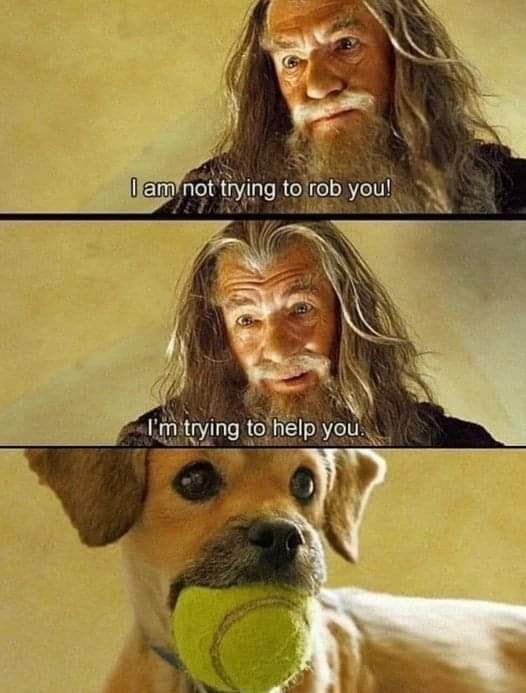
The meme is a three-panel format using screenshots from the Lord of the Rings films.
- Panel 1: Shows a close-up of Gandalf the Grey, with a concerned expression. Text above him reads, "I am not trying to rob you."
- Panel 2: Another close-up of Gandalf, still with a concerned expression, but subtly different. The text reads, "I'm trying to help you."
- Panel 3: A close-up of a golden retriever with a tennis ball in its mouth, looking innocently at the camera.
The humor derives from the stark contrast between Gandalf's dramatic pronouncements and the adorable, innocent image of the dog.
Foucauldian Genealogical Discourse Analysis
This meme operates as a critique of power dynamics and how they are constructed and discursively justified. Gandalf, a powerful figure in the Lord of the Rings universe, uses the language of concern (“help you”) to mask or legitimize his interference (potentially seen as “robbing” in a metaphorical sense).
- Discourse: The meme disrupts the “heroic mentor” discourse surrounding Gandalf. We usually accept his actions as benevolent, but the meme casts suspicion, suggesting a hidden agenda.
- Power/Knowledge: The knowledge (understanding of the narrative) we have of Gandalf allows for this interpretation. The meme works because we know he’s powerful, and that power can be wielded in complex ways.
- Genealogy: If we were to trace a "genealogy" of the phrase "I'm trying to help you," we'd find it frequently used to justify actions that are self-serving or exploitative. The meme draws on this historical use of the phrase and applies it to a powerful, authoritative figure.
The dog, then, is presented as an innocent disruption of this power structure, a representation of uncomplicated need or desire (the tennis ball).
Critical Theory
From a Critical Theory perspective (drawing from Frankfurt School thinkers like Adorno and Horkheimer), the meme highlights the way language is used to reify power structures and mask underlying motivations.
- Ideology: Gandalf’s statements can be seen as reinforcing an ideology of benevolent authority. He claims to act in the best interests of others, but this could be a way to maintain control.
- Commodification: One could stretch the metaphor to connect it to capitalist ideals, where "help" often comes with strings attached, or is a thinly veiled form of exploitation. The "robbery" is not literal, but perhaps a metaphor for the appropriation of agency or resources.
- Mass Culture: The meme itself is a product of mass culture, a playful critique embedded within a readily shareable format. This allows it to circulate widely and potentially destabilize conventional notions of authority.
The dog in the final panel subverts this by representing pure, unadulterated need–a simplicity that stands in stark contrast to the complexity of Gandalf's justifications.
Marxist Conflict Theory
While not a direct application, a Marxist reading could frame Gandalf's actions as a manifestation of class conflict.
- Bourgeoisie/Proletariat: Gandalf, as a powerful wizard, could be seen as representing the ruling class (bourgeoisie), offering "help" that ultimately benefits his own agenda. Those he "helps" could be seen as the proletariat, dependent on the benevolence (or control) of the powerful.
- False Consciousness: The “help” Gandalf offers might be a way to maintain the status quo, preventing the oppressed from realizing their own agency and challenging the existing power structures.
- Exploitation: The metaphor of "robbery" alludes to a form of exploitation, where Gandalf takes something (perhaps control, agency, or resources) from those he purports to assist.
The dog, in this context, represents a pure need that has not yet been corrupted by the complexities of power dynamics or class struggle.
Postmodernism
A postmodern reading would emphasize the meme's deconstruction of meaning and its playfulness with intertextuality.
- Simulacra and Simulation: The meme doesn't offer a "true" interpretation of Gandalf's motivations. Instead, it creates a simulacrum – a copy without an original – that highlights the arbitrariness of meaning.
- Intertextuality: The meme relies on the viewer's knowledge of both The Lord of the Rings and common tropes (like the deceptive "helper" figure). It creates meaning through the juxtaposition of these different texts.
- Irony and Parody: The humor derives from the ironic contrast between Gandalf’s dramatic pronouncements and the absurd image of the dog. This is a form of parody that subverts the seriousness of the original source material.
The dog serves as a meta-commentary on the absurdity of Gandalf's justifications, disrupting the narrative and exposing its underlying contradictions.
Queer Feminist Intersectional Analysis
This is the most challenging lens to apply, but a nuanced reading can reveal some interesting connections. The meme can be seen as a critique of performative allyship.
- Performative Allyship: Gandalf's claims of "helping" might be seen as a performance of concern, masking his own self-interest or reinforcing his power. This echoes the critique of performative allyship, where individuals claim to support marginalized groups without addressing systemic issues.
- Intersectionality: The "robbery" could be a metaphor for the ways in which dominant groups (like Gandalf) exploit marginalized communities. The dog, in this reading, represents a vulnerable group whose needs are often overlooked or ignored.
- Disruption of the Hero Narrative: The dog disrupts the traditional hero narrative by presenting an unadorned, innocent need that stands in contrast to Gandalf's complex motivations. This can be seen as a feminist intervention that challenges patriarchal power structures.
It is important to note that this analysis is speculative and requires a degree of interpretive flexibility. However, it demonstrates how even seemingly innocuous memes can be read through a critical lens to reveal deeper social and political implications.
Hopefully, this provides a detailed breakdown of the meme through multiple theoretical frameworks! It's a great example of how a simple image can be incredibly rich with meaning and interpretation.
simple-description (llama3.2-vision)
This meme is a play on the iconic "I am not a doctor, but I will tell you what I would do" scene from the movie "The Lord of the Rings." The meme replaces the doctor's statement with a more absurd and humorous one, saying "I am not trying to rob you, I am trying to help you." The image is likely a split-screen comparison between a person trying to steal something and a dog trying to playfully steal a ball.
tesseract-ocr
ESS i S i . : a ja. = \ f bs i aS AS a Dein il Luv) Lire you Ee / 2 a Pi YN OP i —~-Zaaw. z ar tn SEPANG 1” Se FN WMe Kone % ir ‘2 ia “@ ie = ‘ rs a uN ey fe e > cma oe yo