First Seen
2023-12-02T21:06:34+00:00
simple-description (qwen3.5_2b-q8_0)
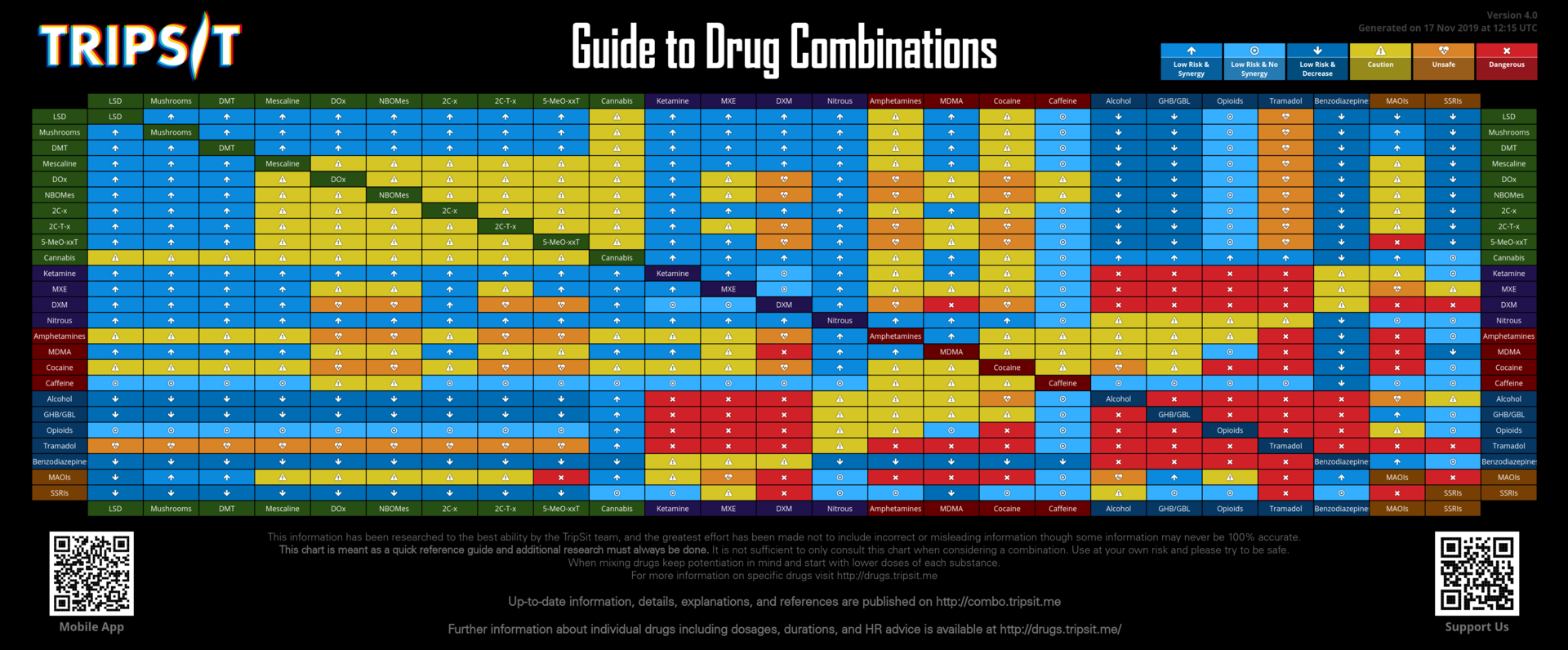
This massive grid chart, often called the "Trip/T" or "Guide to Drug Combinations," is shared by drug enthusiasts to explain dangerous interaction maps. It features a grid filled with rows and columns listing substances like LSD, mushrooms, ketamine, and MDMA, using colorful symbols (triangles and arrows) to indicate if mixing them could lead to death, dangerous side effects, or just "low risk." The visual impact is a grid of cautionary and red "unsafe" warnings. The bottom of the image includes a QR code and text warning that "additional research must always be done" and provides URLs for specific drug references, serving as a digital ledger of toxic drug combinations.
simple-description (llama3.2-vision_11b)
The meme is a table comparing various drugs, with each row representing a different substance. The table lists the effects of each drug, categorized by the type of experience they produce (e.g. "euphoria", "dissociation", "hallucination", etc.). The meme is humorous in that it takes a serious and complex topic (drug effects) and presents it in a simple, grid-like format, making it easy to understand and compare different substances.
Image text: "The effects of various substances on the human brain and body"
detailed-analysis (gemma3-27b-vision)
Okay, let's break down this image of the "Trips! Guide to Drug Combinations" through several analytical lenses, as requested. It’s a complex image with many layers to unpack.
Visual Description
The image is a grid, resembling a periodic table, but instead of chemical elements, it displays a chart of psychoactive drugs and their potential interactions. The drugs listed along both the horizontal and vertical axes include substances like LSD, DMT, Mescaline, 2C-B, 5-MeO-DMT, Cannabis, MDMA, Nitrous, Amphetamines, Cocaine, Caffeine, Alcohol, Opioids, and Benzodiazepines. Each intersection of a row and column is filled with a colored symbol representing the potential risk associated with combining those two substances.
- Colors & Symbols:
- Green (tick symbol): "Synergizes," indicating a potentially positive or enhancing interaction.
- Yellow (exclamation mark): "Caution," signifying a potentially risky but manageable interaction.
- Orange (triangle with exclamation mark): "Low Risk + Mix," indicating a combination with lower risks than other combinations.
- Red (X): "Dangerous," indicating a highly dangerous or potentially fatal interaction.
- Blue (down arrow): "Low Risk & Mix," indicating a combination with lower risks than other combinations.
- Layout: The grid is tightly packed, creating a sense of information density. It resembles a scientific chart, lending it an air of authority, though the subject matter is decidedly counter-cultural.
- Text: There’s a small disclaimer at the bottom clarifying the information source and emphasizing that the chart is not exhaustive and should not be taken as medical advice. A QR code in the lower right corner links to additional information.
Foucauldian Genealogical Discourse Analysis
This image immediately functions as a discourse about drug use, shaped by a specific history and power relations. Applying Foucault, we can see how this chart is constitutive of our understanding of drugs, rather than simply reflecting an objective reality.
- Genealogy of Knowledge: This chart doesn’t emerge from purely scientific objectivity. It's a product of (likely underground) communities sharing experience and attempting to categorize the effects of different drug combinations. The very act of creating such a grid implies a desire to know and control these experiences, which is a key Foucaultian concept.
- Power/Knowledge: The chart implicitly creates a hierarchy of danger. The "Dangerous" category is, in a sense, a disciplinary force. It establishes norms of acceptable and unacceptable drug use, even within a subculture. The act of labeling combinations as "dangerous" has a power effect on those who might consider them.
- Subjectivation: The chart contributes to how individuals understand themselves and their experiences. By providing (a purportedly objective) framework for understanding drug interactions, it shapes how people perceive their own agency and risk tolerance. It subtly defines the boundaries of acceptable self-experimentation.
- Discourse and the Body: The chart is deeply entangled with the body, specifically how psychoactive substances alter perception and experience. It attempts to map the effects of drugs on the body, and in doing so, it constructs a particular understanding of the body as a site of experimentation and control.
Critical Theory
Applying a critical theoretical lens (drawing from thinkers like Adorno and Horkheimer, or the Frankfurt School), the image can be seen as a symptom of larger societal issues.
- Commodification of Experience: The chart, in its attempt to categorize and map drug experiences, can be viewed as a form of commodification. It reduces complex, subjective experiences to quantifiable data, turning them into something that can be ‘managed’ or ‘optimized.’ This aligns with the critical theory critique of how capitalism turns everything into a commodity.
- Rationalization & Control: The grid structure and the use of symbols represent an attempt to impose a rational order on what is inherently irrational – the experience of altered consciousness. This mirrors the broader societal trend toward rationalization and control that critical theorists have identified.
- Loss of Authenticity: By providing a guide to “safe” drug combinations, the chart potentially diminishes the authenticity of the experience. It suggests that one can ‘hack’ consciousness, rather than allowing it to unfold organically.
- Critique of Enlightenment Reason: The chart paradoxically relies on the tools of Enlightenment reason (classification, categorization) to explore experiences that often lie outside the realm of rational understanding. This tension highlights a core critique of modernity: the limitations of reason in fully grasping the complexities of human experience.
Marxist Conflict Theory
From a Marxist perspective, the image reveals power dynamics and class-based tensions surrounding drug use.
- Oppression and Marginalization: Drug use is often associated with marginalized communities and serves as a tool of social control. The creation of this chart (likely by and for a subculture) can be seen as a form of resistance against dominant social norms.
- Ideology and False Consciousness: The chart, while potentially empowering for those within the subculture, could also contribute to a form of “false consciousness” by presenting a simplified, categorized view of drug use that obscures the underlying social and economic forces that contribute to drug abuse.
- Commodification & Capitalism: The underlying driver of illicit drug trades and thus the need for guides like this is rooted in the logic of capitalism, which prioritizes profit over human wellbeing.
- Class & Access to Information: The chart represents a form of specialized knowledge that may not be accessible to all. Those with greater social and economic capital may have more access to information about drug risks and safety, perpetuating existing inequalities.
Postmodernism
Applying a postmodern lens (drawing on thinkers like Lyotard, Derrida, or Baudrillard), the image can be seen as a playful deconstruction of scientific authority and a celebration of subjectivity.
- Simulacra & Simulation: The chart is a representation of reality, but it is not reality itself. It is a simulation that creates a sense of control over experiences that are inherently unpredictable. This aligns with Baudrillard’s concept of simulacra – copies without originals.
- Deconstruction of Grand Narratives: The chart challenges the “grand narrative” of medical authority by offering an alternative, subcultural guide to drug use. It suggests that there are multiple ways of knowing and understanding consciousness.
- Fragmentation & Pluralism: The grid format emphasizes fragmentation and the multiplicity of possible combinations. It rejects the idea of a single, unified understanding of drug effects.
- Subjectivity & Relativism: The chart acknowledges that drug experiences are subjective and vary from person to person. It rejects the idea of objective truth about drug effects.
Queer Feminist Intersectional Analysis
This analysis examines how power, identity, and social structures intersect within the context of this chart.
- Marginalized Identities and Drug Use: Drug use and criminalization disproportionately affect marginalized communities (people of color, LGBTQ+ individuals, low-income communities, etc.). Understanding this chart requires acknowledging these historical and ongoing power imbalances.
- Challenging Heteronormative Drug Culture: Historically, drug use has often been associated with masculinity and patriarchal power structures. A queer feminist analysis might examine how this chart challenges or reinforces those norms.
- Bodily Autonomy and Agency: The chart could be seen as a tool for reclaiming bodily autonomy and agency, empowering individuals to make informed choices about their own bodies and consciousness. However, it's important to acknowledge that this agency is limited by social and economic constraints.
- Intersectional Vulnerability: Individuals with intersecting marginalized identities (e.g., a Black transgender woman) may face unique vulnerabilities related to drug use, including increased risk of police harassment, discrimination, and violence.
- Critique of Medicalization: The chart potentially offers a challenge to the medicalization of consciousness and the tendency to pathologize altered states of being. This can be particularly relevant for communities that have historically been subjected to medical control and experimentation.
Hopefully, this detailed breakdown provides a comprehensive analysis of the image through the requested lenses. Let me know if you'd like me to expand on any specific aspect or explore a different theoretical framework.
tesseract-ocr
TT ROT TELAT =) fee eet ey ee ee a ee Se ee ee ee ee ee ee ae Uhr ll) ee mee lL * * * * * les * * a me . | 0 + 2 Sa * 7 Pa 3 3 a 3 3 3 3 3 es 3 3 |. _— > 10 5 . ao 3 . Rr ca * B eS ee eee LEE a 7 ES ee Ue co coo | 3 3 3 5 5 3 a 5 3 5 a . <= 5 z5 i a a o ~ os TESS Se ee | | rr ee) ee ee eee ee S z 5 5 5 5 5 a — hl! Ue © © s TT EEE — FE a oT Fe or ere] | eae reo Berne: meta ae ae meee rece co! eae Deen ea sa Ere eon Furthe ion abc OTA ene eee 7 rT 6 is available at Pee etry
simple-description (llama3.2-vision)
The meme is a table comparing the effects of various substances, including psychedelics, stimulants, and other substances, on the user's brain and body. The table is organized by the type of substance, with the effects of each substance listed in a grid format. The text at the top of the table reads "Tripsitter: A Guide to Psychedelic Substances and Their Effects".