First Seen
2023-05-10T21:03:35+00:00
simple-description (llama3.2-vision_11b)
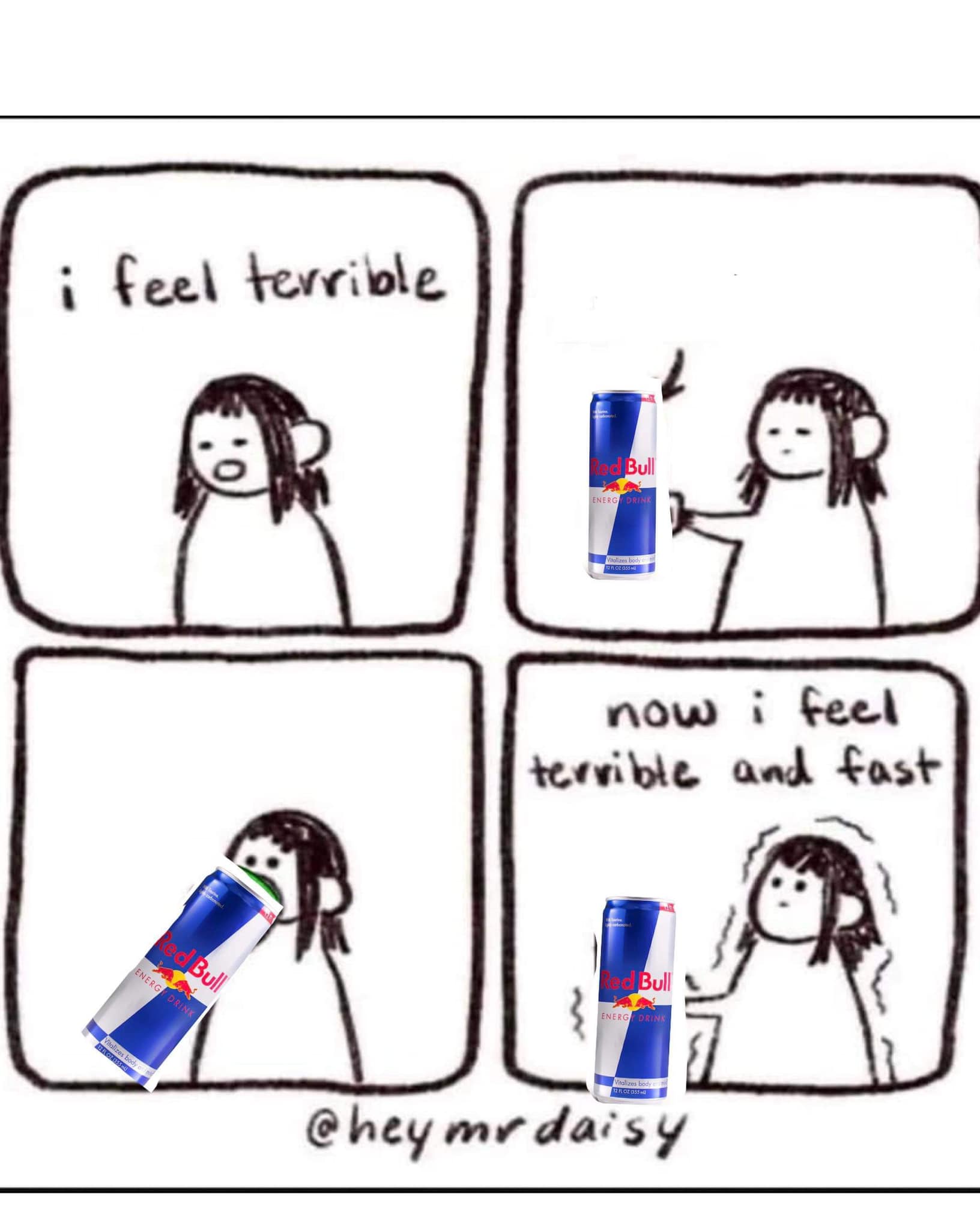
The meme is a four-panel comic strip where a person's emotional state changes from "I feel terrible" to "I feel terrible and fast" after consuming a Red Bull energy drink. The panels show the person's emotional state changing from a sad face to a frustrated and angry face, with the Red Bull can appearing in each panel. The text "I feel terrible" is written in the first panel, and "I feel terrible and fast" is written in the last panel.
detailed-analysis (gemma3-27b-vision)
Okay, here's an analysis of the image, broken down into sections as requested, focusing on the sections that best apply.
Visual Description
The image is a four-panel cartoon drawn in a simplistic, sketchy style. The background is consistently white. The central figure is a person (gender is intentionally ambiguous) with a dark, roughly drawn hairstyle, a simple oval face, and dots for eyes. The figure is depicted in varying poses suggesting emotional states.
- Panel 1: The figure stands straight, face drawn in a neutral expression, with the text “i feel terrible” above it.
- Panel 2: The figure is reaching out to a can of Red Bull.
- Panel 3: The figure is slumped, dramatically leaning to the side, holding the Red Bull can.
- Panel 4: The figure is hunched over, even more dramatically bent, moving quickly to the side. The text reads “now i feel terrible and fast.”
The artist's signature "@heymrdaisy" is at the bottom. The color scheme is minimal – black ink on white, with the red, silver, and blue of the Red Bull can providing the only color. The style leans towards a raw, emotional aesthetic, prioritizing conveying feeling over precise drawing.
Foucauldian Genealogical Discourse Analysis
This image is ripe for analysis through a Foucaultian lens. The cartoon portrays a power dynamic subtly embedded in the normalization of “solving” emotional states (specifically, feeling “terrible”) with a consumable product.
- Discourse of Productivity: Modern Western culture operates under a strong discourse of productivity. Feeling "terrible" is seen as a disruption to this, something that needs to be fixed to allow continued participation in capitalist systems. The Red Bull isn't presented as a genuine solution to well-being, but as a means to mask the negative feeling and allow for continued functioning, or even increased speed. This ties into the idea of docile bodies – the figure, by consuming Red Bull, is becoming more easily controlled and directed towards productive output.
- Normalization of Self-Medication: The cartoon participates in the normalization of using consumables – in this case, a highly caffeinated beverage – to regulate emotional states. This is a historical process. We can trace the emergence of pharmaceutical and consumer culture that allows (and encourages) individuals to manage their feelings with external substances, rather than addressing root causes.
- Power/Knowledge: The power dynamic isn’t about Red Bull forcing anything, but about the creation of a system (capitalism, consumer culture) where this kind of self-medication is presented as a viable, even desirable, option. Knowledge about how to 'fix' feelings is created and disseminated through advertising, social norms, and the acceptance of a fast-paced, demanding lifestyle.
Critical Theory
The cartoon can be analyzed through a Critical Theory framework, particularly focusing on the concept of alienation.
- Alienation from Authentic Experience: The figure's initial state of "feeling terrible" could be interpreted as a genuine emotional response to the pressures of modern life – alienation from work, social connection, or a sense of purpose. Rather than addressing the source of this feeling, the individual turns to Red Bull. This doesn’t resolve the underlying issue, but instead masks it with a temporary boost of energy, creating a cycle of dependence.
- Commodification of Feeling: The image highlights the commodification of emotional states. "Feeling terrible" becomes something that can be fixed with a product, turning emotional well-being into a commodity. This fits into the broader critique of how capitalism turns everything – including feelings – into something to be bought and sold.
- False Consciousness: The phrase "terrible and fast" suggests a kind of acceptance – even embrace – of the negative state, but coupled with increased activity. This could be seen as a form of false consciousness, where the individual believes they are solving the problem (by becoming more productive), while actually reinforcing the systems that are causing the distress in the first place.
Marxist Conflict Theory
This cartoon could be read as commentary on the effects of the capitalist mode of production on the individual psyche.
- Exploitation and Emotional Strain: The "terrible" feeling could be a result of the alienation, overwork, and precarity inherent in capitalist labor. The figure doesn't address the cause of the feeling, but rather seeks a temporary fix to endure the demands of the system.
- Red Bull as a Tool of Capital: Red Bull, as a product, facilitates the continuation of this cycle. It allows individuals to push themselves harder, remain productive despite feeling unwell, and ultimately contribute more to the profits of the company.
- Commodification of the Body: The cartoon illustrates how the body itself becomes a tool for production under capitalism. The individual is not valued for their well-being, but for their ability to work, even when feeling unwell.
In conclusion, the cartoon, despite its simplicity, presents a potent critique of modern culture, consumerism, and the psychological effects of late capitalism. It suggests that the pursuit of productivity often comes at the cost of genuine well-being and that the systems in place perpetuate this cycle.
simple-description (llama3.2-vision)
This meme is a simple comic strip featuring a person who initially feels terrible, but after consuming a Red Bull energy drink, they suddenly feel energized and "not terrible" again. The text "I feel terrible" is written above the first panel, and "I feel terrible and now I feel terrible and now I feel terrible and now I feel terrible" is written above the second panel. The final panel shows the person feeling energized and happy.
tesseract-ocr
+ feel terrible ~ _? @? F now i Feel tervible aad fast re," _ ( \ & | wre y 5 @hey mv daisy