First Seen
2023-05-10T21:03:35+00:00
simple-description (llama3.2-vision_11b)
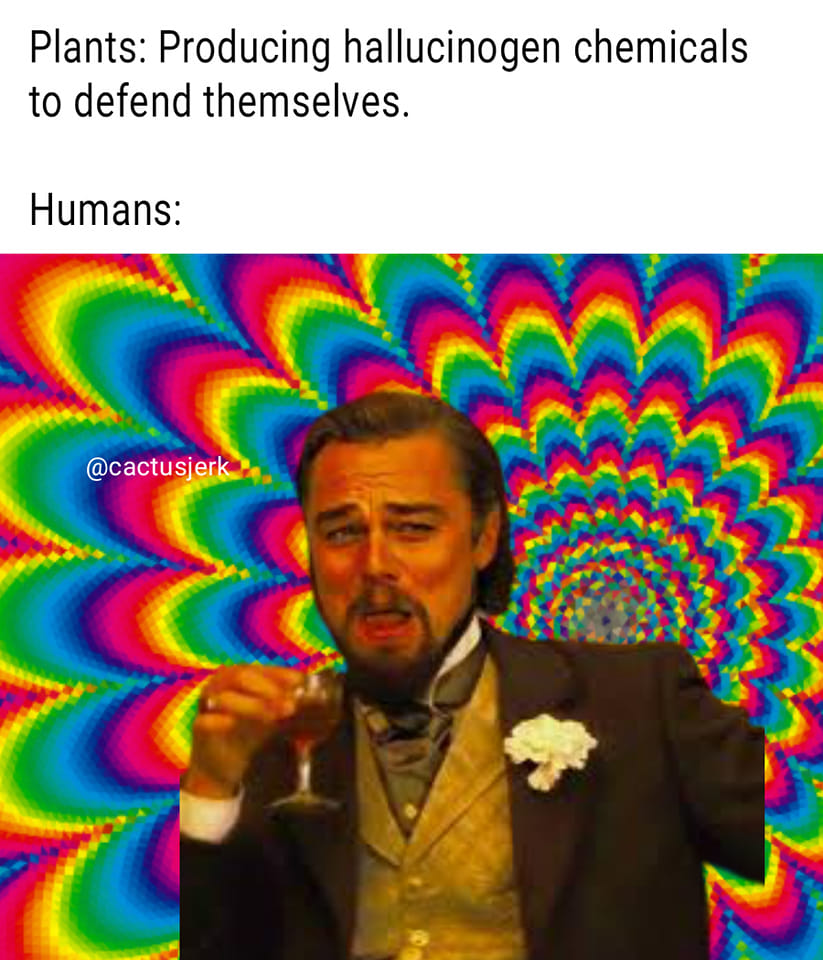
The meme is a humorous commentary on the absurdity of the human desire to create and use substances that can alter one's perception of reality. The image shows a man from the movie Django Unchained, known for his outrageous and eccentric personality, with a psychedelic background. The text at the top reads "Plants: Producing hallucinogen chemicals to defend themselves" and at the bottom "Humans: Making and using them to get high".
detailed-analysis (gemma3-27b-vision)
Okay, here’s an analysis of the image, broken down into sections addressing the requested theoretical frameworks. It's important to note that applying all of these frameworks isn't always necessary or even fruitful; I'll indicate where a connection feels tenuous or less prominent.
Visual Description
The image is a digitally altered meme. The core is a still from the movie The Wolf of Wall Street featuring Leonardo DiCaprio looking visibly distressed, with a drink in his hand. The background has been overlaid with a highly saturated, psychedelic pattern of swirling, rainbow-colored shapes reminiscent of a hallucination or a vintage psychedelic poster. A username "@cactusjerk" is written across the image in a clear font. The text above the image states "Plants: Producing hallucinogenic chemicals to defend themselves." and below the image is written "Humans:" implying that humans are engaging with or responding to this information.
The overall effect is humorous but also subtly unsettling, creating a contrast between the seeming normalcy of the scene and the disorienting visual background. The pairing of a wealthy, potentially exploitative character (DiCaprio) with the psychedelic imagery and the information about plant defenses suggests a satirical commentary on human-plant relationships.
Foucauldian Genealogical Discourse Analysis
A Foucauldian reading centers on how the image constructs meaning through discourse and power dynamics. The pairing of the plant’s self-defense mechanism (producing hallucinogens) with the image of a man in a privileged position (DiCaprio) immediately sets up a power imbalance.
- Discourse & Knowledge: The image implies a shift in understanding the concept of ‘defense’ in nature. Plants aren't passively being acted upon; they actively defend themselves through chemical means. This is a knowledge shift that moves away from anthropocentric views.
- Power/Knowledge: The image subtly points to how human knowledge about plants (and their chemical properties) is produced within structures of power. Humans study plants, isolate compounds, and often then exploit them for various purposes, including recreational and pharmaceutical use. The look of distress on DiCaprio’s face could suggest the realization that the plants are not passive resources but agents with their own forms of agency.
- Genealogy: Tracing the historical development of our understanding of plant chemistry and medicinal properties reveals a genealogy of control. Plants have been seen as resources to be extracted and controlled, rather than organisms engaging in self-preservation. This meme playfully subverts that logic.
Critical Theory
The meme lends itself to a critical theory analysis by revealing and challenging assumptions about nature, power, and human-animal (or human-plant) relationships.
- Domination of Nature: The image exposes the underlying power dynamics at play in how humans relate to the natural world. We typically view plants as objects for our use, not as agents with their own defensive strategies. The fact that plants use psychoactive chemicals as defense mechanisms disrupts this assumed hierarchy.
- Deconstruction of ‘Defense’: The meme challenges the very concept of “defense.” Is a plant’s use of hallucinogens a form of aggression or simply a survival strategy? It destabilizes the binary of ‘attack’ and ‘defense’ suggesting a more fluid and complex relationship between organisms.
- Critique of Anthropocentrism: The image is implicitly critical of anthropocentrism – the belief that humans are the central or most important entities in the universe. By highlighting plant agency, the image subtly suggests that plants have their own intrinsic value and are not simply tools for human benefit.
Marxist Conflict Theory
A Marxist lens focuses on the class and economic tensions revealed by the image. This is perhaps the weakest fit, but still relevant:
- Exploitation of Nature: From a Marxist perspective, the information about plant defenses can be framed as a revelation about the exploitation of natural resources. The plant's defenses become a “cost of production” that is not factored into the price of whatever products are derived from that plant. (e.g., if a plant produces hallucinogens to ward off herbivores, those chemicals might also be valuable to humans for pharmaceutical purposes).
- Control of Resources: The image, with its depiction of a wealthy individual, implies that the control of these resources (and the knowledge about them) is concentrated in the hands of a privileged few.
- Alienation from Nature: The meme could be interpreted as a commentary on the alienation of humans from the natural world, where plants are seen as commodities rather than living organisms with their own inherent value.
Postmodernism
The image embodies several key characteristics of postmodernism:
- Irony & Playfulness: The meme relies on irony and playful juxtaposition – the serious depiction of DiCaprio against the psychedelic background.
- Deconstruction of Grand Narratives: The image challenges the traditional “grand narrative” of human dominance over nature.
- Intertextuality: The use of a well-known meme (the DiCaprio reaction) adds a layer of intertextuality, inviting viewers to bring their own associations and interpretations to the image.
- Simulacra & Hyperreality: The psychedelic background can be seen as a simulacrum – a copy of a hallucination that has become detached from its original referent. This contributes to a sense of hyperreality – a simulated reality that is more real than reality itself.
Queer Feminist Intersectional Analysis
This lens may seem initially less applicable, but it can still offer insights.
- Rejection of Hierarchies: A Queer Feminist perspective would emphasize the rejection of traditional power hierarchies – not just between humans and plants, but also within the realm of nature itself.
- Agency & Resistance: Highlighting plant agency can be seen as a form of feminist resistance to the patriarchal view of nature as passive and submissive. The plant is actively defending itself, and its defense is challenging the assumed dominance of other organisms.
- Interconnectedness & Symbiosis: The meme implicitly highlights the interconnectedness of all living things. The plant's defenses are a response to its environment, and its survival is linked to the survival of other organisms.
In conclusion, the image is a complex and multi-layered meme that can be interpreted through a variety of theoretical lenses. It is a satirical commentary on human-plant relationships, power dynamics, and the exploitation of nature. It is also a playful and visually arresting image that invites viewers to question their assumptions about the world around them.
simple-description (llama3.2-vision)
The meme is a humorous commentary on the relationship between humans and plants. It features a picture of a character from the movie Django Unchained, played by Leonardo DiCaprio, with a shocked and disgusted expression. The text above the image reads "Plants: Producing hallucinogenic chemicals to defend themselves. Humans: [image of Leonardo DiCaprio's character from Django Unchained, with a shocked and disgusted expression, captioned 'Me when I find out plants are trying to kill me']"
tesseract-ocr
Plants: Producing hallucinogen chemicals to defend themselves. Humans: \ ; ami - : nA @cactusjerk mst fs » ya 5 ; IS ait te, ™) ' Je | 4 , "Cai aa e — a .| j