First Seen
2023-05-10T21:03:35+00:00
simple-description (llama3.2-vision_11b)
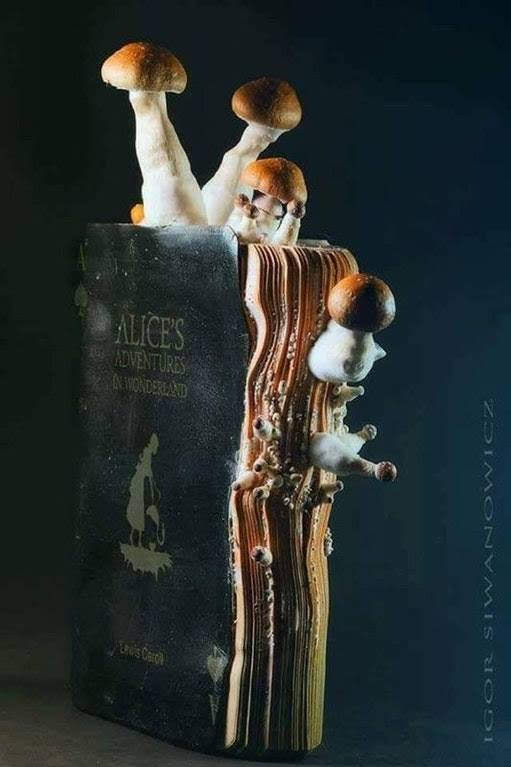
The meme is a playful and humorous take on the idea that some people's brains are so messed up that they can't even remember what they're reading, even if it's a classic like "Alice's Adventures in Wonderland". The image shows a book with mushrooms growing out of it, implying that the reader's brain is so foggy that they can't even recall what's in the book, and that's why they're growing mushrooms. The text "I don't know" is written on the page, indicating that the reader is completely lost and can't even remember what's happening in the story.
detailed-analysis (gemma3-27b-vision)
Okay, here's an analysis of the image, broken down into sections as requested. Some sections will be short or absent, as the image may not heavily lend itself to all frameworks.
Visual Description
The image presents a still-life composition. A vintage copy of Lewis Carroll's "Alice's Adventures in Wonderland" is the dominant element. However, the book is radically altered. The spine and partially the cover appear to be growing mushrooms. These aren’t just on the book, but seem to emerge from its structure, blurring the line between the object (the book) and organic life. The mushrooms range in size and are a creamy/beige color with brown caps. The mushrooms form a kind of organic "crown" or skeletal structure over the book. The lighting is dramatic, with a strong spotlight highlighting the textures of the book’s cover, the edges of the pages, and the mushroom's gills. The background is a deep, dark shade, creating a high contrast and drawing the viewer’s eye towards the central composition. There's a sense of decay and fantastical growth happening simultaneously, a juxtaposition that feels unsettling and intriguing. The image is signed "Igor Siwanowicz".
Foucauldian Genealogical Discourse Analysis
This image lends itself well to a Foucauldian reading. The growth of the mushrooms upon the book can be seen as a visual metaphor for how discourses grow and alter the objects they speak about.
- Discourse & Knowledge: "Alice in Wonderland" itself is a key discourse, influencing childhood, imagination, fantasy, and societal norms. The mushrooms – historically symbols of both sustenance and poison, often linked to the mystical and the unconscious – can be seen as a visual representation of the forces that shape and inflect that original discourse over time. The mushrooms aren't adding to the book, but becoming part of it, changing its meaning through association.
- Power/Knowledge: The image implies a power dynamic. The mushrooms grow on the book, asserting a different kind of “knowledge” – the knowledge of the natural world, of decay, of the unconscious – onto the structured narrative of the book. This is not necessarily a hostile takeover, but a process of layering and transformation.
- Genealogy: The image hints at the history of interpretations around "Alice," the way its meaning has evolved, and been co-opted by various cultural and psychological interpretations. The mushrooms symbolize these accumulated layers, the “roots” of its ongoing relevance.
Critical Theory
The image invites a Critical Theory analysis, specifically relating to the construction of childhood and imagination.
- Deconstruction of Innocence: "Alice in Wonderland" is often presented as a quintessential children’s book, a symbol of innocent imagination. However, the addition of the mushrooms, with their links to the potentially dangerous or hallucinatory, disrupts this simplistic notion. It suggests that even in the realm of childhood fantasy, there is a darker, more complex undercurrent.
- Critique of Narrative Structure: The mushrooms are distorting the form of the book, blurring its boundaries. This can be interpreted as a critique of the very structure of narrative – how it imposes order and control on experience. The mushrooms represent the unruly, chaotic forces that lie beneath the surface of any story.
- The Subliminal: Mushrooms have connections with the subconscious, altered states, and mystery. They symbolize the hidden undercurrents of our conscious experience. This image challenges the notion of a pure, untarnished imagination by presenting a more ambiguous and unsettling interpretation.
Postmodernism
This image is strongly aligned with postmodern aesthetics.
- Blurring Boundaries: The central element is the collapse of boundaries – between object and organism, between text and nature, between the real and the fantastical. This blurring is a key characteristic of postmodern art.
- Intertextuality: The image requires recognition of both "Alice in Wonderland" and the symbolic weight of mushrooms. It’s a work of intertextuality – relying on existing cultural references to create new meaning.
- Fragmentation & Instability: The mushrooms disrupt the clean, ordered structure of the book. This conveys a sense of fragmentation, instability, and the rejection of grand narratives – all hallmarks of postmodern thought.
- Meta-Commentary: The image isn’t just a picture of a book with mushrooms. It's a commentary on the nature of stories, imagination, and our relationship to the natural world. It’s self-aware and deliberately challenges conventional modes of representation.
Marxist Conflict Theory
While not as overtly present as in other analyses, a Marxist reading can be attempted.
- Nature vs. Culture: The image pits the organic, chaotic force of nature (the mushrooms) against the constructed, ordered artifact of culture (the book). This can be interpreted as a symbolic representation of the broader conflict between humanity and the natural world, and the consequences of attempting to dominate it.
- Decay of Capital: The book represents an object of cultural capital. The mushrooms, as a symbol of decay, suggest the inevitable erosion of such structures. This could be interpreted as a critique of the transience of material possessions and the inevitable march of time. However, this reading is quite strained.
Queer Feminist Intersectional Analysis
This framework offers a more nuanced and potentially insightful reading.
- Subversion of Traditional Narratives: "Alice in Wonderland" has been re-read through queer and feminist lenses, questioning its patriarchal structures and uncovering latent desires and challenges to societal norms. The disruption of the book by the mushrooms can be seen as a visual metaphor for these critical interventions.
- The Body & the Other: Mushrooms, as fungal organisms, are often seen as “other” – not quite plant, not quite animal. This “otherness” can be linked to marginalized identities and the struggle for recognition and acceptance.
- Growth & Transformation: The image highlights the themes of growth and transformation, which are central to queer and feminist narratives. The mushrooms, as agents of change, challenge the fixed and rigid structures of the book, allowing for new possibilities and interpretations.
- Reclaiming the Wild: Mushrooms, often found in wild, untamed landscapes, symbolize a rejection of societal control and a reclaiming of natural, embodied experience. This aligns with feminist critiques of patriarchal attempts to regulate and suppress female sexuality and embodiment.
I hope this breakdown provides a comprehensive and insightful analysis of the image. Let me know if you'd like me to elaborate on any particular section or framework!
simple-description (llama3.2-vision)
This meme is a photo of a book with its pages torn out, but instead of being empty, mushrooms are growing out of the book. The text "In 2-3 sentences, describe this meme for someone who cannot see it" is written at the top of the image. The meme is a play on the phrase "In 2-3 sentences" by replacing it with a book and mushrooms, implying that the description of the meme is literally growing out of the book.
tesseract-ocr
ae) Ei i PA deg i) ; hy ; i | , a1 aM | |