First Seen
2024-01-12T20:57:22+00:00
simple-description (qwen3.5_2b-q8_0)
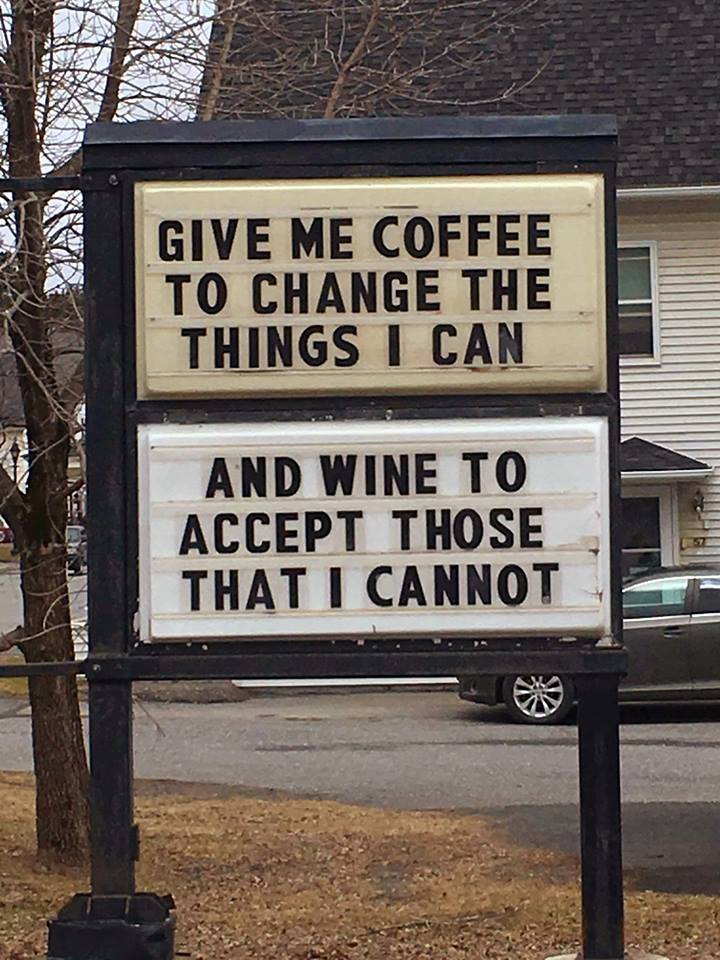
This meme humorously parallels the psychology of addiction and dependency often found in the drugs category. It suggests a progression where a person uses coffee to "fix" a problem before eventually turning to wine to cope with the lingering effects, implying that one might use stimulants to alter their state of mind before accepting the dependency itself. The sign reads: "GIVE ME COFFEE TO CHANGE THE THINGS I CAN / AND WINE TO ACCEPT THOSE THAT I CANNOT"
simple-description (llama3.2-vision_11b)
The meme is a humorous take on the popular coffee shop chain Starbucks' slogan "I'm not a morning person. I'm not a night person. I'm a coffee person." However, in this meme, the phrase is modified to "I'm not a morning person. I'm not a night person. I'm a coffee... AND WINE person." The meme is poking fun at the idea that people often rely on both coffee and wine to get through their days, rather than just one or the other.
detailed-analysis (gemma3-27b-vision)
Okay, here's an analysis of the image, broken down into the requested theoretical frameworks, applying them only where relevant.
Visual Description
The image depicts a dark, rectangular sign, likely situated outside a business (possibly a cafe or bar). The sign is comprised of two separate changeable letter boards, each displaying a phrase in all capital letters. The upper board reads "GIVE ME COFFEE TO CHANGE THE THINGS I CAN." The lower board reads "AND WINE TO ACCEPT THOSE THAT I CANNOT." The sign is a dark color with a black frame. It is supported by black metal legs. The backdrop is a somewhat blurred, residential street scene with a house and bare trees visible, suggesting a fall or early spring setting. The overall aesthetic is a bit worn, typical of a frequently updated sign of this type.
Foucauldian Genealogical Discourse Analysis
This sign provides a fascinating entry point for a Foucauldian analysis. The message isn't about objective reality, but about how we understand, categorize, and react to it.
- Power/Knowledge: The statement positions coffee and wine as tools to manage the world. This is a discourse—a system of thought, language, and practice—that establishes certain relationships between action and substance. The speaker isn't simply stating a preference, but embedding the substances within a system of control and acceptance. It subtly suggests that control is achievable through coffee (engagement, productivity) and passive acceptance through wine (numbing, escapism). The power lies in defining these responses, thereby shaping how the speaker experiences the world.
- Genealogy: Examining the historical roots of the coffee/wine connection reveals a genealogy of coping mechanisms. Historically, both substances have been linked to social rituals, comfort, and altering states of consciousness. This sign isn’t inventing a new connection; it is drawing on a pre-existing historical chain of associations. By framing these substances as a response to alterability/unalterability, it reinforces a history of self-soothing through consumption.
- Disciplinary Practices: The sign implicitly positions the self as needing ‘management.’ We are confronted with the constant categorization of things into those we can/cannot change, and the need to regulate our reactions to them through external substances. This establishes a disciplinary practice of self-regulation.
Critical Theory
This image can be examined through the lens of Critical Theory, particularly focusing on the concept of ideology and how it manifests in everyday life.
- Ideology: The sign presents a seemingly innocuous statement, but it subtly reinforces a pervasive ideology of control and acceptance as necessary responses to the world. It normalizes the idea that we must either change or accept, and that these responses require external substances. It's a micro-level example of how ideologies seep into our everyday language and thinking.
- Commodification of Coping: The message subtly commodifies emotional responses. It presents coffee and wine, products, as solutions to existential issues. This ties into the broader capitalist tendency to turn all aspects of life into commodities, including emotional wellbeing.
- False Consciousness: The sign can be seen as contributing to a form of false consciousness. It prevents deeper examination of why things are unchangeable, or who benefits from the categorization of change/unchangeability. It simply accepts the division, and offers a chemical response, rather than encouraging critical analysis.
Postmodernism
The image aligns well with several themes of postmodern thought.
- Fragmentation & Deconstruction: The sign presents a fragmented view of agency and control. There’s a clear division between "things I can change" and "things I cannot," without a unifying logic. The division itself is a deconstruction of any notion of a holistic self, capable of impacting all aspects of its environment.
- Meta-Narrative Rejection: The statement rejects grand narratives of progress or control. It’s not about fixing the world, but about managing its unfixable aspects. It acknowledges the limitations of agency and the inevitability of acceptance.
- Simulation & Hyperreality: The association of coffee and wine with specific emotional states can be seen as a form of simulation. They aren't inherently solutions, but have become culturally coded to represent solutions, creating a hyperreality where the signifier (the drink) substitutes for the actual emotional process.
Note: A Marxist Conflict Theory or Queer Feminist Intersectional Analysis wouldn’t be particularly relevant to the image. While these frameworks are valuable, the core message doesn’t directly address class conflict, or the intersection of power dynamics based on gender, sexuality, etc. The sign is primarily focused on individual coping mechanisms and the construction of subjectivity.
Let me know if you would like me to expand on any of these points or explore other theoretical frameworks!
tesseract-ocr
Uae yo oa aes a Tg cive ME COFFEE om TO CHANGE THE [om OM) THINGS I CAN Te AND WINETO = 3) Accept THOSE ey THAT I CANNOT fea Sag B. a ————————— i O—— | =
simple-description (llama3.2-vision)
This meme is a humorous take on the popular phrase "I'll have what she's having" from the movie "When Harry Met Sally." The meme features a sign that says "I'll have what she's having... and wine" in response to a customer ordering a coffee. The sign is a playful twist on the original phrase, adding a humorous touch to a common coffee shop experience.