First Seen
2025-05-29T20:21:18.927616+00:00
simple-description (qwen3.5_2b-q8_0)
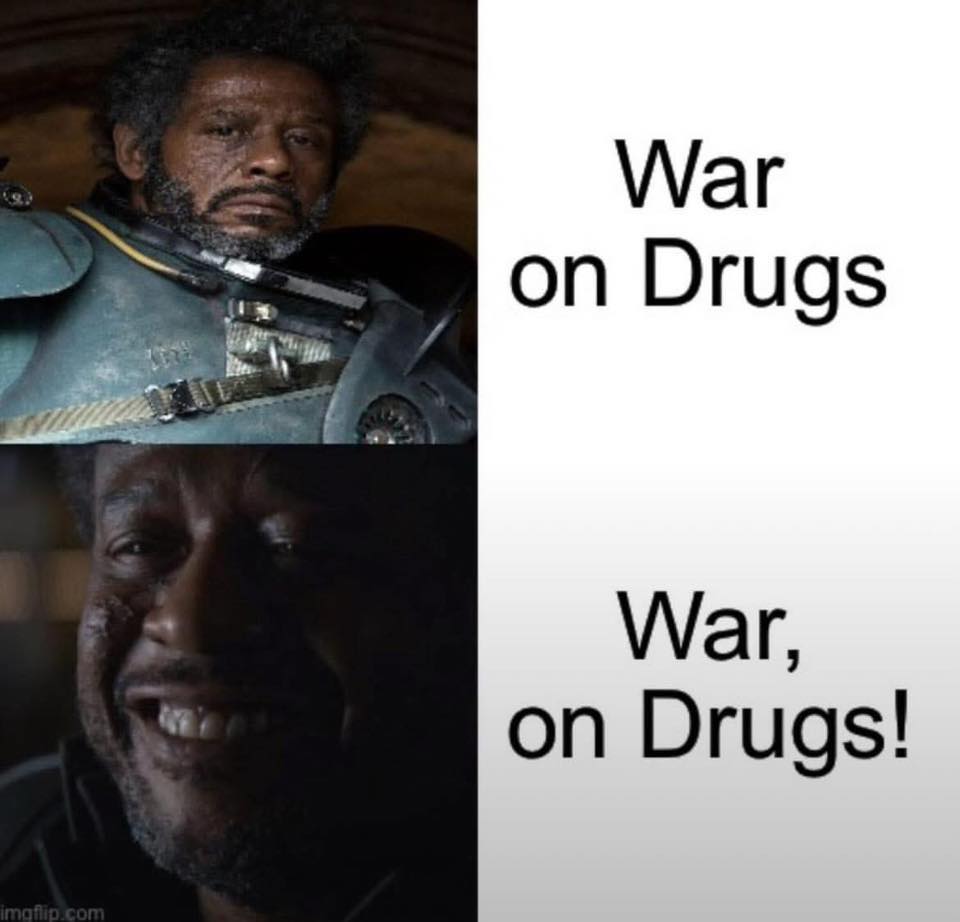
This meme is a joke about the intensity of the "War on Drugs," utilizing a split image to show a character, Denzel Washington, reacting to it differently. In the top panel, he looks weary and serious as if he is in a space suit, while in the bottom panel, he is shown laughing uncontrollably in the dark. The text on the right reads "War on Drugs" on top and "War, on Drugs!" on the bottom, implying that the war on drugs has escalated to a breaking point.
detailed-analysis (gemma3_27b-it-q8_0)
Okay, let's break down this meme through several theoretical lenses, specifically as it relates to the category of "Drugs" and the "War on Drugs."
Visual Description
The meme features two panels of a picture of Carl Weathers playing Greef Karga in The Mandalorian. In the first panel, Karga has a stern, somewhat disappointed expression. Text overlays the image: "War on Drugs." In the second panel, Karga is smiling broadly, eyes wide, with the text "War, on Drugs!" The humor derives from the contrast in Karga’s expression and the slight alteration of the phrase. The emphasis, signaled by the exclamation point, suggests a shift in tone from a serious, somber declaration to an excited, almost zealous one.
Foucauldian Genealogical Discourse Analysis
Michel Foucault’s work is extremely relevant to the "War on Drugs." The meme subtly critiques how the discourse around drugs (and the "War") has been constructed and deployed.
- Genealogy: Foucault's genealogical method examines the historical emergence of concepts and power dynamics. The "War on Drugs" wasn't a natural, inevitable response to drug use. It was constructed through evolving social, political, and economic factors. The meme taps into the growing awareness that the narrative of a ‘War’ implies a simplistic binary of ‘good’ and ‘evil’, fueling escalating measures of control.
- Discourse & Power/Knowledge: The “War on Drugs” is a powerful discourse – a system of thought, language, and practice. This discourse doesn’t simply describe drug use; it creates categories of “drug users”, “criminals”, and “threats,” thereby justifying social control mechanisms (policing, incarceration, legal sanctions). The shift in Karga’s expression suggests the discourse has become unhinged, perhaps overly enthusiastic, about its own power to categorize and punish. The first image represents the serious and somber tone of the “war” and the second represents the zealous, almost fanatical embrace of the rhetoric, prioritizing the exercise of power through the discourse over actual problem-solving.
- Biopower: The War on Drugs deeply relates to Foucault’s concept of biopower – the way modern states regulate life and bodies. Drug control measures aren't just about stopping drug use; they're about controlling bodies, regulating morality, and managing populations. The meme's implied critique suggests this biopower has spiraled into something excessive.
Critical Theory
The meme works as a form of critical commentary on the “War on Drugs”, specifically relating to its function within society.
- Ideology: The "War on Drugs" has functioned as an ideology – a set of beliefs that obscures underlying power structures and justifies inequality. The meme hints at the absurdity of framing a complex social issue as a 'War', serving to hide the real systemic issues at play.
- Hegemony: The idea of the 'War' has achieved a certain cultural hegemony—it’s become a common-sense assumption, difficult to challenge. The meme’s humor arises from the subtle undermining of that hegemony. It prompts a moment of reflection: is this “war” really working, or is it simply perpetuating harm?
- Instrumental Reason: The meme suggests that the “War on Drugs” has become an example of Max Horkheimer and Theodor Adorno’s concept of instrumental reason. The focus has shifted from actually addressing the problems of addiction and harm reduction to simply deploying increasingly powerful, but often ineffective, means of control, detached from ethical considerations.
Marxist Conflict Theory
From a Marxist perspective, the “War on Drugs” isn’t simply a moral failing but a reflection of class conflict and the maintenance of capitalist structures.
- Class & Control: Drug laws disproportionately impact marginalized communities – poor communities, communities of color. This isn’t accidental. The "War on Drugs" can be seen as a tool for social control, suppressing dissent and maintaining the existing power structure.
- Economic Interests: The prison-industrial complex (private prisons, security firms, etc.) benefits from mass incarceration, and the “War on Drugs” fuels this. The meme implicitly questions the underlying economic incentives driving the conflict.
- False Consciousness: The rhetoric of “saving society” from drugs can be seen as a form of false consciousness—a way to mask the true interests at play. The meme suggests a questioning of this narrative, hinting that the “war” serves the interests of the ruling class rather than the working class.
Postmodernism
The meme's playful deconstruction of the phrase "War on Drugs" aligns with postmodern themes.
- Deconstruction: The slight alteration of the phrase—adding the exclamation point and the change in facial expression—deconstructs the assumed seriousness of the “War on Drugs”. It reveals the constructed nature of the term and the potential for its ironic reinterpretation.
- Rejection of Metanarratives: Postmodernism rejects grand narratives (like the idea of a definitive “War”). The meme contributes to this by suggesting the “War on Drugs” is a flawed, overly simplistic approach to a complex issue.
- Playfulness & Irony: The humor of the meme relies on irony and playfulness, characteristics often associated with postmodern art.
In Conclusion:
The meme is more than just a silly picture with text. It’s a subtle but pointed critique of a highly contested and harmful social policy. It invites viewers to question the origins, motivations, and consequences of the “War on Drugs,” and to consider the ways in which it operates as a system of power, control, and ideological reinforcement. Its effectiveness lies in its brevity, its use of a recognizable cultural reference (Carl Weathers), and its ability to spark critical thinking.
simple-description (llama3.2-vision_11b)
The meme is a play on the phrase "War on Drugs" and the Star Wars franchise, with a character from the series, Boba Fett, saying "War... on... Drugs" in a dramatic tone. The meme is humorous because it takes a serious phrase and turns it into a pun, making it a lighthearted and humorous take on the original phrase.
detailed-analysis (gemma3-27b-vision)
Okay, let's analyze this meme image with the requested theoretical frameworks.
Visual Description
The meme is a two-panel reaction image utilizing a scene from the show The Wire. The character depicted is Lester Freamon, a detective known for his methodical investigative style.
- Panel 1: Shows Freamon with a calm, focused, and slightly cynical expression. He is in a dimly lit room, wearing a tactical vest. The framing is a medium shot focusing on his face. The tone is one of assessment.
- Panel 2: A close-up shot of Freamon, now with a widened eye and a more emphatic, almost exasperated expression. This shows a sudden change in intensity.
- Text: The text accompanying the image reads: “War on Drugs” (first panel) and “War, on Drugs!” (second panel). The exclamation point in the second panel emphasizes a dramatic shift in tone.
The contrast between the two images communicates a build-up of realization, frustration or perhaps disbelief. The use of a character known for his logical, measured approach suggests a pointed commentary on a complex issue.
Foucauldian Genealogical Discourse Analysis
This meme lends itself well to a Foucauldian analysis. The "War on Drugs" is not an objective struggle against illicit substances, but a discourse – a system of thought, language, and practice that constructs our understanding of drugs, crime, and punishment.
- Genealogy: Tracing the history of the "War on Drugs" reveals it wasn't a natural or inevitable response to drug use, but a constructed political and social project. It emerged from specific historical contexts, including racial anxieties, political opportunism, and the desire for social control.
- Power/Knowledge: The discourse of the "War on Drugs" is inextricably linked to power. The way we talk about drugs (as inherently evil, as a threat to society) creates the very categories that justify surveillance, policing, incarceration, and the expansion of the carceral state. Freamon's initial calm expression is a quiet knowing of the mechanics of the system, and his later emphatic reaction expresses the absurdity of it.
- Disciplinary Power: The meme suggests a critique of the ways the "War on Drugs" functions as a form of disciplinary power, normalizing certain behaviors and demonizing others. It implicates not just the legal and police systems, but also the medical, educational, and cultural institutions that reinforce this discourse.
The meme's effect lies in revealing the constructedness of the "War on Drugs" – that it's not a natural fact but a social and political phenomenon shaped by power relations.
Critical Theory
From a critical theory perspective, the meme critiques the ideological underpinnings of the "War on Drugs."
- Ideology: The phrase "War on Drugs" itself functions as an ideology—a set of beliefs that legitimize the existing social order. It presents a simplistic narrative of good versus evil, obscuring the complex social, economic, and political factors that contribute to drug use and drug trafficking.
- Hegemony: The dominant narrative of the "War on Drugs" has achieved a degree of hegemony—it is widely accepted as common sense, even though it serves the interests of certain groups (e.g., law enforcement, the prison-industrial complex). Freamon's initial calm is a sort of acceptance of the established order, while his outburst suggests an awakening to its contradictions.
- Domination and Oppression: Critical theory highlights how the "War on Drugs" disproportionately impacts marginalized communities, particularly people of color. The meme implicitly critiques the systemic racism embedded within the criminal justice system. The contrast in images suggests that while on the surface the war on drugs appears rational (calm face), when analyzed it is actually an absurd waste of resources and has destructive consequences.
Marxist Conflict Theory
From a Marxist perspective, the "War on Drugs" can be viewed as a manifestation of class conflict and a tool for maintaining the status quo.
- Class Struggle: The "War on Drugs" can be seen as a way to control and suppress marginalized communities, who are often disproportionately affected by poverty, unemployment, and lack of opportunity.
- Capitalism and Profit: The meme subtly critiques the ways in which the "War on Drugs" benefits certain capitalist interests, such as the prison-industrial complex, pharmaceutical companies, and private security firms. The focus on criminalizing drug use diverts attention from addressing the underlying social and economic conditions that contribute to it.
- False Consciousness: The meme suggests that the public has been misled into believing that the "War on Drugs" is a genuine effort to improve public safety, while in reality, it serves to maintain the power and privilege of the ruling class. Freamon’s realization embodies the moment when people become aware of this deception.
Postmodernism
A postmodern reading of the meme emphasizes the instability of meaning and the deconstruction of grand narratives.
- Deconstruction: The meme challenges the seemingly straightforward meaning of the phrase "War on Drugs." It exposes the contradictions and ambiguities inherent in this concept.
- Simulacra and Simulation: The "War on Drugs" can be seen as a simulacrum—a copy without an original. It is a media-driven spectacle that obscures the underlying realities of drug use and drug trafficking. Freamon's expressions capture this sense of disconnection from reality.
- Hyperreality: The meme could also be interpreted as suggesting that the "War on Drugs" has become a hyperreality – a simulation that is more real than real, and which has eclipsed the actual problems it claims to address.
Queer Feminist Intersectional Analysis
While not explicitly centered on gender or sexuality, an intersectional analysis can reveal how the "War on Drugs" intersects with other forms of oppression.
- Intersectionality: The meme implicitly highlights how the "War on Drugs" disproportionately impacts queer and trans people of color, who are already marginalized due to their race, gender identity, and sexual orientation. The criminalization of drug use can exacerbate existing inequalities.
- Gendered Impacts: The "War on Drugs" can have different impacts on women than on men. For example, women who use drugs are more likely to be arrested for drug-related offenses and are more likely to face harsh sentencing.
- Carceral Feminism: This meme can critique the ways in which the carceral state (prisons, policing) is presented as a solution to gender-based violence and other forms of harm, while neglecting the underlying social and economic conditions that contribute to these problems.
In all of these readings, the power of the meme lies in its ability to disrupt our assumptions and provoke critical thinking about a complex and often misunderstood issue.
Let me know if you'd like me to elaborate on any of these analyses.
simple-description (llama3.2-vision)
This meme is a humorous comparison between two characters, one from a movie and one from a TV show, both known for their tough and intimidating personas. The image juxtaposes a character from the movie "Mad Max: Fury Road" with a character from the TV show "Star Wars: The Mandalorian". The text "War on Drugs" appears on the left, while the text "War on Drugs" is replaced with "War, on Drugs!" on the right.