First Seen
2023-05-10T21:03:35+00:00
simple-description (llama3.2-vision_11b)
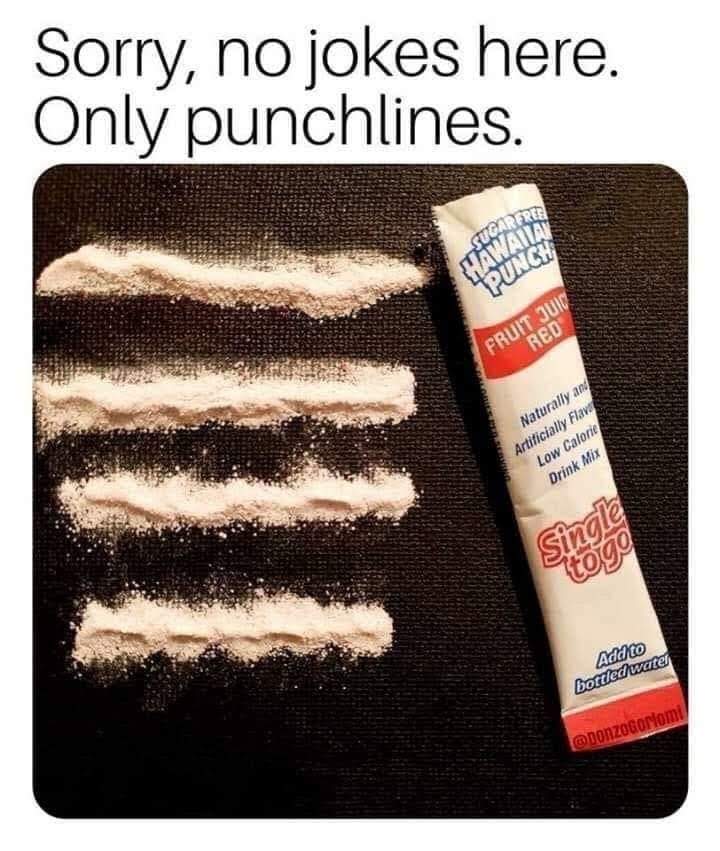
The meme is a joke about the popular phrase "no jokes here" being replaced with "no lines" to reference the lines of cocaine, making a humorous connection between the phrase and the drug. The image shows a series of lines of cocaine with a packet of "Fruit Punch" drink mix in the center, implying that the drink mix is being used to make a cocaine-like substance. The text at the top reads "Sorry, no jokes here. Only punchlines."
detailed-analysis (gemma3-27b-vision)
Okay, let's break down this image using the requested theoretical frameworks. It's a disturbing image, and the analysis will reflect that. Please be aware that this analysis will address potentially sensitive topics like drug use.
Visual Description
The image depicts a dark, textured surface (likely a table) on which a series of parallel, white powder lines have been arranged. The lines are roughly the same length and spacing. Adjacent to these lines is an open packet of "Hawaiian Punch" single-serve drink mix, partially used, with the packet visible to the side. The packet is brightly colored, with red, yellow, and blue, and reads "Naturally and Artificially Flavored, Low Calorie Drink Mix" as well as "Add to bottled water." A user name "@nonzoryoml" is present on the bottom of the image. The image is captioned, “Sorry, no jokes here. Only punchlines.”
The visual juxtaposition is stark: the innocence of a children’s drink next to the strong implication of illicit drug use. The angle is somewhat overhead, suggesting a deliberate presentation of the lines and packet. The lighting is fairly dim, lending an unsettling, clandestine atmosphere.
Foucauldian Genealogical Discourse Analysis
This image is ripe for analysis through a Foucauldian lens. The "lines" clearly evoke the visual presentation of cocaine, immediately situating the image within a discourse of drug use, addiction, and criminality. Foucault would be interested in how this meaning is created, not in determining if it is cocaine (the image doesn’t need to be definitively depicting cocaine to operate as a signifier within that discourse).
- Archaeology of Knowledge: The image draws upon a historical knowledge surrounding drug presentation. The lined-up pattern has become iconic through media portrayals (films, television, news) of drug use, creating a recognizable sign. This image functions by triggering existing knowledge about that imagery.
- Power/Knowledge: The image demonstrates how knowledge about drugs is interwoven with power dynamics. The criminalization of certain substances and the associated discourse construct "addicts" as "others," justifying surveillance, control, and punishment. By presenting this imagery, the image implicitly references those power structures.
- Discipline & Punishment: The image implicitly touches on the discourse surrounding addiction and its punitive consequences. The "punchlines" caption can be interpreted as a dark joke referring to the consequences/punishment of drug use. The image's starkness evokes a sense of illicit activity and the potential for surveillance and control.
Critical Theory
Applying a Critical Theory approach, the image can be seen as a critique of the construction of desire and the commodification of escape.
- Ideology: The Hawaiian Punch packet, a symbol of childhood sweetness and artificiality, juxtaposed with the drug lines, highlights the ways in which capitalist culture both creates and attempts to mask the underlying anxieties and alienation that drive individuals towards escapism. The powdered drink mix promises instant gratification, similar to the fleeting highs of drug use.
- Commodification of Experience: Both the Hawaiian Punch and the implied drugs offer temporary relief or altered states of consciousness, which become commodities in a society driven by consumerism. The image suggests that both are ultimately empty substitutes for authentic experience.
- Alienation: The dark, isolated setting of the image, and the implication of secret, illicit activity, speaks to feelings of alienation and disconnection from society. Drug use, in this framework, becomes a symptom of a deeper societal malaise.
Marxist Conflict Theory
From a Marxist perspective, the image highlights class and power dynamics intertwined with substance abuse.
- Capitalism & Addiction: Capitalism creates conditions conducive to addiction. The pressures of wage labor, economic inequality, and the alienation of the working class can contribute to substance abuse as a coping mechanism.
- Commodification of Suffering: The image suggests that drug use is not simply an individual problem, but a product of systemic issues. The illicit drug trade thrives on the exploitation of vulnerable populations.
- Control & Repression: The criminalization of drugs serves the interests of the ruling class by controlling marginalized communities and diverting resources away from addressing the root causes of social problems.
Postmodernism
From a Postmodern perspective, the image deconstructs notions of authenticity and meaning.
- Simulacra & Simulation: The juxtaposition of the Hawaiian Punch packet and the drug lines blurs the distinction between reality and representation. The image becomes a simulacrum – a copy without an original, a surface appearance without depth.
- Deconstruction of Meaning: The image undermines any easy interpretation. The "punchlines" caption is a cynical play on words that challenges the viewer to question the meaning behind the image. It rejects the possibility of a fixed, stable meaning.
- Fragmentation & Dislocation: The image reflects a sense of fragmentation and dislocation characteristic of postmodern society. The disconnected elements (the drink packet, the lines, the dark setting) contribute to a sense of disorientation.
Queer Feminist Intersectional Analysis
This framework requires a nuanced approach as the image doesn’t immediately signal gender or sexuality. However, intersectional analysis can shed light on how power imbalances influence drug use and its consequences.
- Vulnerability & Marginalization: Individuals who are marginalized based on gender, sexual orientation, race, or class are disproportionately affected by substance abuse and face greater barriers to treatment. The image, in its starkness, implicitly highlights the vulnerability of those living on the margins.
- Trauma & Addiction: Trauma, particularly for those with intersecting marginalized identities, is a significant risk factor for substance abuse. The image's unsettling atmosphere hints at the underlying pain and suffering that may contribute to drug use.
- Power Dynamics & Control: The image can be seen as a commentary on power dynamics and control over bodies and experiences. The criminalization of drugs disproportionately affects marginalized communities, reinforcing existing power imbalances.
Important Disclaimer: This analysis is based on interpretation. The image is disturbing and deals with sensitive subjects. This analysis is not meant to condone or glorify drug use, but to explore the complex meanings and social implications it evokes.
simple-description (llama3.2-vision)
This meme is a joke about the phrase "no jokes" being followed by "only punchlines". The image shows a photo of a packet of "Fruit Punch" drink mix with a packet of "Punch" fruit drink mix next to it, and the text "Sorry, no jokes here. Only punchlines." The joke is a play on words, using the phrase "no jokes" and "only punchlines" to make a humorous comment about the drink mix.
tesseract-ocr
Sorry, no jokes here. Only punchlines. —— ae z