First Seen
2023-05-10T20:59:58+00:00
simple-description (llama3.2-vision_11b)
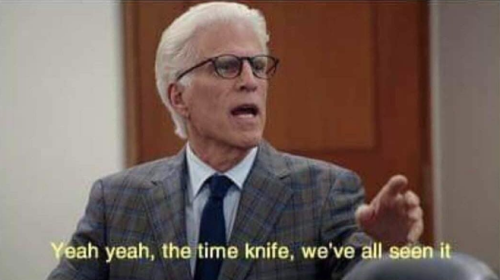
The meme is an image of a character from the TV show "The Good Place" (Michael) with a shocked expression. The text overlayed on the image is "We've all seen the time knife, we've all seen it." The meme is a humorous commentary on the show's use of the "time knife" plot device, which is a central element of the show's storyline.
detailed-analysis (gemma3-27b-vision)
Here's an analysis of the image, broken down into the requested theoretical frameworks. Please note that not all frameworks will apply directly, and some interpretations will require a degree of speculation given the single image.
Visual Description
The image depicts actor Jeff Goldblum, likely from the television series “Legion.” He is an older, Caucasian man with short, white hair, wearing glasses, a dark patterned suit jacket, and a dark blue tie. He’s mid-sentence, mouth open in a somewhat animated expression, with one hand raised as if emphasizing a point. The background is indistinct, a doorway or interior wall. Text overlays the image, reading “Yeah yeah, the time knife, we’ve all seen it.” The lighting is bright, and the composition centers on his face and upper body. The overall tone is one of somewhat eccentric, professorial authority.
Postmodernism
The phrase "the time knife, we've all seen it" is ripe for postmodern interpretation. It immediately calls into question the nature of reality. "The time knife" is an abstract concept—a metonym for temporal disruption, trauma, or the manipulation of history. The statement "we've all seen it" is key. It suggests a shared, yet fragmented experience, a collective unconscious related to time itself. It hints at the loss of the grand narrative. In postmodern thought, "history" isn't a linear progression of objective events but a construct, a series of interpretations. "The time knife" could be a symbol of those ruptures in the perceived linearity of time, and the claim of shared visibility implies that the boundaries between reality and subjective experience are blurred. The image, taken with its somewhat uncanny and surreal feeling, perfectly encapsulates the aesthetic of postmodern art, deconstructing and reconstructing notions of reality. The claim of a “shared” experience is ironic, as postmodernism denies universal truths.
Foucauldian Genealogical Discourse Analysis
Applying a Foucauldian lens, we can analyze the "time knife" as a discourse. It's not simply an object but a concept that organizes and governs how we understand (or fail to understand) time and its effects. The claim “we've all seen it” is particularly intriguing because it suggests the normalization of something previously unseen or unspoken. This aligns with Foucault’s interest in how power operates through the creation of discourses and the shaping of knowledge.
A genealogical approach asks how this discourse of the "time knife" emerged – what historical conditions, social practices, and power dynamics led to its articulation? What institutions (perhaps a specific community, group or even a character within the show) are invested in maintaining this discourse? Who benefits from framing time in this way? The statement implies a certain level of "epistemic violence" – that previous understandings of time have been overturned, perhaps through force or persuasion, leaving a collective sense of recognition, but potentially obscuring the way this new understanding was imposed. The image and text together suggest a process of normalizing trauma or disruption through language.
Critical Theory
Within a Critical Theory framework, "the time knife" could be seen as an allegory for systems of oppression or control. The ‘knife’ implies cutting, fragmentation, and violation. The claim that ‘we’ve all seen it’ could be read as a commentary on the normalization of trauma or violence within society. It’s a sort of complicity by witnessing.
The image itself, with its authoritative figure delivering the line, points to the role of intellectuals or those in positions of power in perpetuating and concealing these structures. The speaker’s calm demeanor in the face of something as potentially disruptive as a “time knife” could be interpreted as a form of ideological control – a way of domesticating a dangerous concept and making it palatable. This aligns with critical theory's focus on how dominant ideologies maintain the status quo by shaping our understanding of reality.
Queer Feminist Intersectional Analysis
From a Queer Feminist Intersectional perspective, the "time knife" could represent the ways in which experiences of time are differentially shaped by intersecting identities (gender, sexuality, race, class, etc.). The fragmentation implied by the ‘knife’ might symbolize the disorienting effects of trauma, particularly for those who have been marginalized or oppressed.
The claim that ‘we’ve all seen it’ could be a critique of the way dominant narratives erase or invalidate the unique temporal experiences of marginalized groups. For example, historical trauma can create a sense of cyclical time, where past events continue to reverberate in the present. This experience may be invisible or dismissed by those who inhabit a more linear understanding of time. The image, with its somewhat ambiguous and unsettling quality, could be seen as an attempt to disrupt those dominant narratives and acknowledge the multiplicity of temporal experiences.
Marxist Conflict Theory (Less Directly Applicable)
While not the most prominent lens, Marxist Conflict Theory could see the “time knife” as a metaphor for the disruptive forces of capitalist change. The ‘knife’ represents the cutting away of old systems and the imposition of new ones. The statement "we've all seen it" could be interpreted as the normalization of exploitation or alienation as an inherent part of the capitalist system. The authority figure delivering the line could represent the ruling class subtly justifying these changes. However, this is a more tenuous reading, and the image and text lend themselves more readily to the other frameworks outlined above.
Disclaimer: These are interpretations based on a single image and the context provided by the text. A deeper understanding would require a knowledge of the source material (Legion) and its overarching themes.
simple-description (llama3.2-vision)
This meme is a screenshot from the TV show "The Good Place" featuring the character Michael, played by Ted Danson. In the image, Michael is reacting to a shocking event with a mix of surprise and irony, saying "Well, I never!" and holding up his hands in a "what?" gesture. The text overlay on the image is "Yeah, we've all seen it."
tesseract-ocr
E ay a | “ ‘ apd, . Lom f “3 Te ta Pu Maw) aa