First Seen
2023-05-10T21:03:35+00:00
simple-description (llama3.2-vision_11b)
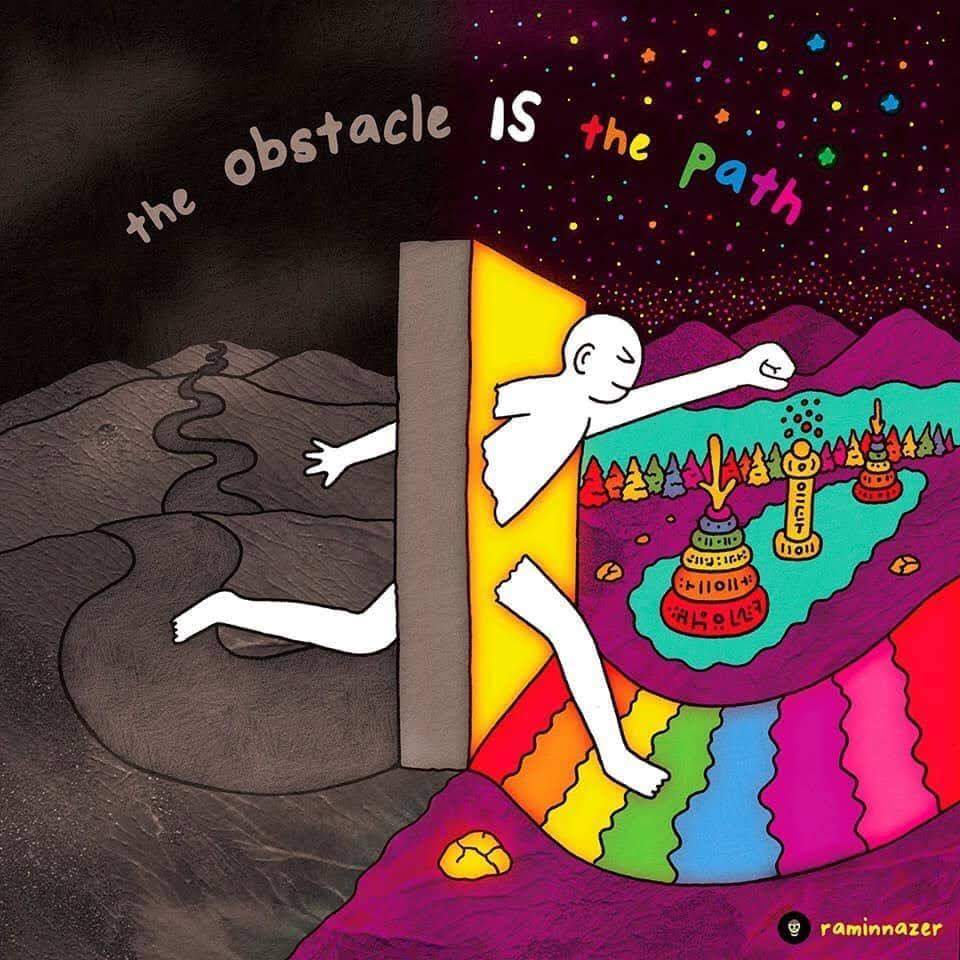
This meme uses a simple drawing of a person walking on a road to convey the idea that the path to a desired goal or outcome (in this case, a specific drug) is often fraught with obstacles and challenges. The text "the obstacle is the path" is a phrase popularized by the 2013 film "The Path" and is often used to describe the idea that the challenges and obstacles we face in life are actually the key to achieving our goals.
detailed-analysis (gemma3-27b-vision)
Okay, let's break down this image through the lenses you've requested. It's a rich image that lends itself to multiple interpretations.
Visual Description
The image depicts a stylized, almost cartoonish human figure in the process of breaking through a solid yellow wall. The figure is slender and rendered in white, appearing to be pushing/climbing through a rectangular opening in the wall. One hand and both legs are on the “dark” side of the wall, while the head and one arm are on the “bright” side.
The "bright" side is a vibrant, psychedelic landscape. It features a flowing, multicolored river or terrain with tree-like shapes, and a series of mushroom-like objects. The landscape feels fantastical and dreamlike. The backdrop on this side is a dark purple with stars/glitter, creating a sense of otherworldly space.
The "dark" side is a simple, flat, dark grey, or black, lacking any detail beyond the wall itself. Above the scene, in stylized lettering, is the phrase “the obstacle IS the path”. The artist’s username (@raminnazer) appears in the lower right corner. The image has a flat, illustrative quality, akin to a digital painting.
Foucauldian Genealogical Discourse Analysis
This image immediately invokes a discourse around power and the construction of reality. The wall itself can be read as a dispositif – a heterogeneous ensemble of discourses, institutions, architectural forms, regulations, laws, and practices that function to produce specific knowledge/truth regimes and control subjects. The wall is not simply a physical barrier, but represents a socially constructed obstacle – norms, expectations, systems of control – that define what is 'allowed' or 'possible'.
The figure breaking through the wall is not just an act of physical overcoming, but a disruption of the discourse that created the wall in the first place. The figure’s effort creates a space where new, different ways of being can emerge. The vibrant landscape on the other side represents the possibilities that become visible when established power structures are challenged. The image can be interpreted as showing the genealogy of resistance, tracing how a perceived obstacle, through forceful engagement, becomes the very means of generating a new reality.
The emphasis on "IS" rather than "leads to" in the central phrase suggests that the obstacle isn’t overcome and then abandoned; it’s integrated into the path itself. This reflects Foucault’s ideas about power being productive, not just repressive. The act of struggle shapes the emergent landscape.
Critical Theory
From a Critical Theory perspective, the image speaks to the ways in which societal structures create and maintain oppression. The wall represents the hegemonic forces that limit individual freedom and self-realization. These forces can be seen as systems of domination—political, economic, cultural—that shape our perceptions and restrict our possibilities.
The figure’s struggle to break through the wall can be interpreted as a metaphor for the emancipation of marginalized groups. The vibrant landscape on the other side represents a utopian vision of a society free from oppression. It's important to note that the image does not depict a simple “overcoming” of the obstacle, but rather a transcendence – a movement through it. This suggests that true liberation requires confronting and integrating the sources of our oppression, rather than simply abandoning them.
The phrase “the obstacle IS the path” can be seen as a call to action. It suggests that we should not shy away from challenges, but instead embrace them as opportunities for growth and transformation. This resonates with the Frankfurt School's focus on critical self-reflection and the need to challenge the status quo.
Marxist Conflict Theory
From a Marxist perspective, the wall represents the material conditions of class struggle. The wall separates those who are "inside" the system (those who benefit from the established order) from those who are "outside" (those who are marginalized and exploited). The figure breaking through the wall represents the proletariat or other oppressed groups challenging the dominant class.
The vibrant landscape on the other side symbolizes a potential socialist or communist utopia, a society where resources are distributed equitably and all individuals have the opportunity to thrive. The struggle to break through the wall represents the class conflict inherent in capitalist society, where the interests of the bourgeoisie and the proletariat are fundamentally opposed.
The phrase "the obstacle IS the path" can be interpreted as a call for revolutionary action. It suggests that the struggles themselves, the very act of challenging the oppressive system, are what will ultimately lead to a more just and equitable society. This aligns with Marx's theory of historical materialism, which posits that social change is driven by class conflict.
Postmodernism
The image embodies several postmodern sensibilities. The highly stylized, illustrative quality rejects traditional representational aesthetics. The psychedelic landscape on the other side signifies a rejection of grand narratives and objective truths. Reality is not presented as fixed or stable, but as fluid and subjective.
The phrase "the obstacle IS the path" challenges binary oppositions (obstacle/path, resistance/acceptance). It suggests that the distinction between these concepts is illusory. This aligns with postmodern deconstruction, which seeks to dismantle hierarchical structures of thought.
The image can also be read as a commentary on simulation and hyperreality. The vibrant landscape may not be "real" in a traditional sense, but it is nonetheless a powerful force that shapes our perceptions and experiences. This resonates with Jean Baudrillard's theories on the loss of the real and the proliferation of signs.
Queer Feminist Intersectional Analysis
From a Queer Feminist Intersectional perspective, the wall represents the interlocking systems of oppression that marginalize individuals based on their gender, sexuality, race, class, and other social identities. It symbolizes the barriers that queer and feminist individuals face in a patriarchal, heteronormative society. The flat, colorless side of the wall could represent the invisibility and erasure experienced by marginalized communities.
The figure breaking through the wall represents the resilience and agency of queer and feminist individuals who resist these systems of oppression. The vibrant landscape on the other side signifies a utopian vision of a society where all individuals are free to express their identities and live their lives authentically. The colorful, flowing terrain represents the diversity and fluidity of gender and sexuality.
The phrase "the obstacle IS the path" resonates with the concept of radical self-acceptance. It suggests that our struggles and traumas can be sources of strength and empowerment. The image emphasizes that liberation is not about escaping our identities, but about embracing them and challenging the systems that seek to oppress us. The integration of the obstacle into the path suggests that trauma and oppression can be transformative forces, shaping our identities and building solidarity.
Hopefully, this detailed breakdown captures the various layers of meaning in the image and provides a comprehensive analysis from the perspectives you requested. Let me know if you'd like me to elaborate on any of these points further.
simple-description (llama3.2-vision)
The meme is a simple illustration of a person walking into a door with a sign that says "The obstacle is the path". The image is meant to be humorous and ironic, suggesting that the person is so focused on the sign that they're not even paying attention to the fact that they're about to walk into a door.
tesseract-ocr
xacle Ky rib ane 32 nid oo® ee es ca a a tr Ril gel