First Seen
2023-05-10T21:03:35+00:00
simple-description (llama3.2-vision_11b)
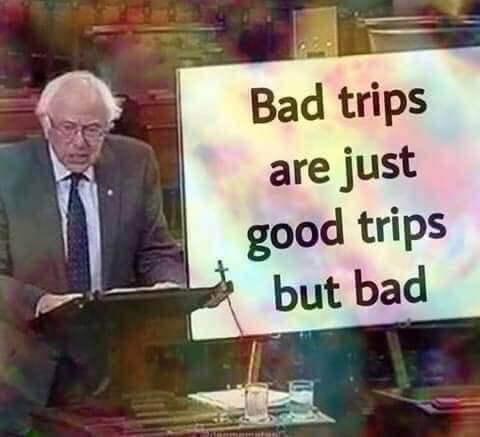
The meme is a photo of Bernie Sanders, a former US presidential candidate, sitting at a desk with a sign behind him that reads "Bad trips are just good trips but bad". The image is likely a joke about the experience of using certain substances, implying that a "bad trip" can be a good experience in a way that's relatable to the use of substances.
detailed-analysis (gemma3-27b-vision)
Okay, let's break down this meme through various theoretical lenses. It's a bit of a wild ride, given the subject matter!
Visual Description
The image is a still frame of Bernie Sanders speaking at a podium. He is wearing a dark suit, and a white-haired and looks earnest. Behind him is a large digital screen displaying the text: "Bad trips are just good trips but bad." The background is blurred, suggesting a large crowd. The lighting is somewhat dim and gives the overall image a slightly vintage or grainy appearance. This image is likely a screenshot taken from a live broadcast or a recording of Bernie Sanders speaking, potentially during his 2020 presidential campaign.
Foucauldian Genealogical Discourse Analysis
This meme utilizes the discourse surrounding experiences with psychedelic drugs ("trips"). A Foucauldian analysis would not be interested in whether "bad trips" are objectively bad, but rather how the category of “bad trip” has been historically constructed and what power dynamics it enacts.
- Discursive Formation: The language of "good" and "bad" trips is not inherent to the experience itself. It's a categorization developed through the intersection of counter-cultural drug use, medical/psychiatric labeling (e.g., anxiety, panic), and narratives of self-discovery/spiritual exploration.
- Power/Knowledge: The classification of a trip as "bad" can become a form of control, both internally (self-judgment) and externally (social stigma, legal repercussions). The meme subtly challenges this classification by equating it to the "good" trips, suggesting that it’s not an inherent quality, but merely an evaluation of the experience.
- Genealogy: Tracing the history of this discourse reveals shifts in attitudes towards psychedelics – from early promise in psychotherapy, to demonization during the War on Drugs, to recent re-emergence in some therapeutic and spiritual contexts. The meme can be seen as part of this shifting discourse.
Critical Theory
From a Critical Theory perspective (drawing from thinkers like Adorno and Horkheimer), the meme can be seen as a subversive challenge to dominant narratives.
- Rejection of Binary Oppositions: The meme deliberately collapses the binary of "good/bad". Critical Theory often critiques binaries as tools of control and simplification. By reducing a complex experience to a difference in evaluation, it challenges the imposed value judgements.
- The "Culture Industry": We can view the meme as an act of resistance against the "culture industry"—the production and dissemination of standardized cultural goods. It takes a highly individual, subjective experience (a psychedelic trip) and challenges how it’s framed within broader societal norms.
- Commodification of Experience: The increasing mainstreaming of psychedelic therapy and experiences could be seen as commodifying a potentially transformative experience. This meme, in its bluntness, can be seen as a challenge to this commodification, reducing the trip to a question of labeling.
Postmodernism
A postmodern lens would focus on the deconstruction of meaning and the subjectivity of experience.
- Relativism: The meme’s core statement is inherently relativist. There's no objective standard of “good” or “bad”. Meaning is constructed by the individual perceiver.
- Simulation & Hyperreality: The meme can be seen as a playful comment on how our experiences are increasingly mediated and simulated. The line between “real” and “artificial” (or “good” and “bad”) becomes blurred.
- Irony and Playfulness: The meme's simplicity and almost absurd logic are characteristic of postmodern humor. It's not necessarily arguing that bad trips are good, but rather poking fun at the very idea of labeling experiences.
Queer Feminist Intersectional Analysis
While less directly applicable, a queer feminist intersectional analysis can still provide some insights:
- Challenging Normative Experiences: "Good" and "bad" trips are often defined by dominant cultural norms about pleasure, control, and the ideal self. A queer feminist perspective would question these norms, suggesting that experiences that deviate from them are not inherently negative, but simply different.
- The Politics of Subjectivity: The meme subtly emphasizes that the interpretation of an experience is crucial. Different individuals (based on gender, sexuality, race, etc.) might have radically different interpretations of the same trip.
- Deconstructing Binary Categories: Challenging rigid binaries (good/bad, normal/abnormal) aligns with queer feminist thought, which often seeks to disrupt and destabilize essentialist categories.
Important Note: It's crucial to remember that this meme operates on a level of absurdity. The application of these complex theoretical frameworks is partly playful, designed to highlight the potential layers of meaning within a seemingly simple image. And, of course, it’s worth reiterating that a "bad trip" can be genuinely distressing and harmful, and should be approached with caution and support.
Let me know if you'd like me to expand on any of these points or explore other theoretical angles!
simple-description (llama3.2-vision)
This meme features a photo of Bernie Sanders, a politician known for his outspoken personality. The image shows him sitting at a desk, looking stern, with a caption that reads "When you're trying to give a serious speech but you're still thinking about the bad trip you had last night."
tesseract-ocr
ma | Bad trips ij gare just | | good trips ——— but bad , : =