First Seen
2023-05-10T21:03:35+00:00
simple-description (llama3.2-vision_11b)
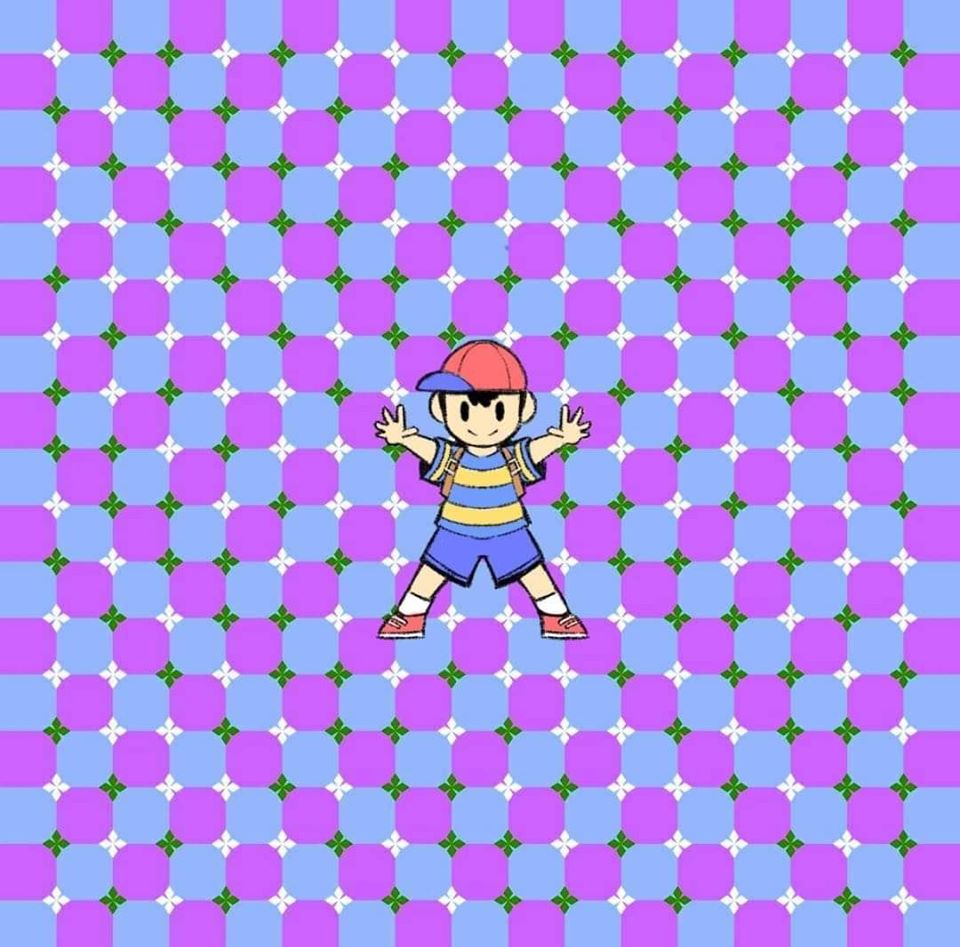
The meme features a character from the game "Earthbound" (also known as "Mother 2") named Ness, who is a young boy with a distinctive appearance and personality. The image is likely a screenshot or illustration of Ness with his arms raised in a "what's up?" or "I'm here!" gesture, possibly with a caption or text that reads "What's up?" or "I'm here!" in a playful or humorous tone. The meme is likely used to express a sense of arrival or to acknowledge someone's presence, much like the character's name and personality.
detailed-analysis (gemma3-27b-vision)
Okay, here's an analysis of the image, broken down into sections based on the requested theoretical frameworks. It's important to note that applying all of these frameworks might feel like a stretch in some cases – that's often the nature of applying theory! I'll try to be thoughtful and specific.
Visual Description
The image presents a brightly colored, digital illustration. The background is a repeating pattern of light purple and light blue squares, intersected by thin green lines forming a checkered/diamond-like design. This creates a high-contrast, somewhat dizzying visual texture.
The central focus is a pixel-art-style depiction of Ness, a character from the Nintendo game EarthBound (Mother 2). Ness is shown in a slightly dynamic pose, with arms outstretched and hands open, appearing to welcome the viewer. He wears his signature baseball cap, striped shirt, and blue shorts, with red and white sneakers. The color palette is bold and cheerful, reminiscent of 16-bit video game aesthetics. The image feels deliberately flat and graphic, with strong outlines and minimal shading.
Foucauldian Genealogical Discourse Analysis
From a Foucauldian perspective, we can examine how the discourse surrounding childhood, heroism, and gaming is constructed and maintained within the image.
- The Construction of "Childhood": Ness, as a child protagonist, embodies a specific construction of childhood within the gaming context. He’s presented as capable, adventurous, and not overly burdened by adult concerns. This contrasts with historical depictions of children needing protection or guidance. The image, and the game itself, participates in a discourse that establishes certain expectations and ideals for childhood, and for what constitutes acceptable forms of ‘play’ or experience for children.
- Power and Normalization: The image participates in the normalization of certain game aesthetics (pixel art, bright colors) and narrative tropes (the heroic child). By repeatedly presenting these elements, the gaming industry (and broader popular culture) exercises a subtle power, establishing what is considered “normal” or expected within the genre.
- Archeology of the Hero: We can explore the "archeology" of the hero figure as it appears in games. How does Ness fit (or deviate) from earlier archetypes? His youth and relative lack of traditional heroic attributes (strength, armor) represent a shift in how heroism is depicted. Tracing this shift can reveal the changing values and anxieties of the culture that created it.
Critical Theory
Using a broadly critical theoretical lens, we can address the following:
- Ideology and Consumption: The image functions as a form of cultural product tied to consumer culture. It promotes a game, and by extension, encourages participation in a specific type of leisure activity. The cheerful aesthetics and appealing character design are designed to ideologically position the viewer as wanting to consume this product.
- The Gaze: The way Ness is presented, looking out and seemingly inviting the viewer, engages with the concept of "the gaze." The image asks the viewer to adopt a certain perspective—to become invested in his story and his world.
- Loss of Authenticity: The digital, pixelated nature of the image could be interpreted as a commentary on the loss of authenticity in the modern world, where reality is increasingly mediated through technology. The artificiality of the image reflects a broader cultural shift towards simulation and virtuality.
Marxist Conflict Theory
Applying a Marxist lens, we can examine the underlying power dynamics and economic forces at play:
- Commodification of Play: The image is a direct manifestation of the commodification of play. The act of playing a game, traditionally a form of leisure, has been transformed into a source of profit for corporations like Nintendo.
- Cultural Hegemony: The prevalence of video games and characters like Ness can be seen as part of a process of cultural hegemony—where the dominant ideology of consumerism and entertainment is perpetuated and normalized.
- Labor and Entertainment: The creation of the game, and of this image, involves the labor of countless individuals (artists, programmers, marketers). The image obscures these labor processes, presenting only the polished, finished product. This creates a system where the value generated by this labor is captured by the owners of the means of production (Nintendo).
Postmodernism
Several aspects of the image align with postmodern characteristics:
- Pastiche and Intertextuality: The image blends elements of pixel art (a style from a specific historical moment in gaming) with a contemporary visual presentation. It's a self-conscious referencing of its own history.
- Blurring of Boundaries: The image blurs the boundaries between "high" and "low" culture—between artistic expression and commercial product.
- Simulation and Hyperreality: The image itself is a simulation—a digital representation of a character from a simulated world. This contributes to the postmodern condition of hyperreality—where simulations become more real than reality.
- Irony and Playfulness: The bright colors and cheerful design can be seen as an ironic commentary on the seriousness of adult life, suggesting a playful escape into a world of fantasy and imagination.
Queer Feminist Intersectional Analysis
This is perhaps the trickiest application, but we can approach it through a few angles:
- Deconstruction of Gender Roles: While Ness is a male character, his depiction subverts traditional heroic tropes. He's not a muscular warrior, but a young boy with psychic abilities. This challenges traditional notions of masculinity and heroism.
- The Gaze and Subjectivity: As a player, the viewer projects their own subjectivity onto Ness. This allows for a fluid and open-ended engagement with the character, potentially subverting traditional power dynamics.
- Visibility and Representation: While Ness isn’t specifically a queer character, the act of representing a non-traditional hero can contribute to a broader conversation about inclusivity and representation. In a medium historically dominated by male protagonists, the presence of a young, non-muscular hero is a subtle but meaningful departure.
- Intersectionality & Consumerism: The consumer culture surrounding games can exacerbate existing inequalities. Access to games, and the ability to participate in gaming communities, is often shaped by factors like race, class, and gender.
Important Note: This is just one possible interpretation. These frameworks are tools for analysis, and different readers may come to different conclusions. The richness of an image like this lies in its ability to support multiple readings.
Let me know if you'd like me to elaborate on any of these sections, or focus on a specific theoretical lens.
simple-description (llama3.2-vision)
The meme is an image of Ness from the video game Earthbound, with his arms outstretched and a big smile on his face. The text "I'm not mad" appears above his head, but the rest of the image is filled with a repeating pattern of tiny, pixelated images of Ness's face, all with the same expression of anger.
tesseract-ocr
++ + + tt ot + + ++ 3+ +. ++ 2+ + tt +t + tt +t + e+ + +. ++ + + + + + + + ++ + +. + te + + 4+ + + +. * + + ++ + ACS + & ++ + ee + + ++ + TA ++ + + ++ ++ + + ++ + + ++ + + + ee +t + + + + +. ++ o+ +. ++ + + + ++ + +. + + + +. ++ 3+ +