First Seen
2023-05-10T21:03:35+00:00
simple-description (llama3.2-vision_11b)
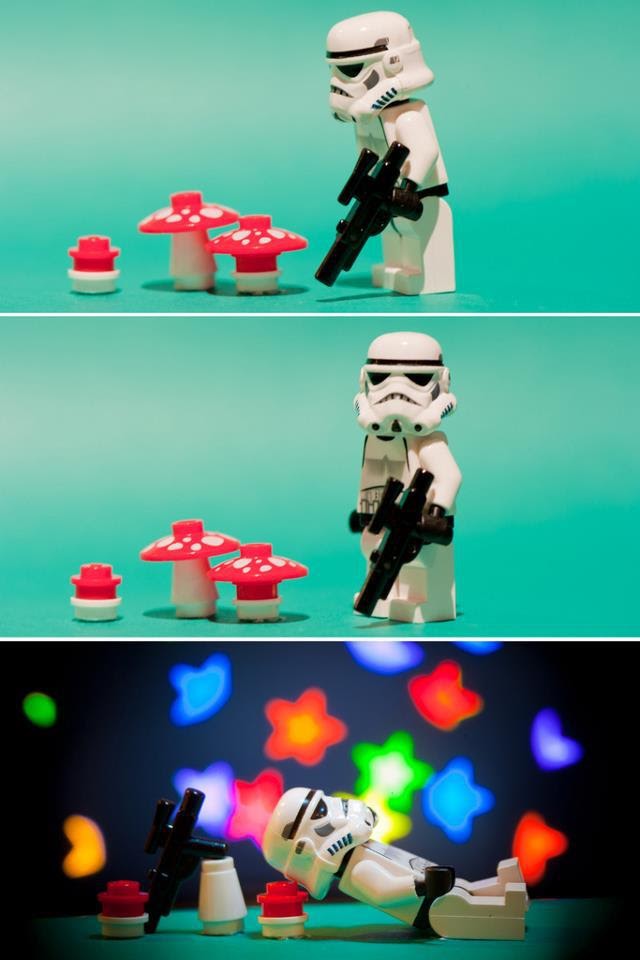
This meme is a humorous comparison between the effects of a drug (in this case, a mushroom) and the effects of a Star Wars character (Stormtrooper). The meme implies that the mushroom is so powerful that it can turn a Stormtrooper into a "mushroom" (a type of fungus), suggesting that the mushroom is so potent that it can even turn a powerful warrior into a weak, vulnerable creature.
detailed-analysis (gemma3-27b-vision)
Okay, let's break down this series of images through the lenses you've requested. It's a fascinating little scene that invites a surprising amount of analysis.
Visual Description
The images depict a series of staged scenes featuring a LEGO Star Wars Stormtrooper figurine. In the first image, the Stormtrooper stands before a cluster of miniature LEGO mushrooms. The background is a flat, solid teal/turquoise. The second image is an identical recreation of the first. In the third image, the Stormtrooper has fallen and is lying on the ground next to the mushrooms, and the background is now filled with a vibrant, blurred kaleidoscope of colorful light spots, resembling a disco or rave atmosphere. The scene is deliberately stylized, artificial, and evokes a sense of whimsy and subversion. The use of LEGO toys heightens the sense of playfulness and artifice.
Foucauldian Genealogical Discourse Analysis
This series of images lends itself well to a Foucauldian analysis. The Stormtrooper represents a historically specific discourse of power and control – the Imperial regime in Star Wars. Traditionally, Stormtroopers embody order, domination, and a rigid, hierarchical system.
However, the mushrooms can be interpreted as a symbol of transgressive knowledge, altered states, or even 'deviance' within the Imperial order. (Mushrooms, of course, have cultural associations with altered perception and non-conformity). The initial stance of the Stormtrooper, seemingly examining the mushrooms, suggests a possible engagement with this alternative discourse.
But the ultimate failure of control, symbolized by the Stormtrooper falling, is crucial. This fall doesn't simply represent a physical event. It represents the decentring of Imperial authority. The kaleidoscope background, a chaotic explosion of color, represents the breakdown of a unified, hegemonic discourse. Foucault would see this as evidence that power isn't simply top-down, but is dispersed, fragmented, and constantly negotiated. The "truth" of the Empire, once seemingly absolute, is now broken into dazzling, destabilizing fragments. The power dynamic shifts, not through a direct rebellion, but through a playful disruption of the established order.
Postmodernism
The series screams postmodernity. The deliberate use of LEGOs as a medium immediately draws attention to the constructed nature of the image. The scene isn't a depiction of reality; it's a self-aware simulation. This aligns with postmodern rejection of grand narratives (like the simplistic good vs. evil of Star Wars).
The juxtaposition of the iconic Stormtrooper (a symbol of a very specific, defined cultural narrative) with the whimsical, slightly absurd mushrooms and the chaotic rave background is a classic postmodern gesture. It creates irony, parody, and a sense of fragmentation. The narrative is deconstructed. What does it mean to have a Stormtrooper "trip out?" The question itself highlights the absurdity and the playful rejection of traditional meaning.
The focus isn’t on creating a cohesive narrative, but on exploring the interplay of signs and symbols. The image doesn’t tell a story so much as present a fragmented tableau. The meaning is open to interpretation, and the ambiguity is intentional.
Critical Theory
From a Critical Theory perspective (drawing on thinkers like Adorno and Horkheimer), the image can be seen as a commentary on the commodification of culture. Star Wars, as a massive franchise, represents the "culture industry" at its finest – the mass production of entertainment that serves to reinforce dominant ideologies and pacify the masses.
However, by taking a LEGO version of a Star Wars character and placing it in this strange, unexpected scene, the image interrupts that process. It exposes the artificiality of the franchise, the fact that it is, at its core, a product. The playful subversion destabilizes the ingrained cultural associations with the Stormtrooper.
The breakdown of control and the embrace of chaos (the rave background) can be read as a subtle critique of the controlling forces of modern society. The image suggests that even within a heavily commodified culture, there is always the potential for disruption and resistance.
Queer Feminist Intersectional Analysis
A queer feminist reading, particularly through an intersectional lens, brings forth layers of interpretation. The Stormtrooper, typically a symbol of rigid conformity and masculine dominance, is rendered vulnerable and incapacitated. This challenges the traditional power dynamic.
The mushrooms can be interpreted as symbolic of the 'other', the marginalized, or the transgressive. They represent a force that destabilizes the dominant order. The “fall” of the Stormtrooper can be viewed as a deconstruction of patriarchal control, a momentary liberation from the constraints of power.
The rave aesthetic, often associated with queer subcultures, offers a space for liberation and celebration. It's a rejection of mainstream norms and a celebration of difference. This is particularly resonant considering the history of queer communities finding refuge and expression within rave culture.
Intersectionality is at play by highlighting how multiple systems of power (patriarchy, colonialism, consumerism represented by the franchise itself) intersect and contribute to oppression. The image’s playful subversion of these power dynamics offers a momentary glimpse of freedom and agency.
Let me know if you'd like me to delve deeper into any of these analyses or explore a different theoretical lens.
simple-description (llama3.2-vision)
The meme is an image of a Stormtrooper from the Star Wars franchise, but instead of his usual armor, he's wearing a pair of glasses and a mustache, giving him a comically nerdy appearance. The text "I can see" appears above the image, and "I am fine" is written below it. The joke is that the Stormtrooper is trying to pass as a normal person, but his nerdy appearance is a dead giveaway.
tesseract-ocr
* pe Sw \ eee vw wnt ee ir e iC] . ad e ei. pe Yt PS