First Seen
2024-03-13T18:04:39.589821+00:00
simple-description (qwen3.5_2b-q8_0)
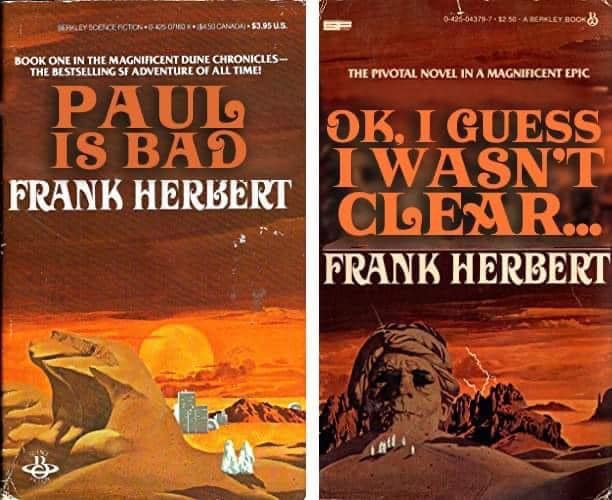
This meme plays on the visual similarity between the two Frank Herbert Dune novels. The image on the left features the classic Paul Is Bad, a famous sci-fi epic about the Dune universe. The image on the right mimics Paul Is Bad perfectly but changes the title to "OK, I Guess I Wasn't Clear...", which is a Dune fanfiction. It creates a humorous confusion by presenting a fanwork cover that looks just like the sequel to a main Dune book.
simple-description (llama3.2-vision_11b)
The meme is a humorous image referencing the science fiction novel "Dune" by Frank Herbert. The image juxtaposes the book's cover with a modern-day product, implying that the book's themes of environmentalism and ecology are just as relevant today as they were when the book was published. The text "Dune" is written in a font that resembles a 1970s-era product label, with the words "Still Relevant" written in a smaller font below.
detailed-analysis (gemma3-27b-vision)
Okay, here's an analysis of the book covers, broken down into sections as requested. It's important to note that applying complex theoretical lenses to book covers is a somewhat unusual exercise, so some sections will be more developed than others. The analysis will focus on the contrast between the two covers.
Visual Description
The two book covers depict Frank Herbert’s Dune with drastically different aesthetics and messaging.
Cover 1: "Paul is Bad" is characterized by a vibrant, almost feverish orange and red color scheme. The dominant image is a large, stylized sandworm rising from a desert landscape. In the background are structures resembling a stylized Arrakeen (capital city on Dune). The overall impression is one of action, danger, and epic scope. The typography is bold and dramatic, placing the emphasis on a declarative statement: "Paul is Bad". It reads as a statement meant to provoke.
Cover 2: "OK, I Guess I Wasn’t Clear..." presents a stark contrast. It features a close-up portrait of an older man (presumably Paul Atreides) with weathered features, set against a muted, desaturated landscape. The color palette is predominantly browns and grays, creating a somber, introspective mood. The text, "OK, I Guess I Wasn’t Clear..." is ironic, almost apologetic, and suggests a complex narrative that is being re-examined.
The visual differences are substantial: the first cover is visually striking and dramatic, aiming to attract a broad audience with a sense of adventure. The second is more subdued and intellectual, inviting a re-reading of the narrative's complexities.
Foucauldian Genealogical Discourse Analysis
This section explores how the covers construct knowledge about Dune and how that knowledge has shifted over time.
Foucault argues that power operates through discourse, shaping what we understand as truth. These covers can be viewed as interventions in the discourse surrounding Dune.
-
The First Cover (“Paul is Bad”): Represents a dominant, perhaps initial, discourse that positions Paul Atreides as a powerful, potentially dangerous figure. It presents a simplified understanding, framing him as an antagonist. This framing has been a common complaint within the Dune fanbase. The declarative statement reinforces a clear, assertive understanding of the text - Paul is bad.
-
The Second Cover (“OK, I Guess I Wasn’t Clear…”): Represents a counter-discourse. It’s a re-evaluation of Paul’s character, admitting complexity and challenging the earlier, more straightforward assessment. The ironic phrasing implies that Herbert himself, or the narrative, underestimated the problematic elements of Paul’s story. It signifies a shift in the discourse surrounding Dune towards a more critical reading that acknowledges the dangers of messianic figures. It invites the reader to question what they thought they knew about the narrative.
The shift between covers demonstrates a genealogy of ideas around Dune: an initial understanding (Paul as a powerful hero/villain) is challenged and refined through new interpretations and critiques. The cover's "apology" acknowledges the growing awareness of the problematic aspects of Paul's character and the potential for unintended consequences.
Critical Theory
Applying broad Critical Theory principles (thinking about power, hegemony, ideology) is useful here.
Both covers ideologically position the reader in relation to the text. The first cover reinforces the traditional adventure/hero narrative, potentially masking the complexities of power dynamics within the Dune universe. It implicitly promotes the idea that a "bad" hero is still an exciting, desirable figure.
The second cover, in contrast, actively challenges that ideological framework. It disrupts the heroic narrative and foregrounds the potential dangers of unchecked power and messianic figures. By admitting that "something wasn't clear," the cover acknowledges that the story may have promoted problematic ideologies without the reader fully realizing it.
The shift between these covers reflects broader cultural shifts towards greater critical awareness of power structures, colonialism, and the problematic tropes often found in science fiction. It's an admission that narratives aren't neutral and that stories can perpetuate harmful ideologies.
Marxist Conflict Theory
From a Marxist perspective, Dune can be read as a study of power, class struggle, and resource control. The covers reflect changing interpretations of those themes.
-
The First Cover: Plays into the traditional adventure trope, focusing on individual heroism and external conflict (man vs. monster, hero vs. villain). It downplays the systemic issues of inequality and exploitation that are central to the Dune universe. It obscures the broader conflicts of class and resource control by focusing on dramatic action.
-
The Second Cover: Highlights the inherent dangers of power, implicitly linking Paul’s actions to broader social and political consequences. The weathered portrait and apologetic tone suggest that the story isn’t simply about individual heroism, but about the responsibilities and burdens of power. It subtly points to the exploitative systems that Paul perpetuated and the suffering they caused. The shift implies a greater focus on who benefits from Paul’s actions.
The contrast suggests a shift from a purely individualistic reading of Dune to a more systemic and critical analysis of power dynamics and social inequalities.
Important Notes:
- Speculation: This analysis involves a degree of speculation, as we’re interpreting visual cues and applying theoretical frameworks to book covers.
- Context: The timing of these covers matters. The second cover likely emerged after decades of fan criticism and a growing awareness of problematic tropes in science fiction.
- Oversimplification: Any attempt to apply complex theoretical lenses to simple visuals inevitably involves some oversimplification.
Let me know if you'd like me to elaborate on any of these sections or explore other theoretical approaches.
tesseract-ocr
EMT AO aE : | Oe rung 7) Ot pot ce a oe
simple-description (llama3.2-vision)
This meme is a play on the classic science fiction novel "Dune" by Frank Herbert, with the title "Dune" replaced by "Dumb". The meme is a humorous take on the original title, implying that the book is actually called "Dumb" instead of "Dune".