First Seen
2024-06-03T23:26:30.428083+00:00
simple-description (qwen3.5_2b-q8_0)
Based on the content and your category, I can explain this meme for you.
The Meme: Dune: Part Two
This meme is a reference to the science fiction film Dune: Part Two.
- Core Concept: In this story, a young boy discovers that he is the heir to a massive, powerful empire. He must travel through a vast, desert planet to find his family.
- Visuals and Maps: The meme often includes maps or travel routes to illustrate the journey through the desert planet. The map shown in this instance features a route starting near Idaho (specifically a real-world location like "Duncan's Outpost").
- The "Duncan's Outpost" Reference: The specific text "Duncan's Outpost" on the map likely serves as a geographical marker or a subtle nod to the specific Dune locations (specifically "Dune's Outpost" from the books) or the "Outposts" that are part of the journey in the film.
- Why it fits the Category: As a Dune meme, this visual references the journey, the desert setting, and the empire-building themes of the story. It uses the familiar visual of a map to evoke nostalgia and discuss the lore of the movie within the community.
simple-description (llama3.2-vision_11b)
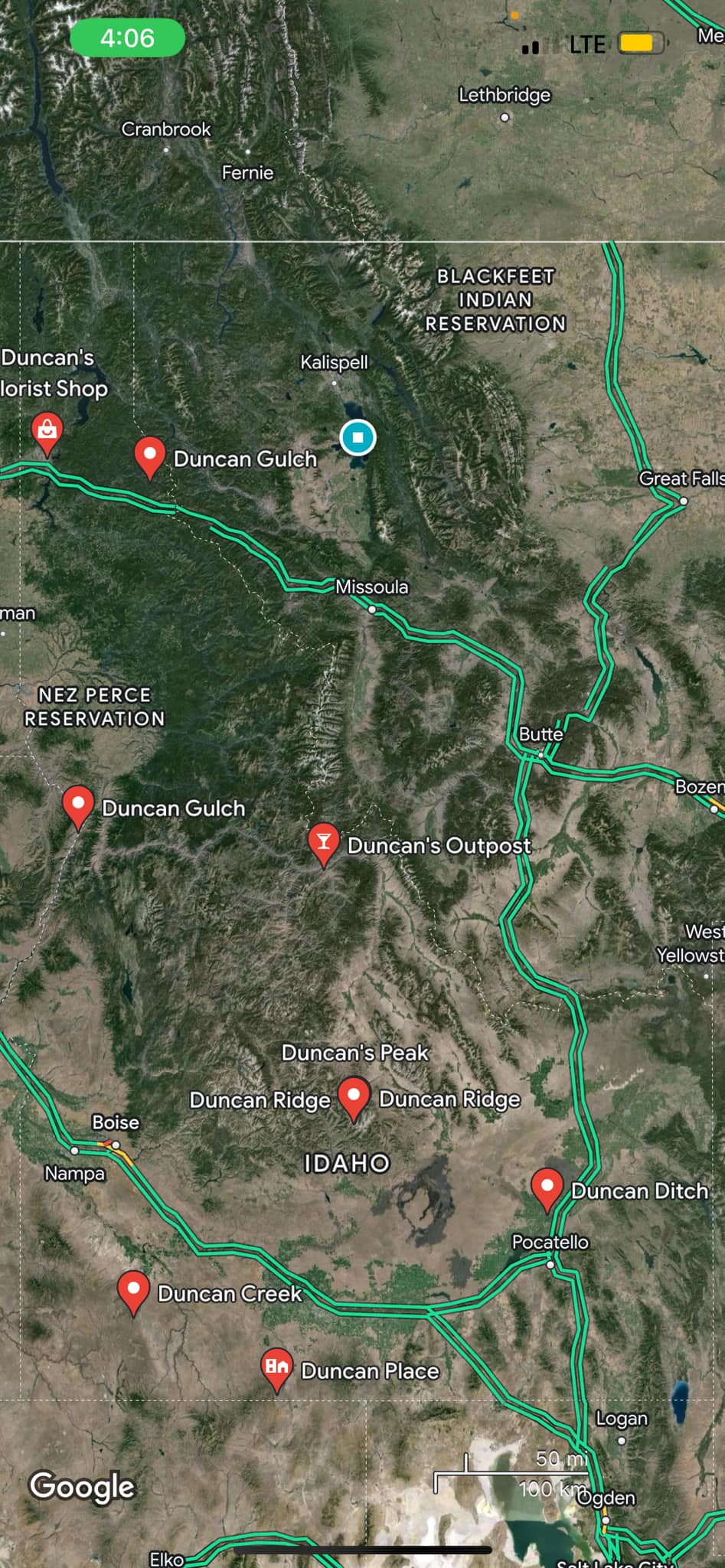
The meme is a screenshot of a Google Maps location search for "Dune" in the state of Idaho, USA. The image shows a map of Idaho with several locations marked as "Dune", including Dune, Dune, Dune, and Dune. The meme is likely a joke about the many places named "Dune" in Idaho, implying that the state is full of "Dunes".
detailed-analysis (gemma3-27b-vision)
Okay, here's an analysis of the image, broken down into sections as you requested. I'll address each theoretical framework only if it applies to the content depicted. Please note that these are interpretations based solely on the image, and can be expanded upon with further context.
Visual Description
The image is a screen capture of a digital map, likely from a navigation app (Google Maps is visibly indicated). It shows a portion of the Northwestern United States, specifically Montana, Idaho, and parts of surrounding Canadian provinces. The terrain is heavily mountainous, showing significant forested areas, particularly in Montana and Idaho. Several major roadways (appearing as dark lines) traverse the landscape, connecting cities and towns. A significant number of locations marked with red pinpoints are labeled "Duncan [something]," indicating a concentration of places named after a person or family with the surname "Duncan". Additionally, there are clearly marked indigenous reservations—the Blackfeet and Nez Perce Reservations. The image also indicates time (4:06) and signal strength (LTE).
Foucauldian Genealogical Discourse Analysis
This image lends itself to a Foucauldian analysis centered around the naming convention of places after "Duncan." A genealogical approach would not seek a single origin of the name, but rather trace the dispersal and shifting meanings of “Duncan” across the landscape.
- Power/Knowledge: The repeated naming of places after “Duncan” signifies a particular historical power dynamic. Who was Duncan? What social, economic, or political power did this individual or family wield to have so many places named in their honor? The map itself acts as a form of "archaeology" of knowledge, revealing the traces of past power relations inscribed onto the landscape.
- Discourse & Subjectivation: The act of naming places with "Duncan" creates a specific discourse around this name. This can be tied to the historical construction of 'pioneer' or 'settler' subjectivities – a discourse that often silences or ignores the pre-existing Indigenous presence. The repetition of the name contributes to a "regime of truth" – a taken-for-granted understanding of the land’s history.
- Dispersal and Discontinuity: The fact that the "Duncans" are scattered across the region, rather than concentrated in one location, suggests a dispersal of power over time. This disperses the original “Duncan” into many local significations.
Critical Theory
The image is ripe for a critical theoretical examination, specifically in regards to the construction of place and identity.
- Space and Power: The map depicts a space that is profoundly shaped by power relations. The roads themselves, designed to facilitate movement and resource extraction, represent a deliberate organization of the landscape according to certain interests. The placement of "Duncan"-named locations (and their possible connection to resource exploitation) can be understood as a manifestation of control over territory.
- Domination and Resistance: The juxtaposition of the "Duncan" locations with the Blackfeet and Nez Perce Reservations is significant. The presence of the reservations demonstrates a spatial division – a segregation – of land between colonizers and Indigenous peoples. While not directly depicted, the map evokes a history of dispossession and resistance.
- Construction of Identity: The repeated naming of places after "Duncan" contributes to the construction of a certain regional identity. The map implicitly reinforces a narrative of settler history, potentially marginalizing or erasing Indigenous histories and ways of life.
Marxist Conflict Theory
The map can be analyzed through a Marxist lens focusing on land ownership, resource control, and the resulting class conflict.
- Means of Production: The mountainous terrain and forests likely represent valuable natural resources (timber, minerals, water). The "Duncan" names, potentially connected to early settlers or land speculators, could signify control over these means of production.
- Class Struggle: The presence of Indigenous Reservations suggests a history of dispossession and exploitation. The reservations can be interpreted as spatial manifestations of class conflict – areas of limited access and control for Indigenous peoples, while "Duncan"-named locations might signify areas of resource extraction and profit for settler populations.
- Spatial Inequality: The map highlights a spatial inequality in land distribution and resource access. The contrast between the reservations and the "Duncan" locations illustrates the historical and ongoing power imbalances that characterize the region.
Postmodernism
While less direct, a postmodern reading can be applied, particularly concerning the blurring of narratives and the fragmentation of meaning.
- Deconstruction of Grand Narratives: The map challenges any simple, linear narrative of the region’s history. The co-existence of "Duncan"-named locations and Indigenous Reservations dismantles the idea of a single, unifying narrative of progress or settlement.
- Fragmentation and Hybridity: The map presents a fragmented landscape – a patchwork of different place names, roads, and reservations. This fragmentation can be interpreted as a reflection of the complex, hybrid identities and histories that characterize the region.
- Simulacra and Simulation: The map itself is a simulation – a representation of reality that is not the reality itself. The "Duncan" names, while referencing a historical figure, have become detached from their original meaning and operate as signs or symbols within the map's representational system.
Queer Feminist Intersectional Analysis
This requires speculation given the absence of explicit gender or sexual representation. However, the framework can be applied to unearth potential silences and power dynamics.
- Silencing of Gendered & Queer Histories: The map overwhelmingly highlights settler-colonial histories named after men (“Duncan”). This erases the contributions, agency, and resistance of women, Two-Spirit people, and other gender/sexual minorities in the region.
- Intersectionality of Oppression: The map reveals the intersecting oppressions of Indigenous peoples (racial, cultural, territorial dispossession) and potentially other marginalized groups (women, queer people) whose histories are not visibly represented.
- Spatialized Power: The naming of places after “Duncan” is a spatial manifestation of patriarchal power, reinforcing a male-dominated historical narrative. The Indigenous reservations can be seen as spatialized sites of resistance and resilience in the face of these power dynamics.
Let me know if you’d like me to elaborate on any of these sections, or to apply other theoretical frameworks to the image!
tesseract-ocr
6 Pr Os iS Ean } a kt ae ass ie Mes? x. A060) ec) ge Ae PN ree eT ae Fave hie | res heat a a NG at ia fe ee OT Tale lee bins ear myers 2 tae A) Pesky +e 1S ges aags roe F . Seats VP EEE tg Sk NO Namek \ pu eI In o}Kele).¢ ce yp ee) Jeena eg Se Maer oy ere y Beis ie 3 ; Lg ees ¥ Slcctaalt) Sy Bt Bie Fy TES hiss oe < eo: WE ET AE : ye RAN Ie ds Le, aa ] See ree \ eats Nn 9 Ti Be pe ‘ He Yak. ? Fe ES? LIN | } a ee aa RESERVATION I; Hawa ee 2 is a Se i ee i oH me Pe Ye tore E nit ata aya ‘s DIU aXet=\ aimee re Lt} Desc i ae sip etry ir. . mes 2 ieee i. Mobs See EGE ae INE lorist Shop KC eke go ae De Ber i \\ ? ee ites he eee ) Pe ari £-@ et \ : : a as Teme) ce \ oN eerie oy i & | Ke eit Bae eet: ae er ee Se aN as a 7 eet eee ‘Sse ON. ee a ee os . lV i Vise . 7 Ms a HIRD ap Be n ee ae a ue Sie ie ee eo pe (mae = Tek “Hey 3 Y Ont Sal SS ee . Oe gaa aS eer ee SS Fa \ Bie Taree eee © Gee: | “Wy be “INEZ/PERCE Mase Bee ce F ee ee Se RESERVATION Ten Sa ae a Ree =~ eee Sar aes (us oe * sg Fe ‘ Pr ey os ass, Riis Pi — A Ae. eae ead i en | Peer a ee me \s mS ee igs (CR) ery is . Je [DUT aorta 70] (el nc aneeneas Fee ‘S) PP ei. fm ~ WN ee Be vg) Fete een x to) et LV Pron: > a MW tec Tai Outpos' ai PT eee Ns AAS he Peas a Oe a Wi) Pa fe ea en ee tae ne te eee are eS f. Sous 4 % igh ce LD = aaN ite EIEN leg’ Sh Me ee ee EN ENS OO et a Te ‘ Mis ia (es % ‘ie ‘ 2 \ uae ; ae = Be hee ie i aS “Se TiN ‘a % oo ae eS a, & } 8s Sa) ea 2 ao tinstocntts Sy ; NY ae ie ee > Ran. st Os oe ~g \\.. : We co ELM TICCO Tell me j Nags Pe PN akereTaM ie lol esa fal PWUIaer- Tasso le} \ an i da Ree at eI Ba NG \ et ult i ees Pn er Ad ac ade oh EN ES eesti: Sa Se ge ian (as 5 7 a “Sas \ ae SOO ae) Ke ae Bing. . “& OP orminceia pyro) eae 8 Wes) Vil = Ae SEAS ea - DS ” \ ‘ mal \ Reet lh te “pg ed ace So ROS Ne Cian, Be . DuncaniGreek NS 4 i REE Zp a\\ ™ y 2 * VS et ————S |e oe ae SS A ee 1 As ~\ Beare , Se % / bo ge. i Se Ga DN pe Place} \ a\\ eae . f \ ie "a ‘ a eo se, : NE mi 3 ee ‘ Aas +e Py (RN spit “WS ] nen 1 oe te , bare ioaeal e i ge ie ae 57 ANA Ser . A ae x a\ Wi ae ov: ( pas ah ee eee Google 2 we a. Yb es eS ti: eo, ie a Y ¥ oS see = RNY SN
simple-description (llama3.2-vision)
The meme is a screenshot of a Google Maps search for "Duncan, Idaho". The search results show a small town called Duncan, Idaho, but it also shows a few other places with similar names, including Duncan, Arizona, Duncan, Oklahoma, and Duncan, South Carolina. The meme is likely poking fun at the idea that there are multiple places named Duncan, and the user is trying to find the one in Idaho.