First Seen
2023-11-16T21:36:25+00:00
simple-description (qwen3.5_2b-q8_0)
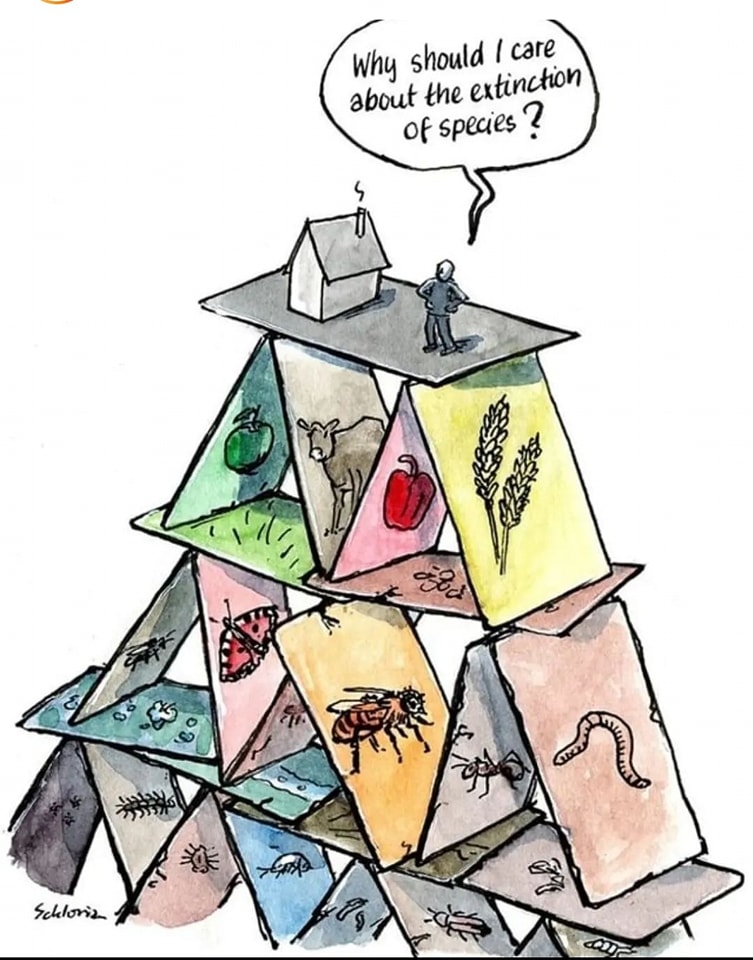
This meme visualizes the Ecological Pyramid of Life, depicting a tiny human figure standing atop a stack of cards that represent different organisms. From the top down, the structure illustrates the food chain, showing how humans are supported by larger animals (like cows) and plants (like wheat and peppers), all of which are built upon the foundation of microscopic life like bacteria and insects. The text bubbles at the top humorously highlights the disconnect by asking, "Why should I care about the extinction of species?", implying that the destruction of the lower levels of nature is irrelevant to a human standing on top of the structure.
simple-description (llama3.2-vision_11b)
The meme is a play on the classic "house of cards" concept, but instead of cards, it's a tower of insects, animals, and plants, all connected by their relationships and dependencies in the ecosystem. The text "Why should I care about the extinction of species?" is a tongue-in-cheek commentary on the lack of concern for the environment and the consequences of human actions on the natural world. The image is a humorous and satirical take on the importance of preserving biodiversity and the interconnectedness of all living things.
detailed-analysis (gemma3-27b-vision)
Okay, let's break down this image through several theoretical lenses.
Visual Description
The image is a cartoon-style illustration, resembling a precarious tower built from triangular "slices" or segments, like those of a pie chart. These slices are filled with drawings of various life forms: fruits (apples, pears), animals (goat, butterfly, snail, worm), plants (wheat, flowers), and insects (bees, spiders). The base of the tower is a jumble of these elements, growing more orderly (though still precarious) toward the top. At the very peak stands a tiny human figure, standing on a house. A speech bubble above the figure asks, “Why should I care about the extinction of species?” The style is illustrative and somewhat whimsical, but the leaning structure imparts a sense of instability and impending collapse. The colors are muted watercolor tones, giving the impression of fragility. The artist is signed as “Schlorz”.
Foucauldian Genealogical Discourse Analysis
This image lends itself strongly to a Foucauldian analysis. The tower itself represents a discourse – a system of thought, language, and practices that produce knowledge and power.
- Power/Knowledge: The image visualizes how our understanding of biodiversity (represented by the tower) is constructed through specific discourses. The precariousness of the tower highlights that this knowledge isn't neutral or objective. It’s built on assumptions, historical practices (agriculture, industrialization), and established power relations.
- Genealogy: Examining the “slices” (species) reveals how each element has been categorized, named, and valued (or devalued) within specific historical contexts. The image invites a tracing of how these categories came to be, and the power dynamics that shaped them. For instance, why are certain species prioritized for conservation while others are ignored? What role did colonial practices of classification play in establishing the current framework of biodiversity?
- Disciplinary Power: The question in the speech bubble ("Why should I care?") embodies a specific discourse of disinterest, or even indifference, toward ecological issues. This is a discourse that has been carefully constructed – through economic incentives, media representations, and political ideologies – to maintain existing power structures. The image suggests that this disinterest is produced by these forces, rather than being a natural or inevitable attitude.
- The Panopticon: The tiny human figure at the top could be read as a metaphor for the individual subject within the discourse. They are “visible” to the entirety of the tower (representing the weight of ecological crisis) but also distanced from it, and able to question its relevance.
Critical Theory
From a critical theory perspective (drawing particularly from the Frankfurt School), the image is a commentary on the instrumentalization of nature.
- Domination of Nature: The tower, built from living things, symbolizes how human beings have historically viewed nature as a resource to be exploited. The “slices” are not presented as intrinsically valuable, but as components to be assembled for human purposes.
- Commodification: The imagery suggests the commodification of nature. Each "slice" could represent a natural resource that is assigned an economic value, often at the expense of ecological integrity.
- Loss of Empathy: The human figure's detached question ("Why should I care?") embodies the loss of empathetic connection with the natural world. This disconnection is seen as a consequence of modernity, rationality, and the prioritizing of human needs over the needs of the ecosystem.
- Critique of Enlightenment Reason: The image can be interpreted as a critique of the Enlightenment's emphasis on reason and control over nature. The precarious tower suggests that this attempt to dominate nature has created instability and threatens the very foundations of our existence.
Marxist Conflict Theory
The image can be interpreted through a Marxist lens as portraying the fundamental conflict between human production and the natural world.
- Means of Production: The tower can be seen as a representation of the “means of production” – the resources and tools used to create wealth. These resources are directly sourced from nature (represented by the slices).
- Class Struggle: The human figure, standing atop the tower, represents a class that benefits from the exploitation of natural resources, while the base of the tower, composed of vulnerable species, represents the exploited.
- Alienation: The question in the speech bubble speaks to the alienation of humanity from nature. Capitalist production has separated people from their ecological roots, leading to a lack of concern for the fate of other species.
- Ecological Crisis as Inherent to Capitalism: The precariousness of the tower symbolizes the inherent instability of a system that prioritizes profit over ecological sustainability. The ecological crisis is not seen as an accidental byproduct of capitalism, but as an inevitable outcome.
Postmodernism
A postmodern reading focuses on the deconstruction of grand narratives and the relativity of truth.
- Deconstruction of “Nature”: The image challenges the idea of a fixed, essential “nature.” The “slices” are fragmented and rearranged, suggesting that nature is not a stable entity but a social construct.
- Relativity of Value: The image questions the idea of inherent value in species. The question in the speech bubble emphasizes that the value of biodiversity is not self-evident, but is assigned by humans based on their own subjective interests.
- Fragmentation and Instability: The precarious tower embodies the postmodern emphasis on fragmentation, instability, and the breakdown of traditional structures.
- Meta-Commentary: The image itself can be seen as a meta-commentary on the way we represent and understand the ecological crisis. It’s not a straightforward depiction of environmental destruction, but a self-reflexive exploration of the discourses that shape our understanding of it.
Please note: These are interpretations. The strength of each reading depends on the viewer's own perspectives and the specific theoretical frameworks they emphasize.
simple-description (llama3.2-vision)
This meme is a cartoonish illustration of a house of cards collapsing, with each card featuring a different environmental or ecological issue (such as pollution, climate change, and species extinction). The text "Why should I care about the extinction of species?" is written on a card at the top of the structure, implying that the person asking the question is oblivious to the importance of environmental issues. The image is meant to be humorous and satirical, highlighting the disconnect between people's awareness of environmental problems and their willingness to address them.
tesseract-ocr
hy should | care We bre extinction of species @ 5 \) - d\5 Ge Sane She Pe GH it A\ Ti \ , Y {7 A mie , “e\ L ANS, \ KT Qe a¥ et :\ VY OY Le 52 Lan eek Y , PALATE FY / 4 RA | OF A a ¢ x\ ara SY \ “ feller NON ae Ae