First Seen
2025-05-03T05:14:52.934003+00:00
simple-description (qwen3.5_2b-q8_0)
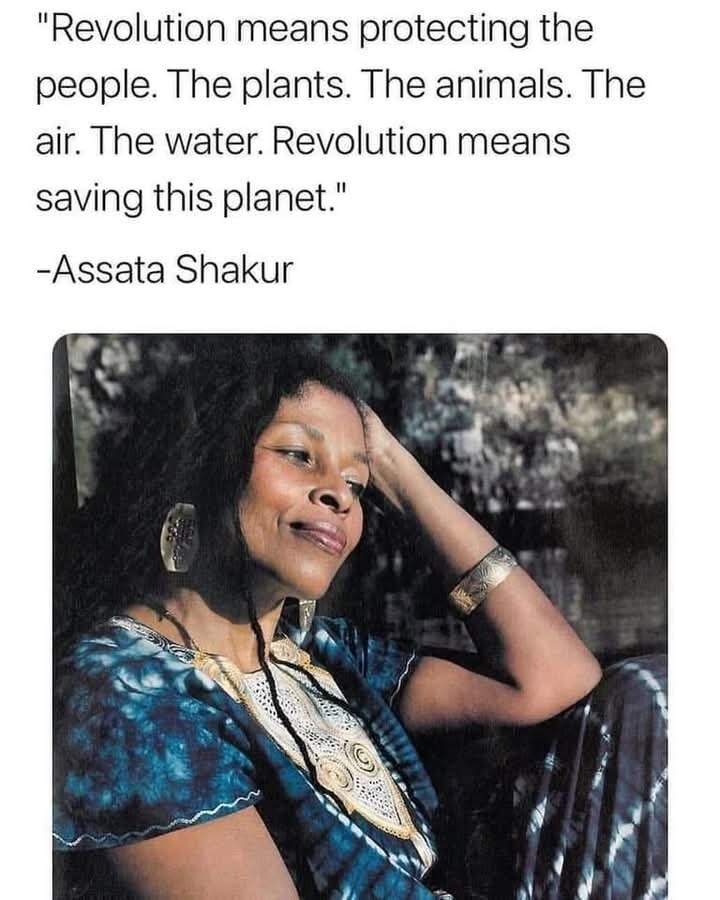
This ecology meme features a powerful quote from Assata Shakur that explains how to protect the planet. Because I cannot see the text, the image reads: "Revolution means protecting the people, the plants, the animals, the air, the water. Revolution means saving this planet." The picture shows a woman wearing a blue patterned top, large earrings, and a bracelet, gazing peacefully at a distant view of trees.
detailed-analysis (gemma3_27b-it-q8_0)
Okay, let's break down this meme featuring Assata Shakur's quote from an ecological perspective, using the requested theoretical frameworks where relevant.
Visual Description
The meme features a color photograph of Assata Shakur lying on her side, gazing slightly upwards and to the side. She has a relaxed, thoughtful expression. She’s wearing a patterned blue and purple fabric and appears to be outdoors, resting among lush greenery. The image is softly lit, and she has gold bracelets and a decorative necklace. The overall impression is one of serenity and connection to nature. The context of a natural setting lends itself to the ecological message.
Critical Theory
From a Critical Theory perspective, Shakur’s statement is a powerful rejection of instrumental reason—the notion that nature exists solely to be exploited for human benefit. Critical Theory, originating from the Frankfurt School, critiques societal structures that perpetuate domination and oppression. In this context, the domination of nature is interwoven with the domination of marginalized human groups.
Shakur's quote suggests that a genuine "revolution" (a fundamental change in power structures) cannot only address human inequalities; it must include the liberation of the non-human world. A truly just society, according to this perspective, would dismantle systems that commodify and degrade both people and the planet. It challenges the anthropocentric (human-centered) worldview that underpins much of modern society. This is a rejection of the idea that humans are separate from and superior to the natural world.
Marxist Conflict Theory
A Marxist lens examines the inherent conflicts arising from the control of resources and modes of production. Capitalism, in this framework, inherently drives ecological degradation because profit maximization is prioritized over environmental sustainability. The “revolution” that Shakur envisions can be interpreted as a rejection of capitalist exploitation – exploitation that extends not just to the working class but to the earth's resources themselves.
The quote implies that a revolutionary transformation must address the material conditions that cause ecological harm (e.g., destructive industrial practices, unequal access to resources). It suggests a need to challenge the ownership and control of natural resources, aligning with Marxist calls for collective ownership and democratic control. The quote acknowledges that the struggles for human liberation and ecological liberation are fundamentally connected; both stem from the same system of exploitation.
Foucauldian Genealogical Discourse Analysis
A Foucauldian approach would analyze how the discourse surrounding "revolution" and "nature" has been constructed over time. Historically, the idea of nature has been used to justify colonial expansion, resource extraction, and hierarchical social structures. "Nature" has often been framed as something to be conquered, dominated, and controlled.
Shakur’s statement disrupts this historical discourse. It redefines “revolution” not as a power grab over nature, but as a protective relationship with nature. It challenges the power/knowledge nexus that has positioned humans as masters of the natural world. It exposes the constructed nature of this "mastery" and offers an alternative understanding of revolution as one rooted in care and preservation. The genealogy would trace the evolution of the term ‘revolution’ and how it has been deployed historically, ultimately revealing how Shakur's statement is a radical re-appropriation.
Queer Feminist Intersectional Analysis
This framework adds layers by acknowledging how systems of power intersect and disproportionately impact marginalized groups, including women, LGBTQ+ individuals, and people of color. Ecological degradation often exacerbates these existing inequalities. For example, environmental racism refers to the disproportionate exposure of marginalized communities to environmental hazards.
Shakur herself, as a Black revolutionary woman who faced state repression, embodies this intersectionality. Her quote speaks to a holistic liberation that recognizes that the well-being of all beings—human and non-human—is interconnected. Queer feminist thought would emphasize the destabilization of binary oppositions (human/nature, culture/wilderness) that contribute to both social and ecological harms. It argues for a more fluid, relational understanding of the world where care and interconnectedness are central.
Postmodernism
A postmodernist reading might question the very idea of a single, universal "revolution." Postmodernism critiques grand narratives (overarching explanations of history or social change) and emphasizes the importance of localized, contextualized struggles.
While Shakur's quote presents a clear vision, a postmodern approach would acknowledge that "revolution" can take many forms and will likely be shaped by specific social and ecological contexts. It would emphasize the need to deconstruct dominant power structures in multiple ways and recognize the validity of diverse approaches to liberation. However, the meme can also be read as an attempt to create a new 'grand narrative' of intersectional liberation.
In summary, the meme is a powerful statement that challenges conventional notions of revolution. From an ecological perspective, it calls for a fundamental shift in our relationship with the natural world, recognizing that human liberation is inextricably linked to the liberation of all living beings and the planet itself. The use of various theoretical frameworks helps to further unpack the complexities and significance of Shakur's message.
simple-description (llama3.2-vision_11b)
The meme is a humorous quote from the perspective of ecology, highlighting the importance of environmental conservation. The image is likely a photo of a person, but the text " 'Revolution means protecting the people. The plants. The animals. The air. The water. Revolution means saving this planet.' - Assata Shakur" is overlaid on top of it, conveying a message about the need for environmental protection.
detailed-analysis (gemma3-27b-vision)
Okay, here's an analysis of the image and quote, broken down into sections as requested. I'll flag when a section doesn't apply, and indicate the level of application based on what’s visible and the quote’s core themes.
Visual Description
The image features Assata Shakur, a prominent figure in the Black Liberation movement, photographed in a natural setting. She is a Black woman with natural, grey-streaked hair, gazing upwards with a thoughtful expression. She's wearing a vibrant, tie-dyed purple and blue garment, and accessorized with multiple necklaces and bracelets made of natural materials like wood and metal. The background is a blurred expanse of green foliage, suggesting a forest or heavily vegetated area. The lighting is soft and natural, contributing to a sense of serenity and connection to nature. The composition emphasizes Shakur's gaze towards the sky, conveying hope, aspiration, or perhaps a connection to something larger than herself.
Foucauldian Genealogical Discourse Analysis
Applicability: Moderate. This framework is relevant because the notion of "revolution" itself is a discourse – a system of thought, language, and practice that produces certain understandings of power and resistance.
- Genealogy: A genealogical approach would examine how the concept of revolution has evolved historically. What power dynamics shaped the idea of revolution as a societal change? How has the meaning of revolution been constructed and contested over time? Shakur’s quote challenges the dominant discourses on revolution, often focusing solely on human agency, by explicitly expanding it to include the non-human world.
- Power/Knowledge: Shakur's quote illustrates the link between power and knowledge. The dominant discourse often positions humans as separate from and superior to nature, legitimizing exploitation. By explicitly including plants, animals, air, and water in her definition of revolution, she challenges this established power/knowledge relation. She asserts that true liberation requires acknowledging the interconnectedness of all life.
- Disciplinary Power: A Foucauldian lens could examine how systems of power (capitalism, colonialism, patriarchy) exert control through the domination of nature. Shakur's call to save the planet can be seen as a resistance to these disciplinary mechanisms.
Critical Theory
Applicability: High. Critical Theory is a particularly strong framework for analyzing this image and quote.
- Critique of Domination: The quote directly critiques systems of domination that prioritize profit and power over the well-being of the planet and all its inhabitants. It challenges the anthropocentric worldview that places humans at the center, and the structures that facilitate ecological destruction.
- Emancipation: Shakur’s definition of revolution is fundamentally emancipatory. It advocates for the liberation not just of people, but of all life. It calls for a radical restructuring of society to ensure the flourishing of all beings.
- Interconnectedness: Critical Theory emphasizes the interconnectedness of social, political, and ecological issues. Shakur’s quote embodies this, recognizing that human liberation is inextricably linked to the health and well-being of the environment.
- Social Justice: The quote is a clear statement of social and ecological justice, demanding a system that values all forms of life and protects the planet for future generations.
Marxist Conflict Theory
Applicability: Moderate. Conflict Theory, rooted in Marxism, focuses on power imbalances and class struggle.
- Class Struggle: From a Marxist perspective, the exploitation of nature is linked to the exploitation of labor. Capitalism requires the relentless extraction of resources from the environment, mirroring the extraction of surplus value from workers. Shakur’s quote could be seen as a call to dismantle this system of exploitation.
- Means of Production: The “air, water, plants, and animals” that Shakur names are, from a Marxist perspective, essential “means of production” – the resources necessary for survival and the creation of wealth. The control of these resources by a privileged few is a source of conflict.
- Alienation: Capitalism alienates humans from both their labor and from nature. Shakur’s quote suggests a need to reconnect with the natural world as a way of overcoming this alienation and building a more just society.
- Revolution as Class Struggle: The classic Marxist understanding of revolution involves a struggle between the proletariat (working class) and the bourgeoisie (ruling class). Shakur extends this struggle to encompass the environment, positioning nature as a victim of capitalist exploitation.
Postmodernism
Applicability: Low to Moderate. Postmodernism's focus is on deconstruction, relativism, and the rejection of grand narratives.
- Deconstruction of "Revolution": A postmodern reading might deconstruct the very concept of "revolution," questioning its inherent meaning and questioning whether a single definition is even possible. Shakur’s quote, however, offers a redefinition rather than a rejection of the term.
- Rejection of Universal Truths: Postmodernism rejects the idea of universal truths or objective realities. While Shakur's statement is emphatic, it’s not necessarily presented as an absolute truth, but rather as a perspective grounded in her experiences and commitments.
- Emphasis on Difference: Postmodernism values difference and celebrates the diversity of perspectives. Shakur’s inclusion of non-human life in her definition of revolution can be seen as an affirmation of the value of all beings.
Queer Feminist Intersectional Analysis
Applicability: High. This framework is highly relevant to understanding the nuances of Shakur's statement.
- Intersectionality: Shakur herself experienced significant oppression as a Black woman. Intersectionality recognizes how multiple forms of oppression (race, gender, class, etc.) intersect to create unique experiences of marginalization. Her commitment to protecting the environment extends this logic to include non-human beings.
- Feminist Ecology (Ecofeminism): Ecofeminism highlights the connections between the domination of women and the domination of nature. Both are often seen as resources to be exploited. Shakur’s quote aligns with this perspective, recognizing the interconnectedness of these struggles.
- Queer Ecology: Queer ecology challenges traditional hierarchies and binaries, embracing fluidity, interconnectedness, and non-normative relationships. By expanding the definition of revolution to include all life, Shakur subverts the anthropocentric hierarchies that prioritize human interests above all else.
- Decolonization: The call to protect the planet is deeply connected to decolonization. Colonialism and capitalism have historically relied on the exploitation of both people and nature. Shakur’s quote is a call to dismantle these systems of oppression and build a more just and sustainable world.
I hope this analysis is helpful! Let me know if you'd like me to elaborate on any particular point.
simple-description (llama3.2-vision)
This meme is a quote from the rapper Ice Cube, but it has been altered to replace his name with the name of the rapper Snoop Dogg. The text is a humorous example of how a quote can be altered to make it sound like it was said by someone else.