First Seen
2023-05-10T21:03:35+00:00
simple-description (llama3.2-vision_11b)
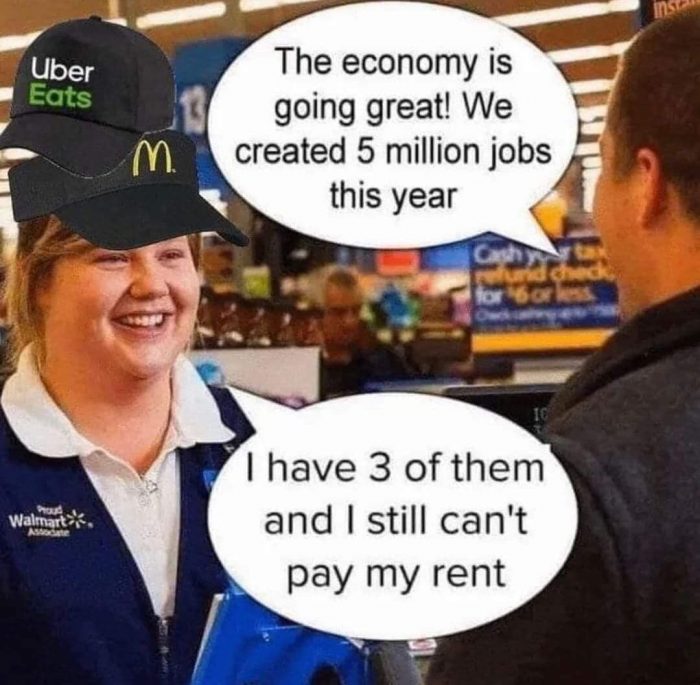
The meme is a humorous commentary on the economic impact of the gig economy, particularly in the context of job creation. A Walmart employee is jokingly explaining the economy's success to a customer, citing the 5 million jobs created in a year, but also acknowledging the reality of many people struggling to make ends meet. The image is likely a satirical take on the idea that the economy is booming, but at the same time, many people are struggling to afford basic needs.
detailed-analysis (gemma3-27b-vision)
Okay, let's break down this meme using the frameworks you requested. I'll include sections only where those frameworks are relevant to the image's content and message.
Visual Description
The meme features a staged image, likely a screenshot or created photo. A Walmart employee, wearing a nametag and a uniform vest, is smiling at a Black customer. Overlaid on the image are speech bubbles. The employee states, “The economy is going great! We created 5 million jobs this year.” The customer responds, “I have 3 of them and still can’t pay my rent.” The employee is wearing multiple company logos of the "gig economy" on their hat (Uber Eats and McDonald's) suggesting that the employee is involved in multiple low wage jobs. The background shows a retail checkout counter. The meme plays on the disconnect between macro-economic claims about job creation and the lived experience of precarious work.
Marxist Conflict Theory
This meme is deeply rooted in Marxist conflict theory. At its core, it highlights the inherent contradictions within capitalism.
- Exploitation of Labor: The meme implicitly points to the exploitation of labor under capitalism. The “5 million jobs” are likely largely in the service sector – often characterized by low wages, minimal benefits, and job insecurity. The customer's statement demonstrates that even holding multiple jobs, the worker is unable to afford basic necessities like rent. This suggests that the value created by their labor is not being adequately returned to them, but rather, is accruing to the owners of capital.
- Alienation: The customer is alienated from the fruits of their labor. Despite contributing to the "growth" of the economy, they remain in a precarious financial situation. They are disconnected from the benefits of the economic system they are helping to sustain.
- Class Conflict: The exchange subtly exposes class conflict. The employee’s cheerful declaration represents the perspective of those who benefit from the capitalist system, while the customer’s response reflects the experience of those who are struggling within it. The customer is an individual highlighting the real cost of production, while the employee is repeating the claims of an elite, out of touch class.
- Precarious Labor: The "multiple jobs" narrative highlights the growth of precarious labor in modern capitalism. The gig economy is often characterized by a lack of security and a race to the bottom, and this meme highlights the realities of those who are working multiple jobs.
Foucauldian Genealogical Discourse Analysis
A Foucauldian analysis would examine the discourse surrounding economic “progress” and employment statistics, and how these discourses shape our understanding of work and poverty.
- Power/Knowledge: The meme demonstrates how "knowledge" about the economy is produced and wielded as a form of power. The statement “The economy is going great!” is presented as an objective truth, but it obscures the lived realities of many workers. This 'truth' reinforces a certain power dynamic - those making the claim benefit from maintaining the status quo.
- Disciplinary Power: The discourse of economic success subtly disciplines workers. It implies that if individuals work hard enough, they should be able to achieve financial security. When they are unable to do so, the blame is often shifted to individual failings, rather than systemic issues.
- Genealogy of 'Work': The meme highlights how our understanding of 'work' and its value has changed over time. It shows how 'work' is often framed in terms of GDP and job numbers, rather than in terms of the lived experiences of workers. This meme draws attention to how the value of work is being obscured by capitalist production, and that the value of labor isn't being reflected in wages.
Postmodernism
A postmodern reading focuses on the breakdown of grand narratives and the fragmented nature of truth.
- Deconstruction of "Progress": The meme deconstructs the idea of linear economic "progress." It reveals how this concept can be used to mask inequality and exploitation. The employee’s statement appears as a simple assertion, but the customer’s response destabilizes it.
- Irony and Satire: The meme relies on irony and satire to critique the dominant narrative. The juxtaposition of the cheerful statement and the bleak reality creates a humorous, but critical effect.
- Loss of Authenticity: The meme touches on the loss of authenticity in contemporary society. It suggests that the "economy" is being presented as a spectacle, divorced from the lived realities of those who are struggling.
In summary: This meme is a potent social commentary that uses visual irony and a concise exchange to critique the inequalities inherent in modern capitalism. It draws on Marxist, Foucauldian, and postmodern frameworks to expose the disconnect between official narratives and lived realities, and challenges the notion of economic "progress" as a universal good.
simple-description (llama3.2-vision)
The meme is a humorous image featuring a Walmart employee interacting with a customer. The employee is wearing a Walmart vest and has a name tag that reads "I'm with stupid". The customer is holding a sign that reads "I'm not stupid". The text in the image reads: "Me: I'm with stupid. Customer: I'm not stupid. Me: Oh, okay, then you're with me."
tesseract-ocr
ea p - The economy is | ore hel going great! We oo _ ia created 5 million jobs : 3 this year i ) = le eae i .£\ fie ans > ee a ers an PY y a ov WF | have 3 of them ae and | still can't r pay my rent