First Seen
2024-03-27T22:50:42.276723+00:00
simple-description (qwen3.5_2b-q8_0)
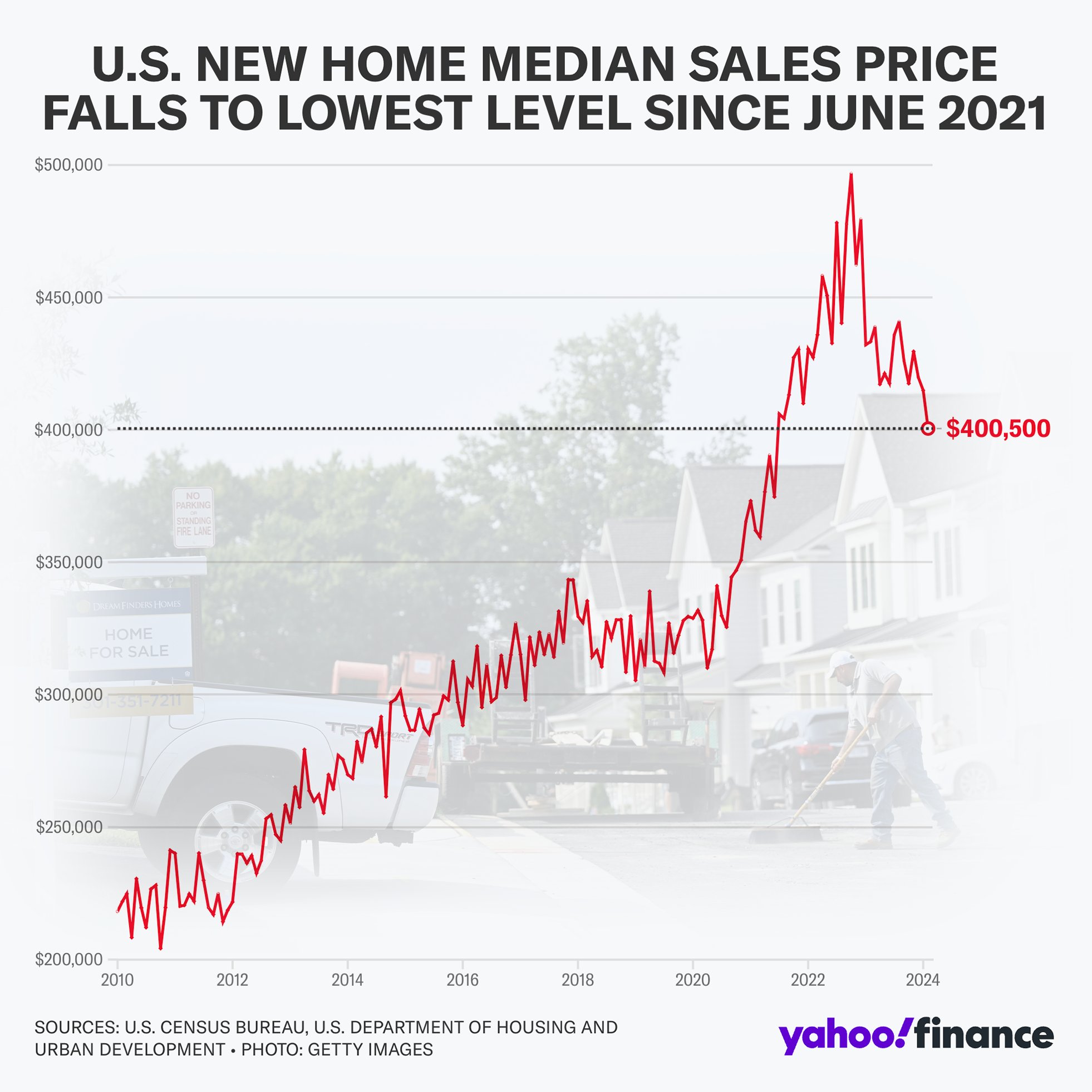
This graph depicts a sharp decline in the U.S. median sales price for new homes, marking a significant downturn from a peak of nearly $460,000 in early 2023. The title indicates that this specific price ($400,500) is the lowest level since June 2021, highlighting a sharp correction in home values despite the steep upward trend in prices during the post-2010 era.
simple-description (llama3.2-vision_11b)
This meme is a humorous commentary on the current state of the US economy, specifically the housing market. The image shows a graph of the S&P 500 stock market index, with a red line indicating the current value of the index. The text "S&P 500: $4,000" appears at the top of the graph, while the text "S&P 500: $4,000" appears at the bottom, with a red arrow pointing to the current value of the index. The meme is saying that the current value of the S&P 500 index is $4,000, implying that the stock market is overvalued and that the current value of the index is a sign of the market's instability.
detailed-analysis (gemma3-27b-vision)
Okay, here's an analysis of the image, broken down into the requested sections. I'll explain when a section doesn't fully apply or is limited. Given the nature of the image (a financial graph), some of these lenses are more fruitful than others.
Visual Description
The image is a line graph depicting the median sale price of new homes in the U.S. from 2010 to 2024 (projected). The Y-axis represents price in US dollars, ranging from $200,000 to $500,000, while the X-axis represents time. The line is red and indicates a general upward trend from 2010 to late 2022, followed by a sharp downturn in late 2022 and early 2023. As of the image’s data point in 2024, the price has leveled out to around $400,500. A shadowy outline of suburban homes is visually placed behind the graph, emphasizing the physical context of the data. The graph is labeled “U.S. New Home Median Price Falls to Lowest Level Since June 2021.” Source attribution is provided along the bottom. The image is branded with “Yahoo Finance.”
Foucauldian Genealogical Discourse Analysis
This chart isn't about inherent truth, but a product of discourse, of how "housing value" is defined and measured. A Foucauldian approach would ask: what systems of power construct the idea of a "median home price"?
- Power/Knowledge: The U.S. Census Bureau and Department of Housing and Urban Development (listed as sources) wield significant power through their data collection and definition of metrics like "median price." These definitions are not neutral; they embed specific assumptions about the nature of homeownership, value, and market function. The “Yahoo Finance” branding further suggests an entanglement with capital and financial discourse.
- Genealogy of the "Home": The very concept of a "home" – as a financial asset rather than simply shelter – has a history. The chart implies that a home is something to be valued and traded, tracing back to economic policies promoting homeownership, the growth of mortgage markets, and the commodification of housing. The fluctuating line indicates a shift in perceptions, fueled by broader societal trends.
- Disciplinary Practices: The chart implicitly participates in disciplinary practices related to finance. It encourages a focus on numerical data, market performance, and speculative investment. It normalizes the idea of housing as a financial instrument.
- Limitations: A complete genealogical analysis would require delving into the historical development of housing policy and financial instruments which is beyond the scope of the image.
Critical Theory
This image provides fertile ground for applying critical theory, particularly around the concept of ideology.
- Reification: The chart reifies housing, treating it as a detached, quantifiable object, rather than a fundamental human need. By focusing solely on price, it obscures the social, political, and ethical dimensions of housing access.
- Ideology of the Market: The line graph naturalizes the fluctuations in price, presenting them as objective consequences of "market forces." This masks the structural factors (government policies, wealth inequality, predatory lending, etc.) that contribute to those fluctuations.
- Commodification of Basic Needs: The chart reinforces the broader ideological trend of commodification, where even essential needs like shelter are reduced to commodities to be bought and sold.
- Instrumental Rationality: The focus on price implies an instrumental rationality—that maximizing financial gain is the primary goal of the housing market. It ignores broader values like social equity, community building, or sustainable development.
- Limitations: The image is a small piece of information. A full critical theory analysis would require context.
Marxist Conflict Theory
This chart is strongly amenable to a Marxist interpretation.
- Class Conflict: The fluctuating price line demonstrates the inherent instability and contradictions within a capitalist housing market. The rising prices from 2010-2022 are indicative of the increasing concentration of wealth and the exploitation of labor, as the costs of materials and construction are absorbed into the increased home prices, benefiting those who already own property.
- Exploitation: The increased price levels demonstrate the exploitation of those who cannot afford housing, exacerbating class divisions.
- Capital Accumulation: The chart reflects the process of capital accumulation, where housing serves as a vehicle for wealth creation for a select few.
- Crisis of Overproduction: The downturn in 2023 can be interpreted as a sign of a crisis of overproduction, where the market is saturated with housing that a large segment of the population cannot afford.
- Superstructure: The data presented in the chart is part of the "superstructure" – the institutions and ideologies that reinforce the economic base. The chart justifies the market system by presenting price fluctuations as natural and inevitable.
Postmodernism
A postmodern reading of the image is a bit more nuanced.
- Deconstruction of "Value": The chart highlights the constructed nature of "value." The price isn't inherent in the house itself; it’s a socially constructed agreement. The fluctuations demonstrate the instability and fluidity of that agreement.
- Simulacra and Simulation: The chart can be seen as a simulacrum – a representation of reality that is more real than reality itself. People increasingly make decisions based on the data presented in charts like this, rather than on their own lived experiences.
- Fragmented Narrative: The chart only presents one aspect of the housing market. It fragments the overall reality into a single metric, ignoring other factors like quality of life, environmental impact, and community.
- Limitations: Postmodernism can often be deconstructive and might not offer practical solutions to housing problems.
Queer Feminist Intersectional Analysis
This area is the most limited application, but still relevant.
- Housing as a Site of Oppression: Historically, housing has been a site of oppression for marginalized groups. Housing discrimination based on race, gender, sexual orientation, and disability is well documented. Rising housing prices disproportionately affect LGBTQ+ individuals, women, and people of color who face systemic economic inequalities.
- Intersectional Impacts: The downturn in prices, while seemingly positive, could have different impacts depending on intersectional identities. For example, Black women, who face both racial and gender discrimination in housing, may still be excluded from benefiting from lower prices due to pre-existing economic barriers.
- Disrupting Normative Ideals: The idealized suburban home depicted in the background of the chart reinforces normative ideas of family and domesticity. These ideals can be exclusionary and oppressive for individuals who do not fit into traditional molds.
Let me know if you’d like me to elaborate on any of these sections or explore other theoretical frameworks.
simple-description (llama3.2-vision)
This meme is a humorous illustration of a stock market graph that shows a massive drop in value. The graph is labeled "Dow Jones" and has a red line that plummets from a high point of $36,000 to a low of $0, with a final value of -$36,000. The text above the graph reads "Market Value: -36,000" and "I think I lost my shirt...".
tesseract-ocr
U.S. NEW HOME MEDIAN SALES PRICE FALLS TO LOWEST LEVEL SINCE JUNE 2021 $500,000 $450,000 $400,000 ssrssresestssteessentenseessentenseententenasentenenasensesasensenenanenannnannerntsnasensanserarsarsnasramsaesateaerseasserseareersnaeeer- $400,500 $350,000 $300,000 $250,000 $200,000 2010 2012 2014 2016 2018 2020 2022 2024 freee oe yahoo/finance