First Seen
2024-02-19T02:37:27+00:00
simple-description (qwen3.5_2b-q8_0)
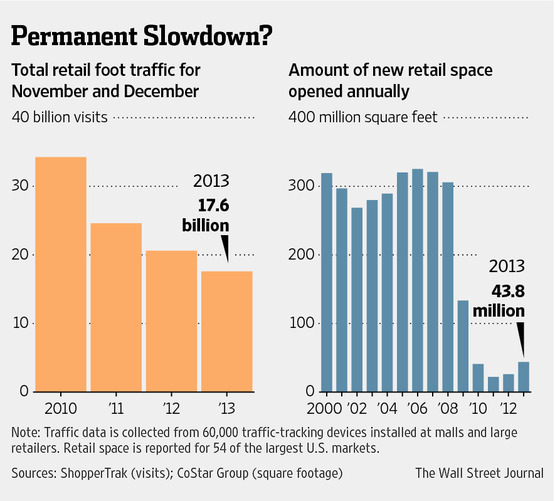
This meme suggests a "permanent slowdown" in the U.S. economy by contrasting two charts that illustrate a massive decline in retail activity over the last decade. The left chart displays total foot traffic falling from over 40 billion visits in 2010 to just under 20 billion in 2013. The right chart adds context by showing that new retail space opened annually dropped from over 300 million square feet to just 43.8 million by 2013.
simple-description (llama3.2-vision_11b)
The meme is a humorous take on the economic concept of a "jobless recovery," which refers to a situation where the economy is growing but there are not enough jobs available. The image shows a graph with two lines, one representing the number of job openings and the other representing the number of people unemployed. The meme is saying that the jobless recovery is a joke, implying that the economy is growing but not creating enough jobs for people to get back to work. The text on the image reads "The jobless recovery is a joke" and "The economy is growing, but not creating enough jobs to get people back to work."
detailed-analysis (gemma3-27b-vision)
Okay, let's break down this chart – depicting retail foot traffic and new retail space opened – through a few different critical lenses.
Visual Description
The image presents a comparative chart illustrating two metrics related to retail trends between 2000-2013.
- Left Chart: This is a bar graph charting “Total retail foot traffic” for the months of November and December (peak shopping season) from 2010-2013. The chart displays a steep decline in foot traffic from 30.1 billion visits in 2010 to 17.6 billion visits in 2013. The bars are orange.
- Right Chart: This is a bar graph charting "Amount of new retail space opened annually" from 2000-2013. From 2000-2007, the opening of new retail space remained relatively high. It then sharply decreased in 2008 and continued to fall between 2008-2013. The bars are blue.
- Title and Annotations: The chart is titled “Permanent Slowdown?” and contains data sources (ShopperTrak and CoStar Group) and publication credit (The Wall Street Journal). Data points are specifically highlighted for 2013, showing 17.6 billion visits and 43.8 million square feet of new retail space.
The visual immediately suggests a correlation between decreased foot traffic and a decline in the expansion of retail spaces.
Foucauldian Genealogical Discourse Analysis
This chart, within a Foucauldian framework, represents a specific “discourse” around consumption and retail. The very act of measuring foot traffic and new retail space establishes a "regime of truth" about what constitutes successful economic activity.
- Power/Knowledge: The data collected by ShopperTrak and CoStar is not neutral. It's a form of "power/knowledge" – the data defines what counts as a successful shopping experience and shapes how retail is understood. The categories of "foot traffic" and "square footage" are themselves constructed categories, not inherent truths.
- Genealogy: A genealogical tracing of this data would reveal how the normalization of measuring consumer behavior emerged. The shift from viewing shopping as a social/cultural practice to a purely quantifiable economic metric represents a power shift. The data allows for the "discipline" of retail—encouraging retailers to optimize space, track consumers, and maximize profits.
- Biopower: Tracking foot traffic can be seen as a form of biopower, where the population’s behavior (consumer habits) is measured and managed. This data allows for the “optimization” of the consumer population.
The chart isn’t just about numbers; it's about how the very categories we use to understand retail are constructed through power relations. It highlights how the act of measurement itself is a disciplinary practice.
Critical Theory
From a Critical Theory perspective (particularly drawing on the Frankfurt School), this chart points to a broader crisis in late capitalism.
- Commodification: The declining foot traffic and new retail space could be seen as a symptom of “over-accumulation” – capitalism’s tendency to produce more goods and services than the population can sustainably consume. This leads to saturation of the market and a decline in demand.
- The Culture Industry: The decline could also be related to the “culture industry” turning people away from shopping as a dominant form of leisure. Alternative forms of entertainment and experience-based consumption might be taking precedence.
- Alienation: The data suggests a detachment between consumer desire and the reality of the retail landscape. This could be symptomatic of alienation, where consumers feel disconnected from the products they buy and the systems that produce them.
- Rationalization: The obsessive focus on measuring foot traffic and square footage represents a process of rationalization—the increasing domination of reason and efficiency. This can lead to the dehumanization of economic activity.
Marxist Conflict Theory
Within a Marxist framework, this chart reflects the inherent contradictions of capitalism.
- Overproduction/Crisis: The decline in both foot traffic and new retail space points towards a crisis of overproduction. Capitalism is driven by the pursuit of profit, leading to the relentless expansion of production. But this expansion is not always matched by an equivalent increase in purchasing power, leading to oversupply and a decline in profits.
- Class Struggle: The chart implies a shift in the balance of power between capital (retailers) and labor (consumers). Declining foot traffic suggests a potential weakening of consumer demand, and therefore, a potential challenge to the power of capital.
- Exploitation: The pursuit of profit maximization, reflected in the constant expansion of retail space and attempts to increase foot traffic, is at the expense of workers who are exploited to produce and sell goods.
The chart could be interpreted as evidence of a growing contradiction between the forces of production and the relations of production, potentially leading to an economic crisis.
Postmodernism
A postmodern reading of this chart would focus on the fragmentation of consumer culture and the blurring of boundaries.
- Hyperreality: The focus on quantifying shopping experience (foot traffic) can be seen as creating a “hyperreality”—a simulation of reality that is more real than real. The data itself constructs the idea of what "shopping" is.
- Loss of Grand Narratives: The decline in foot traffic and retail space challenges the “grand narrative” of endless economic growth and consumerism. It suggests a shift away from a unified consumer culture towards a more fragmented and diverse landscape.
- Simulacra & Simulation: The chart represents a simulation of consumer behavior. It’s a representation of a representation, divorced from any inherent reality. The data is not the shopping experience itself, but a coded representation of it.
Queer Feminist Intersectional Analysis
While less directly applicable, a queer feminist intersectional analysis can add nuance:
- Spatial Politics: The design of retail spaces (and their decline) affects different groups differently. The shrinking of retail space may limit access to resources and goods for marginalized communities, particularly those who rely on public transit or live in areas with limited shopping options.
- Gendered Labor: The decline could impact retail workers, disproportionately women and people of color, who often make up a significant portion of the workforce.
- Consumption as Identity: The shift away from traditional shopping may be tied to changing attitudes toward consumerism and identity formation, particularly among younger generations who prioritize experiences and values over material possessions.
- Intersectionality: The impact of the decline in retail is not uniform. It intersects with other forms of oppression, such as race, class, and disability, creating unique challenges for different communities.
Let me know if you'd like me to expand on any of these analyses or delve into specific aspects further.
tesseract-ocr
Permanent Slowdown? Total retail foot traffic for Amount of new retail space November and December opened annually 40 billion visits 400 million square feet 30 2013 300 17.6 billion 20 eye 200, Be \ 2013 43.8 10 100 ™ a a Oo 2010 ‘ll az B 2000 '02 '04 '06 ‘08 10 ‘12 Note: Traffic data is collected from 60,000 traffic-tracking devices installed at malls and large retailers. Retail space is reported for 54 of the largest U.S. markets. Sources: ShopperTrak (visits); CoStar Group (square footage) ‘The Wall Street Journal
simple-description (llama3.2-vision)
This meme is a humorous comparison of the amount of new retail space opened in the US in 2013 versus the total number of retail visits in the same year. The meme states "In 2013, 17.6 million sq ft of new retail space opened. That's like 40 people visiting every sq ft of new retail space every day for a year."