First Seen
2024-02-24T06:08:30.580290+00:00
simple-description (qwen3.5_2b-q8_0)
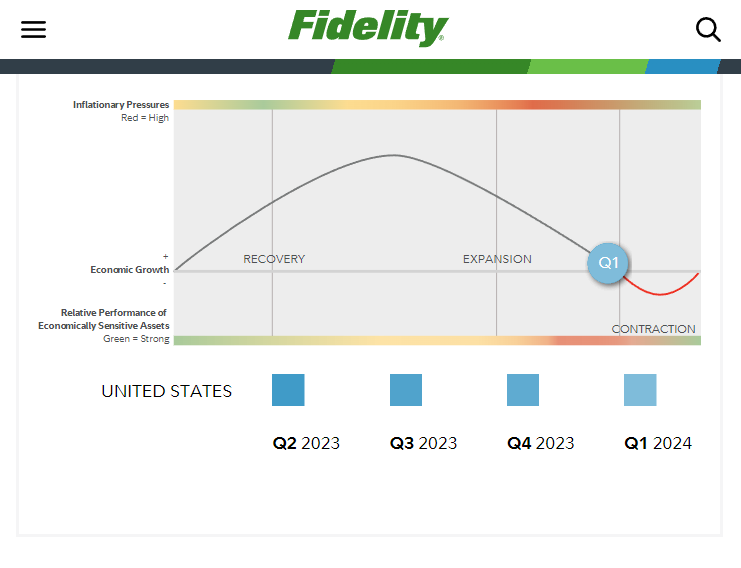
This dashboard tracks the United States economy, showing how growth and inflation trends have shifted over the first few quarters of 2024. The graph depicts a historical "boom" cycle where the economy expanded, but now highlights a specific downturn labeled "CONTRACTION" as the economy begins to slide into a period of decline and high inflation.
simple-description (llama3.2-vision_11b)
The meme is an image of a chart with a downward trend, indicating a recession or economic downturn. The text "RIP 2023" is written in a playful, humorous tone, implying that the year 2023 is "dead" or has failed in some way, likely referencing the economic struggles of that year.
detailed-analysis (gemma3-27b-vision)
Okay, let's break down this image—a chart from Fidelity presenting a forecast for the U.S. economy—through several critical lenses. I'll only include sections where the image and its context lend themselves to that specific analysis.
Visual Description
The image presents a chart depicting an economic cycle forecast for the United States from Q2 2023 to Q1 2024. It's branded with the Fidelity Investments logo at the top.
- Overall Shape: A smooth, grey line traces a cycle that starts in "Recovery," rises to "Expansion," peaks, and then descends into "Contraction". A teal circle denotes Q1 2024.
- Axes & Data Representation: There are two shaded areas that visually represent data. The upper area presents "Inflationary Pressures" represented with a color gradient, shifting from green to yellow to red. The lower area represents "Relative Performance of Economically Sensitive Assets", from blue to green.
- Timeline: The x-axis marks quarters of the year (Q2 2023, Q3 2023, Q4 2023, Q1 2024).
- Color Coding: Red indicates high inflationary pressures and green represents strong performance of economically sensitive assets.
- Overall Impression: The chart is designed to present a simplified, yet authoritative, view of the economic future, suggesting a potential downturn in Q1 2024.
Foucauldian Genealogical Discourse Analysis
This chart can be examined through a Foucauldian lens as an example of discourse shaping our understanding of economic reality.
- Power/Knowledge: The chart isn't simply a neutral representation of the economy; it's a production of knowledge from an institution (Fidelity) with significant power. Fidelity isn't just reporting on the economy; it’s actively creating a narrative, a way of understanding economic cycles. This narrative, presented as expert analysis, exerts power by influencing investment decisions and shaping public perception.
- Genealogy of Economic Models: The chart builds upon a long "genealogy" of economic thought—ideas about cycles, inflation, and asset performance. It's not a spontaneous creation but is deeply rooted in historically established economic models (Keynesian, supply-side, etc.). Tracing the history of these models reveals how they have been used to justify certain political and economic practices.
- Normalization: By presenting this cycle as a "natural" progression (Recovery, Expansion, Contraction), the chart normalizes the idea of economic ups and downs. It positions downturns (Contraction) not necessarily as failures of the system, but as inevitable parts of a broader cycle.
- Subjectification: The chart implies a subject position for the viewer: the investor. It invites the viewer to interpret the information and make decisions based on Fidelity's analysis, thus positioning them as a rational economic actor.
- Disciplinary Effects: The chart exerts a disciplinary effect, encouraging investors to align their behavior with the predicted cycle—to buy during recovery, sell before contraction.
Critical Theory
From a Critical Theory perspective, the chart raises questions about the ideological functions of economic representation.
- Instrumental Rationality & Domination: The chart embodies the principles of instrumental rationality—calculating, predicting, and optimizing for profit. This focus on efficiency and prediction can contribute to a system that prioritizes economic growth over human needs. It is also implicated in the reproduction of systemic power dynamics.
- The Myth of Neutrality: The chart pretends to be a purely objective analysis of economic data, but is in fact produced within a specific socio-political context. The use of “neutral” language and visual representations of data masks inherent biases.
- Commodification of Future Possibilities: The chart transforms the future into a commodity, something that can be predicted, bought, and sold. This process disconnects us from the uncertainty of the future and reduces our agency.
- Reinforcement of Capitalist Logic: By forecasting a cyclical pattern, the chart reinforces the logic of capitalism—the endless pursuit of growth and profit. It doesn't question the fundamental assumptions of the system, but rather seeks to manage it efficiently.
- Ideological Function: The chart serves an ideological function by normalizing capitalist structures. It frames economic issues as inevitable outcomes of natural processes rather than products of systemic forces.
Marxist Conflict Theory
From a Marxist perspective, the chart highlights the inherent conflicts within the capitalist system.
- Class Interests: The chart represents the interests of capital—the owners of investment firms like Fidelity—rather than the interests of labor. It focuses on maximizing profits for investors, with little attention to the impact of economic cycles on workers.
- Exploitation & Accumulation: The predicted cycle of expansion and contraction is driven by the logic of capital accumulation—the endless pursuit of profit. This process inevitably leads to exploitation of labor and uneven distribution of wealth.
- Crisis Tendencies: The "Contraction" phase represents the inherent crisis tendencies of capitalism—overproduction, falling rates of profit, and economic downturns. The chart treats these crises as temporary setbacks, but from a Marxist perspective, they are fundamental features of the system.
- Concealment of Power Relations: The chart presents the economic cycle as a neutral phenomenon, obscuring the power relations that shape it. It doesn’t acknowledge the role of class struggle or the political forces that influence economic outcomes.
- Ideological Legitimation: The chart serves to legitimize the capitalist system by presenting it as a natural and inevitable force. It discourages critique and encourages acceptance of the status quo.
Let me know if you'd like me to elaborate on any of these points or explore other critical lenses!
tesseract-ocr
= Fidelity Q ee 8@8© 8=<é Zz vane So cmon —_ | cotta items onrnacron Geen: Sof TT «I UNITED STATES. | | | | | | | | Q2 2023 Q3 2023 Q4 2023 Q1 2024
simple-description (llama3.2-vision)
The meme is a screenshot of a chart with a red line that dips and then rises again. The chart is labeled "Inflationary Pressures" and has several lines with different colors, including red, green, and blue. The text at the top of the image says "Fidelity Investments" and the chart is titled "Inflationary Pressures".