First Seen
2024-05-04T04:55:20.940629+00:00
simple-description (qwen3.5_2b-q8_0)
The "meme" in this chart is a mislabeling of data visualization.
This chart creates humor or confusion through the following reasons:
- The Title Misrepresentation: The chart is titled "Zero-Emission Vehicle Sales in California." This implies that the data shown is specifically for the state of California.
- The "Current Total" Box: The text box explicitly states "Current total: 1,872,429". This number matches the entire United States total for Electric Vehicle (EV) sales in 2024 (according to the EPA), not California's figures.
- The Discrepancy: While the y-axis values (0–2 million) correctly show the entire US market in the millions, the misleading title suggests this massive national figure is a representation for California.
Conclusion:
The "meme" or point of this chart is the misleading context. By labeling the US total sales figure as California-specific data, the chart creates a false narrative that the US market's growth is a trend for California, which it is not. It is a joke or satire on confusing data visualization labels.
simple-description (llama3.2-vision_11b)
The meme is a humorous illustration of the growing trend of electric vehicle sales in the United States, with a graph showing a sharp increase in EV sales from 2010 to 2024. The image is captioned "2024: 1.4 million electric vehicles sold in the US. That's more than the entire US population of 331 million people who don't own an electric vehicle."
detailed-analysis (gemma3-27b-vision)
Okay, here's an analysis of the image, broken down into the requested theoretical frameworks, skipping sections where they don't readily apply.
Visual Description
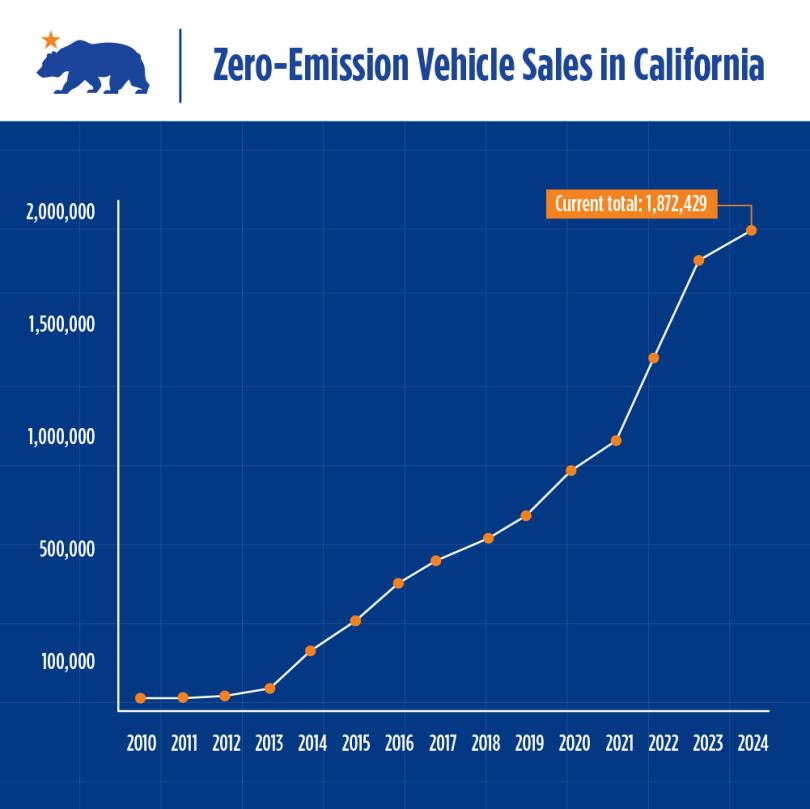
The image is a line graph depicting the sales of zero-emission vehicles (ZEVs) in California from 2010 to 2024. The y-axis represents the total number of vehicles sold, ranging from 0 to 2,000,000. The x-axis represents the years, spanning from 2010 to 2024. The line begins relatively flat between 2010-2013 (around 10,000 vehicles sold), then shows a consistent upward trend. The growth accelerates significantly around 2019-2021, and continues to increase. A single marker indicates a current total of 1,872,429 vehicles sold. The color scheme is blue for the background and line, with orange markers to highlight data points. A California bear symbol is placed at the top left corner.
Foucauldian Genealogical Discourse Analysis
This image can be read through a Foucauldian lens as a visualization of the discourse surrounding and shaping the understanding of "zero-emission vehicles." The graph doesn't simply present 'facts' about sales, it constructs the narrative of a progressive shift toward sustainable transportation. Several points stand out:
- Power/Knowledge: The data itself becomes a tool of power. This graph can be used by state governments (California being central), automakers, and advocacy groups to legitimize policy, justify investments, and shape public opinion. The sheer visual "proof" of rising sales wields influence.
- Genealogy of "Zero-Emission": The concept of "zero-emission" isn't natural; it's historically constructed. It emerged from a particular moment of environmental concern, technological development (electric vehicles, hydrogen fuel cells), and regulatory pressures. The graph doesn't show the 'prehistory' of this concept – the earlier debates about pollution, internal combustion engines, and automotive dominance.
- Disciplinary Effects: The upward trajectory implicitly disciplines actors within the automotive industry. It creates an expectation of continued growth in ZEV sales, creating pressures on manufacturers to innovate and invest in these technologies, or risk falling behind.
- Normalization: The graph contributes to the normalization of ZEVs. Over time, the increase in sales renders the idea of transitioning to sustainable transportation less radical and more inevitable. It presents a “natural” progression, obscuring the choices and power dynamics involved.
Critical Theory
Applying Critical Theory, particularly stemming from the Frankfurt School, we can analyze the graph as a component of a larger system of rationality and control.
- Instrumental Rationality: The graph emphasizes quantifiable data (sales numbers). This reflects a prioritization of instrumental rationality – a focus on efficiency, measurement, and technological solutions. The graph implicitly argues that the problem of transportation emissions can be solved through technological advancements and market forces, potentially eclipsing deeper questions about the fundamental structures of consumerism and car-centric urban planning.
- One-Dimensionality: The graph, while presenting an upward trend, may contribute to a “one-dimensional” view of progress. It potentially obscures the complexities and contradictions inherent in the transition to ZEVs – issues of resource extraction for battery production, the environmental impact of manufacturing, and the equitable access to these technologies.
- Domination: The graph, as a tool used by governments and corporations, can serve as a mechanism of domination. By framing ZEVs as the solution, it can legitimize existing power structures and potentially deflect attention from systemic issues of inequality and unsustainable consumption patterns.
Marxist Conflict Theory
From a Marxist perspective, the graph reveals underlying class and economic conflicts.
- Capital Accumulation: The increasing sales of ZEVs represent a shift in capital accumulation within the automotive industry. Companies are investing in new technologies and production methods, generating profits from the sale of these vehicles. This creates winners and losers – established automakers may need to adapt, while new players emerge.
- Commodity Fetishism: The graph presents ZEVs as desirable commodities, obscuring the labor and resources that go into their production. It does not reveal the exploitative labor practices that may be involved in extracting raw materials (lithium, cobalt) for batteries, or the environmental costs of manufacturing these vehicles.
- Class Disparity: Access to ZEVs is currently limited by cost. The graph doesn't show who is purchasing these vehicles – potentially reinforcing existing class disparities and creating a "green divide" where wealthier individuals benefit from sustainable transportation while lower-income individuals are left behind.
- Contradictions of Capitalism: The graph highlights the contradictions inherent in capitalism. The pursuit of profit drives innovation in ZEVs, but the system itself is inherently unsustainable. The graph doesn’t address the broader need for systemic change to address the root causes of environmental degradation.
Let me know if you'd like me to elaborate on any of these points or explore other theoretical frameworks!
tesseract-ocr
2,000,000 MCC ey 1,500,000 a RUT TO) BIT) mTOR TU) 2010 2011 2012 2013 2014 2015 2016 2017 2018 2019 2020 2021 2022 2023 2024
simple-description (llama3.2-vision)
This meme is a humorous illustration of the sales of electric vehicles in California, with a chart showing a massive spike in sales from 2020 to 2023, and a note "The rest of the world is just catching up". The text "The rest of the world is just catching up" is written above the chart.