First Seen
2023-05-10T21:03:35+00:00
simple-description (llama3.2-vision_11b)
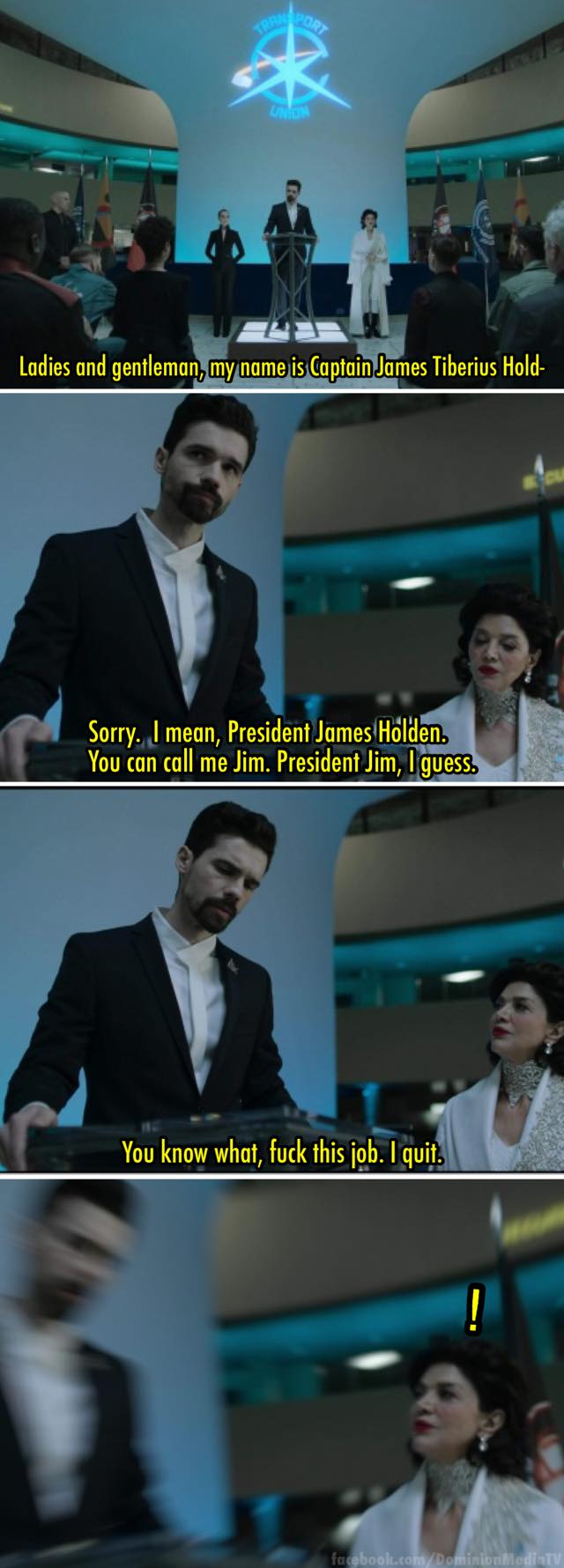
This meme is a humorous exchange between two characters, one of whom is a character from the Expanse series, in a scene where they have a sarcastic and irreverent conversation. The character says "You know what, fk this job. I quit." The text "You know what, fk this job. I quit" appears in the image.
detailed-analysis (gemma3-27b-vision)
Okay, let's break down this image and its textual elements through several theoretical lenses. It's a pretty rich meme, actually, playing with expectations of leadership and power!
1. Visual Description
The image is a screenshot of a scene, likely from a science fiction production (given the setting). A man in a dark suit (presumably "Captain/President Jim Holden") is speaking to a group of people in a brightly lit, futuristic interior. The setting seems to be some sort of reception or official event. The angle is slightly low, making the man appear dominant, yet his posture and facial expression quickly betray a disruption of that power dynamic. The background is a mix of other people, presumably staff or dignitaries. The editing choices are a meme format, with bright yellow text overlayed on the image. The use of "!" adds to the sense of abruptness and defiance.
2. Foucauldian Genealogical Discourse Analysis
This meme is excellent fodder for a Foucauldian analysis. Foucault would be interested in how the discourse of leadership is constructed, maintained, and subverted here.
- Discipline & Power: Initially, the character performs the expected discourse of authority. He announces his title ("Captain," then "President"). This is an act of self-definition within a pre-existing system of power.
- The Genealogy of "Captain/President": Foucault would ask: What historical conditions allowed this title ("Captain/President") to gain authority? What institutions and social practices support it? The science fiction setting itself begs these questions – this is not simply a military or political title but one tied to a particular futuristic vision of governance.
- Subversion & The Break: The abrupt shift to "Jim" and the expletive ("fuck this job. I quit.") is a radical disruption of this discourse. It’s a rejection of the roles, expectations, and power structures embedded within the "Captain/President" identity. He de-authorizes himself. He rejects the power/knowledge matrix associated with the role.
- The "I" vs. The Title: The move from the performative "Captain/President" to the colloquial "Jim" is crucial. It’s an attempt to reclaim individual agency outside of the imposed identity.
3. Critical Theory
Applying a broad Critical Theory framework (drawing on thinkers like Adorno, Horkheimer, and the Frankfurt School):
- The Critique of Authority: The meme directly critiques the uncritical acceptance of authority. It questions the inherent value and legitimacy of leadership positions, even those in a futuristic context.
- Alienation & Dehumanization: The character's outburst can be seen as an expression of alienation. The weight of responsibility and the pressures of the role ("Captain/President") have become unbearable, leading to a rejection of the system itself. He's expressing a sense of being reduced to a function, rather than being recognized as a person ("Jim").
- The Illusion of Control: The futuristic setting, while appearing technologically advanced, doesn’t necessarily translate to human liberation. The character’s breakdown suggests that even in a technologically advanced society, power structures and expectations can be oppressive.
4. Marxist Conflict Theory
While not a direct application, we can read this through a Marxist lens:
- Class & Power: The roles of "Captain/President" inherently signify positions of power and control. The character’s resignation can be seen as a rejection of the exploitative nature of that power. Even if he's not actively exploiting others, he’s participating in a system that inherently creates hierarchies and inequalities.
- Alienation of Labor: The character’s frustration can be interpreted as alienation from his "labor." The demands of the job have become so overwhelming that he feels disconnected from the purpose and meaning of his work.
- Resistance: The act of quitting is a form of resistance. It's a rejection of the capitalist (or analogous) system of power and control. He’s reclaiming his agency and refusing to participate in a system that he finds oppressive.
5. Postmodernism
This meme is very postmodern. Several elements resonate with postmodern thought:
- Deconstruction of Grand Narratives: The meme deconstructs the traditional "heroic leader" narrative. It shows a leader who is flawed, frustrated, and ultimately rejects his role.
- Rejection of Essentialism: The shift from "Captain/President" to "Jim" challenges the idea of a fixed, essential identity. The character is not simply defined by his title, but as a complex individual with agency.
- Irony & Parody: The meme uses irony and parody to subvert expectations. We expect a leader to be strong and resolute, but this character is anything but.
- Fragmentation of Identity: The character’s breakdown can be seen as a fragmentation of identity. He is unable to reconcile his public persona with his private self.
6. Queer Feminist Intersectional Analysis
This is a slightly more nuanced application, but still relevant:
- Challenging Hierarchies: The act of quitting disrupts the established hierarchy of power. It’s a rejection of the patriarchal (or analogous) structures that often uphold leadership positions.
- Vulnerability & Emotional Labor: The character’s outburst is a display of vulnerability. Leadership roles often require emotional labor – suppressing personal feelings and maintaining a facade of strength. The character’s breakdown can be seen as a rejection of this expectation.
- Reclaiming Agency: The act of quitting is a reclamation of agency. The character is refusing to be defined by the expectations of others and is asserting his right to make his own choices. This ties into feminist concepts of self-determination.
- Intersectional Considerations: Depending on the character’s broader context (race, class, etc.), the meme could also be interpreted as a critique of the ways in which intersecting systems of oppression contribute to the burdens of leadership.
In essence, this meme is surprisingly rich in theoretical potential. It encapsulates many critical themes about power, identity, and resistance, making it a fascinating object of analysis.
simple-description (llama3.2-vision)
This meme is a screenshot from a TV show, specifically "The Expanse", where a character, Captain James Holden, is being interviewed by a reporter. The reporter asks him to introduce himself, and he responds with a humorous and sarcastic comment about his name. The text on the image reads: "In 2-3 sentences, describe this meme for someone who cannot see it. The image shows a character, Captain James Holden, being interviewed by a reporter. He responds to the reporter's question about his name, saying 'Ladies and gentlemen, my name is Captain James Holden. You can call me Jim. Captain. Captain. Captain.'"
tesseract-ocr
Ke An 7 TIS, <r / | oe m5 = ae : mae" \ »* = a oy A -