First Seen
2023-07-19T21:01:33+00:00
simple-description (qwen3.5_2b-q8_0)
Based on the image provided, here is an explanation of the meme:
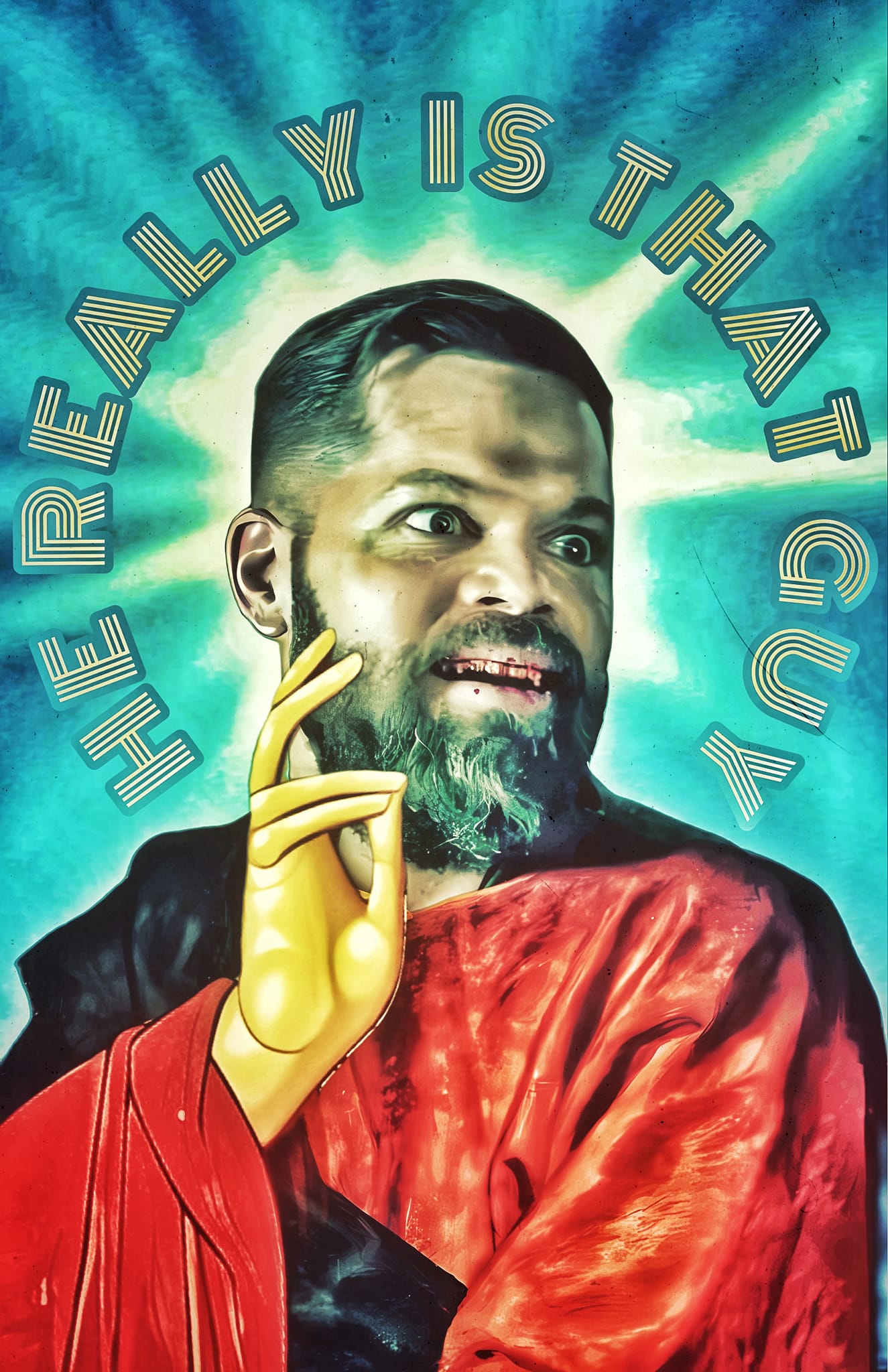
This image appears to be a caricature or "fan art" meme featuring a man with a beard and a red robe looking upward with a confused or exasperated expression. He is holding a golden hand near his face, a visual reference often associated with the "Golden Hand" from the movie The Matrix.
The text "HE REALLY IS THAT GUY" is written in a stylized, arched font around the top of his head. This text plays a humorous role in the meme, suggesting that the man depicted is actually a famous person or figure. The overall tone is one of exaggerated disbelief or admiration, using pop culture references (like The Matrix and religious imagery) to create a satirical commentary on the subject's image or status.
simple-description (llama3.2-vision_11b)
The meme is a photo of a man with a shocked expression, captioned "I can explain". This meme is often used to respond to a complex or confusing situation, implying that the speaker has a deep understanding of the issue and can provide a detailed explanation. The image is humorous and lighthearted, implying that the speaker is confident in their ability to explain the situation, but the actual explanation is not provided.
detailed-analysis (gemma3-27b-vision)
Okay, here’s an analysis of the image, broken down into the sections you requested, focusing on what applies. Note that many of these approaches overlap and are interconnected.
Visual Description
The image is a brightly colored, expressive painting of a Black man. He is positioned in a three-quarter view, with his head and upper torso filling the frame. He has a dark beard and mustache, and a slightly stern expression. His skin tone is rich and warm. He’s wearing a bright red garment that could be interpreted as a robe or a cloak. A portion of a dark jacket is also visible.
The background is a swirling mix of light blue, green, and hints of purple, creating an ethereal, almost halo-like effect behind the man's head. Circling his head, in large, stylized capital letters, is the phrase "HE REALLY IS THAT GUY." The lettering is in a golden/yellow color. The painting style is somewhat reminiscent of traditional religious icon painting, but with a distinctly modern and vibrant energy. The overall impression is one of power, authority, and perhaps even a satirical commentary on veneration and charisma.
Foucauldian Genealogical Discourse Analysis
This image lends itself strongly to a Foucauldian analysis. The phrase "HE REALLY IS THAT GUY" functions as a discourse—a system of thought, language, and practice that constructs reality. The painting isn’t just about a man; it actively constructs an idea of authority, leadership, or specialness.
- Genealogy: A genealogical analysis would trace the history of this phrase and its associated imagery. The halo-like background and robe/cloak evoke religious iconography, specifically the depiction of saints or divine figures. The painting appropriates these visual tropes and applies them to a contemporary figure (the man depicted), which is a powerful act of recontextualization. The phrase itself is a form of social validation, affirming a pre-existing power dynamic or reinforcing a particular narrative about this individual.
- Power/Knowledge: The painting visually embodies the relationship between power and knowledge. The repetition of the phrase creates a performative truth: by asserting that “he is that guy,” the painting actively makes that assertion seem real, regardless of the underlying evidence. The image participates in constructing a power dynamic, potentially influencing how viewers perceive and interact with the individual depicted.
- Disciplinary Power: The painting doesn’t explicitly depict discipline, but it subtly reinforces the power structures that create the need for authority. By bestowing a certain veneration onto the man, the image reinforces the norms that necessitate "leaders" or "special individuals" to guide and control.
Critical Theory
This image resonates with several tenets of Critical Theory, particularly those related to mass media and the construction of idols.
- Culture Industry: The painting can be seen as a commentary on the “culture industry” (Adorno & Horkheimer). The image suggests a process of commodification of charisma and authority. The individual is presented as a symbol, a brand, rather than a complex human being. The image serves to reinforce this construction through its deliberate and dramatic visual language.
- Ideology: The phrase “HE REALLY IS THAT GUY” is inherently ideological. It promotes a belief system that relies on unquestioning faith in authority or leadership. The image actively reinforces this ideology through its visual presentation.
- The Authoritarian Personality: The painting’s celebratory tone can be interpreted as a reflection of (or a critique of) the “authoritarian personality” (Adorno et al.). The image seems to celebrate a strong, decisive figure, potentially appealing to those who desire strong leadership and social order.
Postmodernism
The image exhibits several characteristics often associated with postmodern art.
- Appropriation: The painting blatantly appropriates imagery from religious iconography—the halo, the robe/cloak—and recontextualizes it in a contemporary setting. This is a hallmark of postmodern art, which often challenges traditional hierarchies and aesthetic conventions.
- Irony & Parody: The painting’s combination of reverent imagery and the casual phrasing “HE REALLY IS THAT GUY” introduces a layer of irony and potential parody. The image might be questioning the very notion of veneration or challenging the uncritical acceptance of authority.
- Hyperreality: The painting presents an exaggerated, stylized image of the man, divorced from any specific context. This can be seen as a form of hyperreality—a simulation that has become more real than the real. The image functions as a signifier, pointing to an abstract idea of leadership or charisma rather than a concrete individual.
Queer Feminist Intersectional Analysis
This section is trickier, as the image doesn't immediately present explicit gender or sexuality themes. However, an intersectional lens can still offer insightful perspectives.
- Subversion of Masculinity: The presentation of the man, while confident, is not necessarily conventionally masculine. The clothing, the somewhat vulnerable expression, and the overt veneration of his image could be interpreted as a subversion of traditional expectations of male authority.
- Critique of Hero Worship: The painting's central theme of hero worship can be analyzed through a feminist lens. Feminist theory often critiques the tendency to elevate male figures as saviors or leaders, arguing that this reinforces patriarchal power structures. The painting, by highlighting this dynamic, might be subtly questioning it.
- Intersectionality: Considering the man's race, the image can be viewed within the context of how Black men are often both idealized and marginalized in society. The image could be commenting on the complex interplay of race, gender, and power dynamics in the construction of leadership. It is important to note that the image’s potential interpretations depend heavily on the specific context of its creation and reception.
Important Note: Art interpretation is subjective. These are just a few potential readings of the image, informed by the theoretical frameworks you requested. Other interpretations are certainly possible.
Let me know if you'd like me to elaborate on any of these sections or explore different theoretical perspectives!
simple-description (llama3.2-vision)
This meme features a screenshot from the YouTube video "I Found Out What Happened to the Star of the Movie 'The Star of the Movie'". The image shows the creator of the video, a man with a shocked expression, and the text "I Found Out What Happened to the Star of the Movie 'The Star of the Movie'" is overlaid on top of it. The meme is likely being used to express surprise or shock at something.
tesseract-ocr
ee om bf , a Ei} ie | Z . Fi) 4 i (j fi